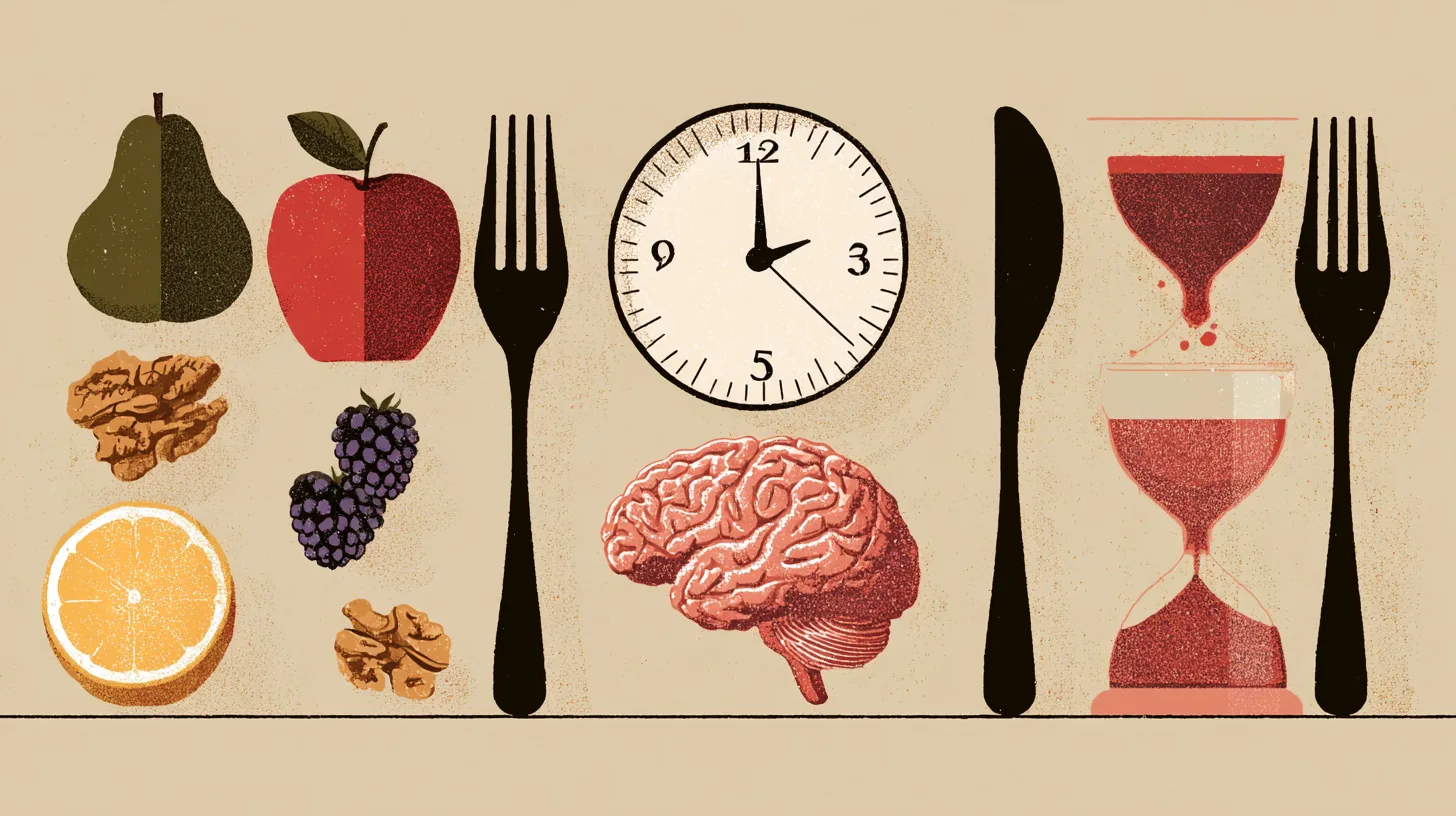
Intermittent Fasting and the Brain: The Science of Ketones, BDNF, and Cognitive Enhancement.
When the body runs out of glucose, the brain does not starve. It switches fuel systems, and that switch triggers a neuroprotective cascade that physically reverses measurable brain aging on MRI. Here is what the science actually says, and what to do with it.
01The Metabolic Switch
When glucose runs out, the brain switches operating modes
The most counterintuitive finding in nutritional neuroscience is that the brain works better when you stop feeding it. Not indefinitely, and not for everyone. But across a specific window of caloric absence, the human brain switches fuel systems, and the new fuel does not merely sustain function. It triggers a cascade of molecular signals (brain-derived neurotrophic factor, autophagy, reduced neuronal insulin resistance) that appear to physically reverse measurable indices of brain aging.[1][2] That is not a wellness claim. It is what showed up on MRI scans in the first randomised controlled trial to combine brain imaging, cerebrospinal fluid biomarkers, and neuronal extracellular vesicle analysis in a single intermittent fasting study.[2]
The scale of the population this finding could reach is large. More than one billion adults worldwide are now classified as obese, a figure that has tripled since 1975.[20] An additional 1.5 billion are overweight. The metabolic environment those numbers describe (chronic hyperinsulinemia, systemic inflammation, disrupted glucose regulation) is precisely the environment in which the intermittent fasting brain signal is strongest.[21][22] Midlife obesity alone carries a 2.04× relative risk of developing dementia, according to Anstey and colleagues' meta-analysis of prospective studies (95% CI: 1.59–2.62).[30]
The question is not whether intermittent fasting affects the brain. The question is how, and under what conditions the effect is large enough to matter.
Intermittent fasting brain research has a translation problem. The most compelling neuroscience evidence comes from animal models: hippocampal neurogenesis, amyloid plaque reduction, lifespan extension.[7][8][25] The human evidence is sparser, more recent, and frequently underpowered. A 2025 meta-analysis in Psychological Bulletin, aggregating 222 effect sizes across 3,484 participants, found no meaningful cognitive difference at a median 12-hour fast.[15] Short-term fasting in healthy people does not appear to make you sharper.
Chronic intermittent fasting in metabolically compromised populations is a different story. Kapogiannis and colleagues' 2024 Cell Metabolism trial, the only human RCT combining BrainAGE MRI, CSF biomarkers, and neuronal vesicle signalling, found that eight weeks of 5:2 intermittent fasting produced significant gains in executive function and cued recall, reduced brain-age estimates on MRI, and lowered neuronal insulin resistance markers.[2] A healthy diet, on its own, did not achieve the same brain-level changes.
The asymmetry is the finding. Intermittent fasting does not appear to sharpen already-healthy brains in the short term. It appears to rescue compromised ones over weeks and months, and the mechanism runs through fuel, not willpower.
02The Mechanism
The Metabolic Switch That Rewires Your Brain
The mechanism begins in the liver. Between 8 and 12 hours after the last meal, hepatic glycogen stores are exhausted.[1] The liver shifts from glycolysis to beta-oxidation of fatty acids, and the byproduct of that shift is a class of molecules called ketone bodies, primarily beta-hydroxybutyrate (BHB), acetoacetate, and acetone.[1][9] This transition is not gradual. It is a metabolic phase change: the AMP-to-ATP ratio rises, AMPK activates, mTORC1 is inhibited, insulin falls, glucagon rises, and plasma BHB climbs from roughly 0.05 millimoles per litre in the fed state to 1–3 mM during a 16-hour fasting window.[1][11]
De Cabo and Mattson's canonical 2019 NEJM review called this the metabolic switch: the moment the body stops burning glucose and starts burning fat, with ketone bodies as the signal molecules that coordinate the downstream response.[1] This is not energy deprivation. It is energy-source substitution. And the substitute fuel does something glucose does not: it talks to the genome.
BHB crosses the blood-brain barrier via monocarboxylate transporters (MCT1 and MCT2) and enters neurons, where it produces more ATP per molecule of oxygen consumed than glucose does.[9] That alone would make it a superior crisis fuel.
When fasting depletes hepatic glycogen, plasma BHB climbs from 0.05 mM to 1-3 mM and crosses the blood-brain barrier via MCT1 and MCT2 transporters, where it fuels a BHB-to-NF-kB-to-BDNF signal that activates TrkB receptors and downstream CREB, driving synaptic strengthening and neurogenesis, while AMPK suppresses mTORC1 and triggers autophagy to clear damaged neural debris.
Diagram · HPC
Gibbons and colleagues at the University of Otago measured ketone delivery to the human brain directly, calculating it from cerebral blood flow and arteriovenous concentration differences via internal jugular vein catheterisation, and found a nine-fold increase after 20 hours of fasting.[3] Nine-fold. Not a marginal uptick. A near-order-of-magnitude surge in an alternative fuel source that the brain cannot access when insulin is chronically elevated and glycogen is never depleted.
That same study contained an irony that illuminates one of the field's most persistent confusions. The researchers found no change in peripheral blood BDNF levels at rest during the fast.[3] This matters because dozens of studies have measured blood BDNF as a proxy for brain neurotrophic activity, and the results are contradictory. Alkurd and colleagues' 2024 systematic review of 16 human studies found an almost perfect directional split: five showed BDNF increases, five showed decreases, six showed no change.[4] The measurement is not the mechanism.
That matters because BDNF in peripheral blood is predominantly derived from platelets, not neurons.[4] In animal hippocampal tissue, intermittent fasting reliably upregulates BDNF via a BHB → NF-κB signalling pathway that activates TrkB receptors and downstream CREB, leading to synaptic strengthening and neurogenesis.[7][8] But confirming that chain directly in living human brains remains technically beyond current methods. The animal mechanism is plausible. The human blood measurement is noise.
03Evidence
Ranking the Strongest Studies on Intermittent Fasting and the Brain
01The claim
The single load-bearing finding
The hero study finds p<0.001 executive function.
Not all evidence is equal, and in intermittent fasting brain research, the gap between the strongest studies and the weakest is unusually wide. Animal studies dominate the mechanistic literature. Human RCTs are recent, small, and frequently testing different protocols against different populations with different endpoints. A systematic review of human BDNF responses finds results split almost exactly into thirds: up, down, unchanged.[4] In this landscape, ranking the evidence by methodological weight is not academic decoration. It is the only way to separate signal from noise.
Pooled estimate
p<0.001
executive function
02How we measured
Grading the IF brain trials
Studies scored on design, sample, rigour, causality, replication, citations.
Causality is the decisive criterion here: animal models of fasting neuroscience are compelling, but the cognitive benefit in humans has only been demonstrated in metabolically compromised populations, not in healthy adults fasting briefly.
Rubric weights
03The spread
Heterogeneity across 5 studies
Methodological quality across the ranked studies.
The hierarchy reveals a field in transition. Ten years ago, the evidence base was almost entirely preclinical: mice fasted, mice measured, mechanism proposed, human implications inferred. Kapogiannis' 2024 trial is the first study to close that loop with brain-level human data. It matters because it confirms the animal-model predictions: the metabolic switch produces neurological effects that diet quality alone does not explain.[2] The null finding is equally important.
Rubric spread
82
→ 58 /100
Highest to lowest rubric score across the ranked studies.
04What does not hold
Negative knowledge
What the evidence base does not support.
Protocol heterogeneity complicates the picture further. Studies test widely different fasting regimens: 16:8 daily time-restricted eating, 5:2 twice-weekly caloric restriction, alternate-day fasting, Ramadan dawn-to-sunset protocols, extended multi-day fasts, against different populations with different metabolic baselines.[5][6][23] The 5:2 protocol is the only one with direct human brain-imaging RCT evidence.[2] The 16:8 protocol is the most practically sustainable and reliably crosses the metabolic switch threshold daily.[1]
5 trials. One pooled answer.
Below: the anchor study in full; then the forest plot at scale; then the supporting trials in ranked order.
01Anchor
Brain responses to intermittent fasting and the healthy living diet in older adults
Intermittent fasting produces direct neurological changes (reduced brain-age, improved cognition, lower neuronal insulin resistance) that a healthy diet alone does not achieve in metabolically compromised older adults.
The only human IF RCT combining brain imaging, CSF analysis, and neuronal vesicle signalling. Pilot-scale (N=40) but methodologically unmatched; companion NIH study ongoing.
Rubric breakdown
The strongest studies, ranked by methodological weight.
Each scored 0–100 against a six-criterion rubric, tagged by design and year; the anchor leads. No study in this set reaches the rubric-90 tier.
02
Effects of Intermittent Fasting on Health, Aging, and Disease
Codified the metabolic switch, the transition from glucose to ketone-based brain energy occurring between 8 and 12 hours of fasting, as the central mechanistic event linking IF protocols to neuroprotective outcomes.
76/100
03
A periodic diet that mimics fasting promotes multi-system regeneration, enhanced cognitive performance and healthspan
Fasting-mimicking diet extended median mouse lifespan by 11% (25.5 to 28.3 months, p<0.01), improved novel object recognition, and activated hippocampal neurogenesis in aged mice. Human pilot (N=38) showed ~24% IGF-1 reduction and 11.3% fasting glucose reduction. A subsequent two-cohort parallel-group RCT (total N≈200) confirmed 2.5-year biological age reduction after 3 FMD cycles, independent of weight loss.[13]
71/100
04
Effect of Calorie Restriction and Intermittent Fasting Regimens on BDNF Levels and Cognitive Function in Humans: A Systematic Review
Of 16 human studies examining IF and BDNF: 5 showed significant increases, 5 showed significant decreases, 6 showed no change. Continuous caloric restriction produced more consistent BDNF elevation than intermittent protocols.
63/100
05
The Effects of Intermittent Fasting on Brain and Cognitive Function
Mapped IF evidence across epilepsy, Alzheimer's disease, MS, Parkinson's, mood/anxiety disorders, and general cognition. Benefits emerged most robustly in populations with existing neurological dysfunction. No clear cognitive benefit was found in healthy subjects on short-term protocols.
58/100
04Stakes
The Neurological Cost of Chronic Metabolic Override
The modern eating pattern keeps the metabolic switch locked in the off position. The consequences show up in white matter, processing speed, and the measured age of the brain.
Neuronal Insulin Resistance
Chronic hyperinsulinemia disrupts insulin signalling in the brain itself. Kullmann and colleagues' Physiological Reviews analysis established that brain insulin resistance sits at the crossroads of metabolic and cognitive disorders, impairing glucose uptake in neurons, reducing synaptic plasticity, and accelerating neurodegeneration.[14] When neurons become insulin-resistant, the brain loses access to its primary fuel even when blood glucose is abundant.
afternoon brain fog, difficulty concentrating after meals, mental fatigue that coffee does not fix
White Matter Degradation
Postprandial hyperglycemia is independently associated with white matter hyperintensities and brain atrophy in patients with type 2 diabetes.[19] Zheng and colleagues found that metabolic syndrome disrupts white matter network organisation, correlating with measurable cognitive decline.[16] The wiring between brain regions degrades silently, long before the person notices slower processing. Path analysis suggests white matter hyperintensities mediate approximately 15.6% of the HbA1c-to-cognition pathway.[18]
slower recall, difficulty holding multiple ideas simultaneously, conversations that feel harder to follow
Inflammatory Cascade
Overnutrition induces a systemic inflammatory response, neuroinflammation, gut-barrier disruption, and microglial activation, that impairs cognitive function independently of weight gain.[17] Obesity's cognitive cost operates through inflammation and vascular changes, not body mass alone.[26] The brain does not care what the scale reads. It cares whether the inflammatory signal is on or off.
persistent low-grade fatigue, reduced motivation, difficulty initiating complex tasks
Accelerated Brain Aging
The cumulative effect of insulin resistance, white matter degradation, and chronic inflammation is measurable on MRI as accelerated brain aging, the brain-age-gap estimate that Kapogiannis' trial showed intermittent fasting can reduce.[2] Anand and colleagues' JAMA Network Open study confirmed the adiposity-cognition relationship across large adult cohorts.[29] The gap between chronological age and brain age widens in metabolically dysfunctional individuals. Intermittent fasting is one of the few interventions shown to close it.
feeling cognitively older than your years, declining working memory, reduced mental stamina
05Protocol
A 4-Step Intermittent Fasting Brain Protocol
Evidence-informed, not evidence-mandated. The science supports these steps but does not prove you must follow them exactly. Adjust to your metabolic context.
The protocol, as a sequence.
Daily → Late fasting → First meal → 8–12 week cycles
16:8 Time-Restricted Eating
Compress daily eating to an 8-hour window (e.g. 10:00–18:00), consuming only water, black coffee, or unsweetened tea outside it.
A 16-hour fast reliably crosses the 8–12-hour metabolic switch threshold, ensuring daily activation of the ketone-BDNF-autophagy cascade.[1] The 5:2 protocol (2 days at 500 kcal) is the only variant with brain-imaging RCT evidence.[2] Early eating windows (noon start) align with circadian metabolic rhythms and may improve cognitive flexibility.[28]
Breaking the fast with high-glycaemic refined carbohydrates immediately spikes insulin, suppresses ketone production, and terminates the neuroprotective signalling window. Break fast with protein and whole foods first.
Fasted-Window Exercise
Schedule aerobic or resistance training in the final 2–3 hours before the eating window opens (hours 13–16 of the fast).
Exercise during late fasting depletes muscle glycogen, accelerates the metabolic switch, and increases muscular oxidative capacity more than fed-state training.[24] The combination produces peak ketone elevation just before the eating window, maximising the brain's BHB exposure window.
Exercising at the start of the fast (hours 0–4) before ketones have accumulated misses the synergistic benefit. Timing within the fast is the critical variable.
Break-Fast Composition
First meal should prioritise adequate protein, DHA/EPA omega-3 fats, and polyphenol-rich foods.
Protein supports BDNF synthesis; DHA is a cofactor in BDNF expression (DHA deficiency blunts the BDNF response); flavonoids support BDNF pathway signalling.[10][12] The composition of the first meal determines how quickly the neuroprotective window closes.
Treating the fast-break as a binge opportunity. A large, high-carbohydrate meal immediately suppresses AMPK signalling, terminates autophagy, and caps the neuroprotective window short.
Track Metabolic Markers
Monitor fasting insulin and/or HbA1c at 8–12 week intervals. Track subjective cognitive performance during fasting windows.
Kapogiannis' trial found brain improvements correlated with neuronal insulin resistance reduction, measurable via standard fasting insulin.[2] Weight loss is a secondary signal; metabolic restoration is the brain health target.
Judging IF purely by weight change. The most important brain effects, reduced neuronal insulin resistance and brain-age improvement, are not weight-dependent and require metabolic biomarker tracking to detect.[2]
06Verdict
The verdict.
"The brain does not starve during a fast. It switches fuel systems, and the backup fuel carries its own repair programme.", Adapted from Mattson (2015)
Bottom line
The brain evolved a backup fuel system. The modern diet ensures it never turns on. The science now shows what that omission costs, and what happens when you finally flip the switch.
The argument
Intermittent fasting does not make healthy brains sharper in the short term. What the controlled human evidence now supports is this: it triggers a metabolic switch that activates a coordinated neuroprotective cascade. Ketone delivery surges nine-fold, neuronal insulin resistance decreases, brain-age estimates on MRI improve, and the cellular maintenance systems that clear neural waste come online. The benefit is conditional on metabolic status, cumulative over weeks, and most pronounced in the populations at highest risk of cognitive decline. That is not a limitation of the evidence. It is the evidence's most important finding.
Intermittent fasting is not a performance enhancer in the nootropic sense, take this, think faster. It is a metabolic intervention that restores a fuel-switching capacity the brain evolved to use but that chronic ad libitum eating has disabled for most of the modern population.[1][27] The nine-fold ketone surge at 20 hours of fasting is not a pharmacological effect.[3] It is what the brain does when you stop preventing it from doing what it was designed to do.
The metabolic switch: fed state to 16-hour fast.
The Metabolic Switch Is Neuroprotective
Intermittent fasting triggers a fuel-system transition from glucose to ketones that activates BDNF signalling (in animal tissue), autophagy, and reduced neuronal insulin resistance. The switch is not deprivation. It is a coordinated neuroprotective programme that the chronically fed brain never initiates.
Chronic Metabolic Override Degrades the Brain
Never activating the metabolic switch means never initiating the downstream neuroprotective cascade. The result: accelerated brain aging, white matter degradation, and neuronal insulin resistance, measurable on MRI and correlated with a 2.04× dementia risk in midlife obesity.
Daily Fasting Crosses the Threshold
A 16:8 eating window reliably crosses the 8–12-hour metabolic switch threshold every day. The minimum effective dose is consistency, not duration, not severity, not complexity. The brain needs the switch to flip. It does not need a heroic fast.
Put it to work
Where this science goes next on HPC
07Bibliography
The bibliography.
-
01
Journal
doi: 10.1056/NEJMra1905136
Effects of Intermittent Fasting on Health, Aging, and Disease
-
02
Journal
doi: 10.1016/j.cmet.2024.05.017
Rubric 82/100
Brain responses to intermittent fasting and the healthy living diet in older adults
-
03
Journal
doi: 10.1113/JP283582
Fasting for 20 h does not affect exercise-induced increases in circulating BDNF in humans
-
04
Meta
doi: 10.3390/medicina60010191
Alkurd R, Mahrous L, Zeb F, Khan MAB, Alhaj H, Khraiwesh HM, Faris ME
-
05
Meta
doi: 10.1016/j.pmedr.2024.102757
Sharifi S, Rostami F, Babaei Khorzoughi K, Rahmati M
-
06
Journal
doi: 10.1016/j.jnha.2025.100480
Beveridge J, Montgomery A, Grossberg G
-
07
Journal
doi: 10.1002/brb3.1444
Intermittent fasting increases adult hippocampal neurogenesis
-
08
Journal
doi: 10.1038/s41380-021-01102-4
Intermittent fasting enhances long-term memory consolidation, adult hippocampal neurogenesis, and expression of longevity gene Klotho
-
09
Journal
doi: 10.3390/ijms21228767
Effects of Ketone Bodies on Brain Metabolism and Function in Neurodegenerative Diseases
-
10
Journal
doi: 10.3390/nu14061275
Effects of Intermittent Fasting on Brain Metabolism
-
11
Journal
doi: 10.1097/00004647-200010000-00012
Pan JW, Rothman DL, Behar KL, Stein DT, Hetherington HP
-
12
Review
doi: 10.3389/fragi.2023.1161814
Neurotrophic effects of intermittent fasting, calorie restriction and exercise: a review and annotated bibliography
-
13
Journal
doi: 10.1038/s41467-024-45260-9
Rubric 71/100
Fasting-mimicking diet causes hepatic and blood markers changes indicating reduced biological age and disease risk
-
14
Journal
doi: 10.1152/physrev.00032.2015
Brain Insulin Resistance at the Crossroads of Metabolic and Cognitive Disorders in Humans
-
15
Meta
no doi
Acute effects of fasting on cognitive performance: A systematic review and meta-analysis. PMID: 41182703
-
16
Journal
doi: 10.1002/oby.23873
Metabolic syndrome-related cognitive impairment with white matter hyperintensities and functional network analysis
-
17
Journal
doi: 10.3389/fnins.2022.884579
Overnutrition Induced Cognitive Impairment: Insulin Resistance, Gut-Brain Axis, and Neuroinflammation
-
18
Journal
no doi
White Matter Hyperintensities Mediate the Negative Impact of HbA1c Levels on Cognitive Function
-
19
Journal
no doi
Postprandial Hyperglycemia Is Associated With White Matter Hyperintensity and Brain Atrophy in Older Patients With T2DM
-
20
Journal
source
WHO Obesity and Overweight Fact Sheet
-
21
Journal
doi: 10.1016/S0140-6736(23)01301-6
Global burden of diabetes 1990–2021
-
22
Journal
doi: 10.1016/S0140-6736(25)00355-1
Global, regional, and national prevalence of adult overweight and obesity
-
23
Journal
doi: 10.1038/s41574-022-00638-x
Varady KA, Cienfuegos S, Ezpeleta M, Gabel K
-
24
Journal
no doi
Exercise Training and Fasting: Current Insights
-
25
Journal
doi: 10.1016/j.cmet.2023.07.014
Circadian modulation by time-restricted feeding rescues brain pathology and improves memory in mouse models of Alzheimer's disease
-
26
Journal
no doi
Obesity and cognitive decline: role of inflammation and vascular changes
-
27
Journal
no doi
Energy intake, meal frequency, and health: a neurobiological perspective
-
28
RCT
doi: 10.1016/j.appet.2022.106034
Early time-restricted eating may favorably impact cognitive acuity in university students: a randomized pilot study
-
29
Journal
doi: 10.1001/jamanetworkopen.2021.46324
Evaluation of Adiposity and Cognitive Function in Adults
-
30
Meta
doi: 10.1111/j.1467-789X.2011.00867.x
Anstey KJ, Cherbuin N, Budge M, Young J
No entries match the current filter and search.
The protocol card
Intermittent Fasting and the Brain: The Science of Ketones, BDNF, and Cognitive Enhancement
One sheet. The four moves, in the order the day runs them.
-
01
Daily
16:8 Time-Restricted Eating
Compress daily eating to an 8-hour window (e.g. 10:00–18:00), consuming only water, black coffee, or unsweetened tea outside it.
AvoidBreaking the fast with high-glycaemic refined carbohydrates immediately spikes insulin, suppresses ketone production, and terminates the neuroprotective signalling window. Break fast with protein and whole foods first.
-
02
Late fasting
Fasted-Window Exercise
Schedule aerobic or resistance training in the final 2–3 hours before the eating window opens (hours 13–16 of the fast).
AvoidExercising at the start of the fast (hours 0–4) before ketones have accumulated misses the synergistic benefit. Timing within the fast is the critical variable.
-
03
First meal
Break-Fast Composition
First meal should prioritise adequate protein, DHA/EPA omega-3 fats, and polyphenol-rich foods.
AvoidTreating the fast-break as a binge opportunity. A large, high-carbohydrate meal immediately suppresses AMPK signalling, terminates autophagy, and caps the neuroprotective window short.
-
04
8–12 week cycles
Track Metabolic Markers
Monitor fasting insulin and/or HbA1c at 8–12 week intervals. Track subjective cognitive performance during fasting windows.
AvoidJudging IF purely by weight change. The most important brain effects, reduced neuronal insulin resistance and brain-age improvement, are not weight-dependent and require metabolic biomarker tracking to detect.
hiperformanceculture.com · 30 sources · 6 April 2026



How this was made
The desk, the instrument, and when this page is next examined.
- Desk
- HPC Editorial
- Instrument
- 6 weighted criteria, 100 points see every score
- Register
- 30 sources, 24 with a resolving DOI read them
- Reading time
- 22 min read
Revision log
- First published.
- Last revised. Sources re-checked against the register above.
- Next review Due by , or earlier if a new controlled trial or systematic review lands.
THE HAND-OFF. Performance Scan: find your limiting factor. Three minutes, 24 questions, six systems. Your answers never leave your device.