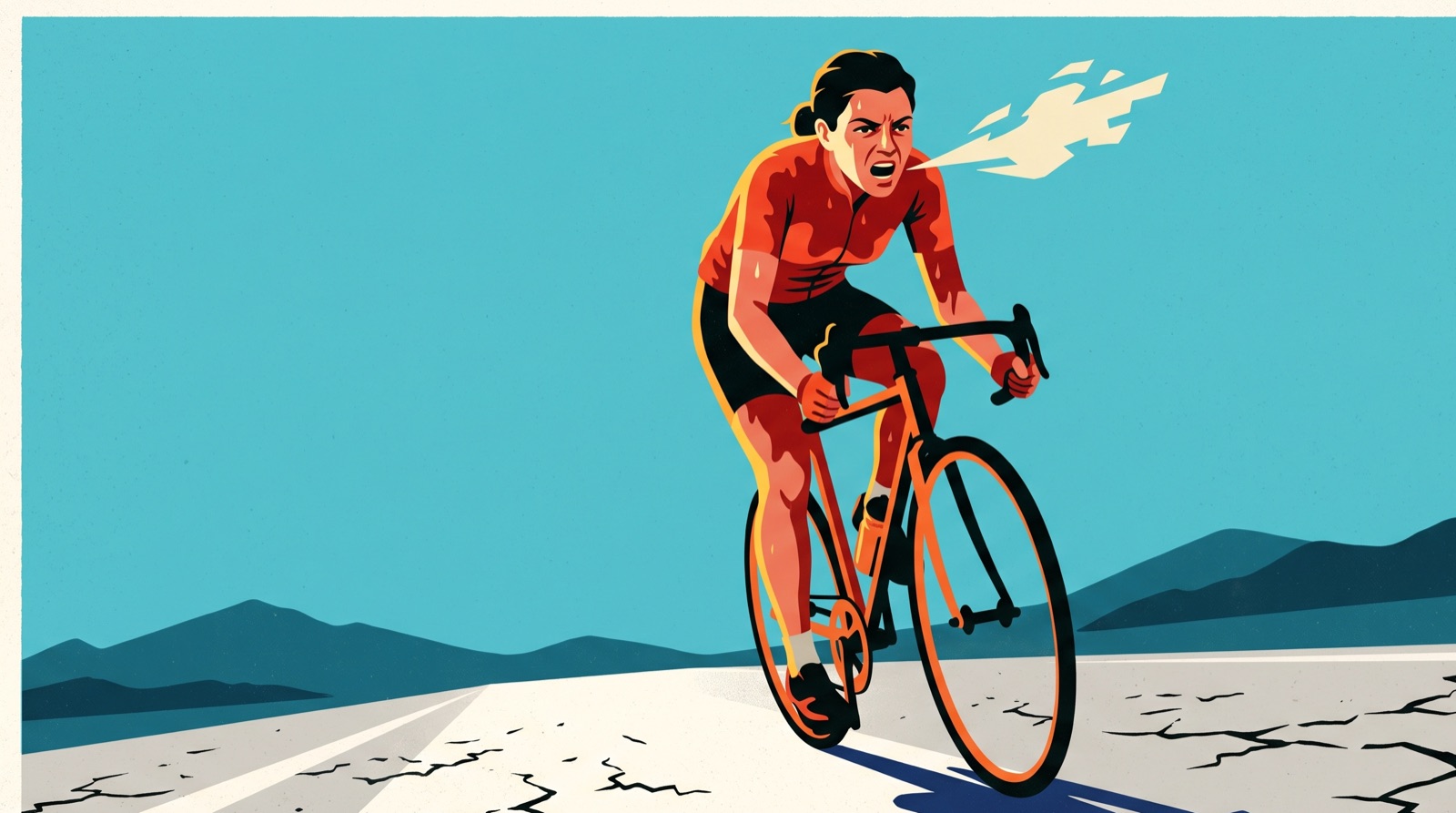
VO2 Max n.
The term is also rendered VO2max (no space) in scientific literature; the two forms describe an identical physiological quantity.
also known as maximal oxygen uptake, maximal aerobic capacity
The definition
VO2 Max is the maximum rate at which the body can consume oxygen during exhaustive exercise, expressed in millilitres per kilogram per minute. Governed by the Fick principle, it reflects the integrated capacity of the lungs, heart, and skeletal muscle to transport and utilise oxygen. The gold-standard measure of cardiorespiratory fitness, VO2 Max is a powerful predictor of longevity.
The mechanism
VO2 Max is governed by the Fick equation: oxygen consumption equals cardiac output multiplied by the arteriovenous oxygen difference. In most individuals, the primary constraint on this product is maximal cardiac output, which is itself bounded by peak stroke volume1. This is why endurance training enlarges the left ventricle: a larger stroke volume produces a higher cardiac output at any given heart rate, raising the aerobic ceiling.
Endurance performance is shaped by three interacting variables: VO2 Max sets the absolute aerobic ceiling; lactate threshold determines the fraction of that ceiling sustainable for extended efforts; and exercise economy describes the oxygen cost of producing a given speed or power output1. Elite performance demands high scores on all three. A runner with an exceptional VO2 Max but poor economy will lose to a rival who uses less oxygen per kilometre at submaximal pace.
Training-induced gains arise from both central and peripheral adaptations. Centrally, cardiac stroke volume increases, raising peak cardiac output. Peripherally, skeletal muscle capillary density and mitochondrial volume rise, improving the extraction of oxygen from circulating blood1. VO2 Max also declines with age: normative data from the FRIEND registry show that men aged 60-69 in the top fitness percentile score approximately 40 mL/kg/min, against values above 55 mL/kg/min for men aged 20-29 at the same rank4.
Aerobic Capacity Bands — VO2 max bands — from poor to elite aerobic capacity; higher means more oxygen used under load.
In practice
The clinical weight of VO2 Max becomes concrete when fitness stratification is mapped against long-term health outcomes.
Worked example
A 45-year-old male executive undergoes a graded treadmill test as part of a corporate health programme. His VO2 Max measures 32 mL/kg/min, placing him in the 'poor' category for his age group according to FRIEND registry norms. His cardiologist notes that this single metric carries greater prognostic weight than his fasting glucose or total cholesterol, and recommends a structured aerobic conditioning block before his next annual assessment.
VO2 Max is the most modifiable variable on the standard cardiometabolic risk panel, which is why a low score warrants a training prescription before any pharmaceutical intervention.
Why it matters
The mortality data surrounding VO2 Max are among the most robust in preventive medicine. A meta-analysis of 33 studies found that each 3.5 mL/kg/min increment in cardiorespiratory fitness corresponded to a 13% reduction in all-cause mortality and a 15% reduction in cardiovascular events2. In a cohort of 122,007 patients undergoing exercise treadmill testing, poor fitness carried a mortality hazard comparable to or greater than coronary artery disease, smoking, and type 2 diabetes, with no observed ceiling to the benefit of higher fitness3.
An umbrella review synthesising 26 meta-analyses, representing over 20 million observations, found that high versus low cardiorespiratory fitness was associated with a 53% reduction in all-cause mortality risk5. The practical implication is unambiguous: lifting VO2 Max from the bottom to the middle quintile for your age and sex produces a mortality benefit that no pharmaceutical agent has matched. For the performance-oriented individual, the case is identical; a higher aerobic ceiling underpins every quality of effort, from sustained cognitive work to competitive athletic output.
Questions of record
What is a good VO2 Max for my age and sex?
Reference values vary by age and sex. The FRIEND registry classifies fitness into five bands: poor, fair, good, excellent, and superior4. A 40-year-old man requires approximately 42 mL/kg/min to reach the 'good' threshold; a woman of the same age requires roughly 36 mL/kg/min. Your category is best determined by a direct cardiopulmonary exercise test.
How do you increase VO2 Max with training?
High-intensity interval training is the most time-efficient stimulus for raising VO2 Max1. Gains arise from cardiac adaptations (enlarged stroke volume and higher peak cardiac output) and peripheral adaptations (greater capillary density and mitochondrial volume in skeletal muscle). Consistent aerobic training over 8 to 12 weeks produces measurable improvements in most previously inactive individuals.
Does a higher VO2 Max mean a longer life?
The association is strong and graded, with no observed upper ceiling of benefit. A large cohort study found that poor fitness carried a mortality risk comparable to or greater than established disease and smoking3. An umbrella review of more than 20 million observations confirmed a 53% lower all-cause mortality risk in highly fit versus poorly fit individuals5.
What is the difference between VO2 Max and lactate threshold?
VO2 Max sets the absolute aerobic ceiling: the maximum oxygen your cardiovascular system can deliver and your muscles can use. Lactate threshold is the intensity at which lactate accumulates faster than it is cleared1. Elite endurance performance requires both: a high VO2 Max and a lactate threshold that allows sustained effort at a large fraction of that ceiling.