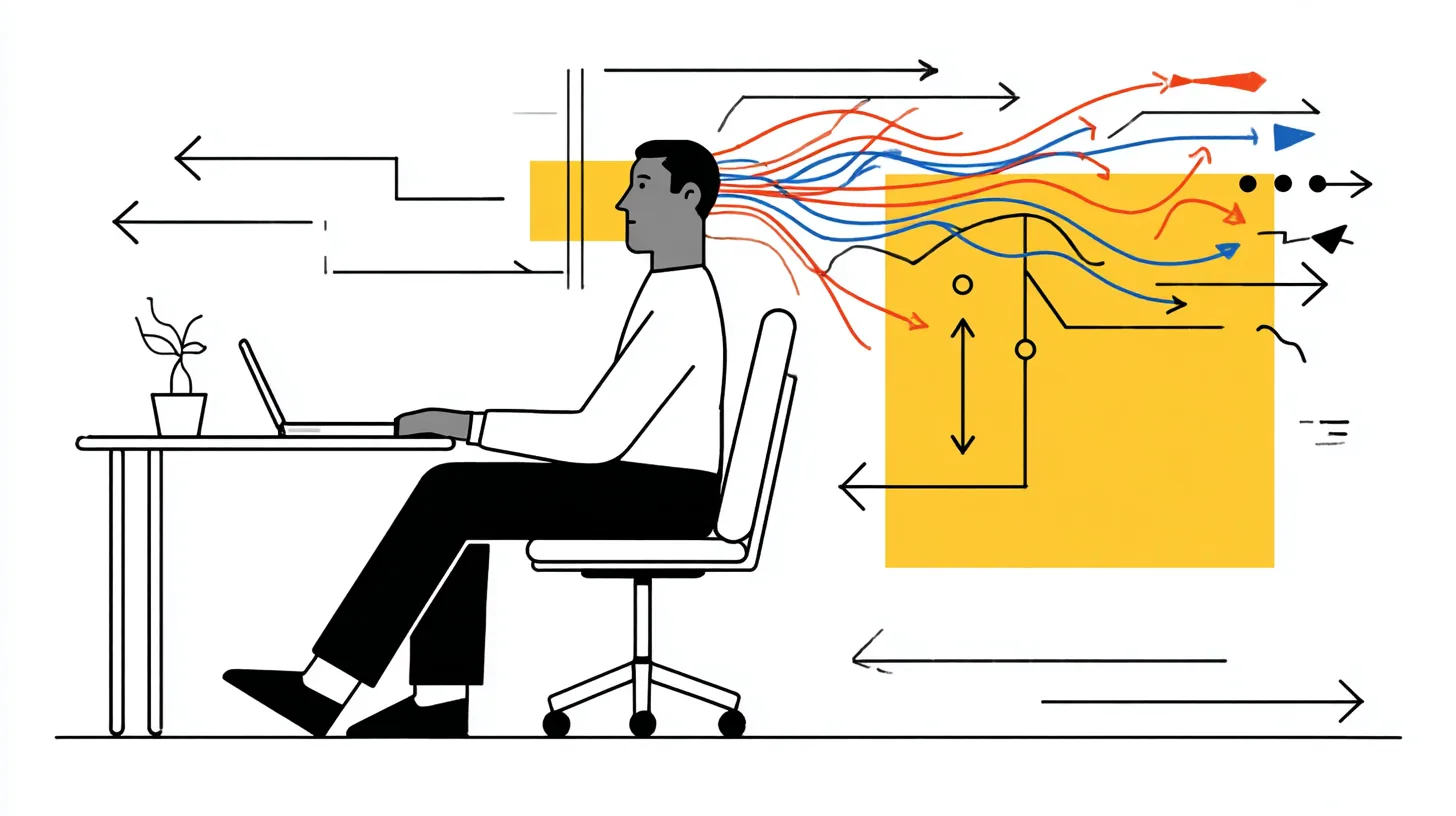
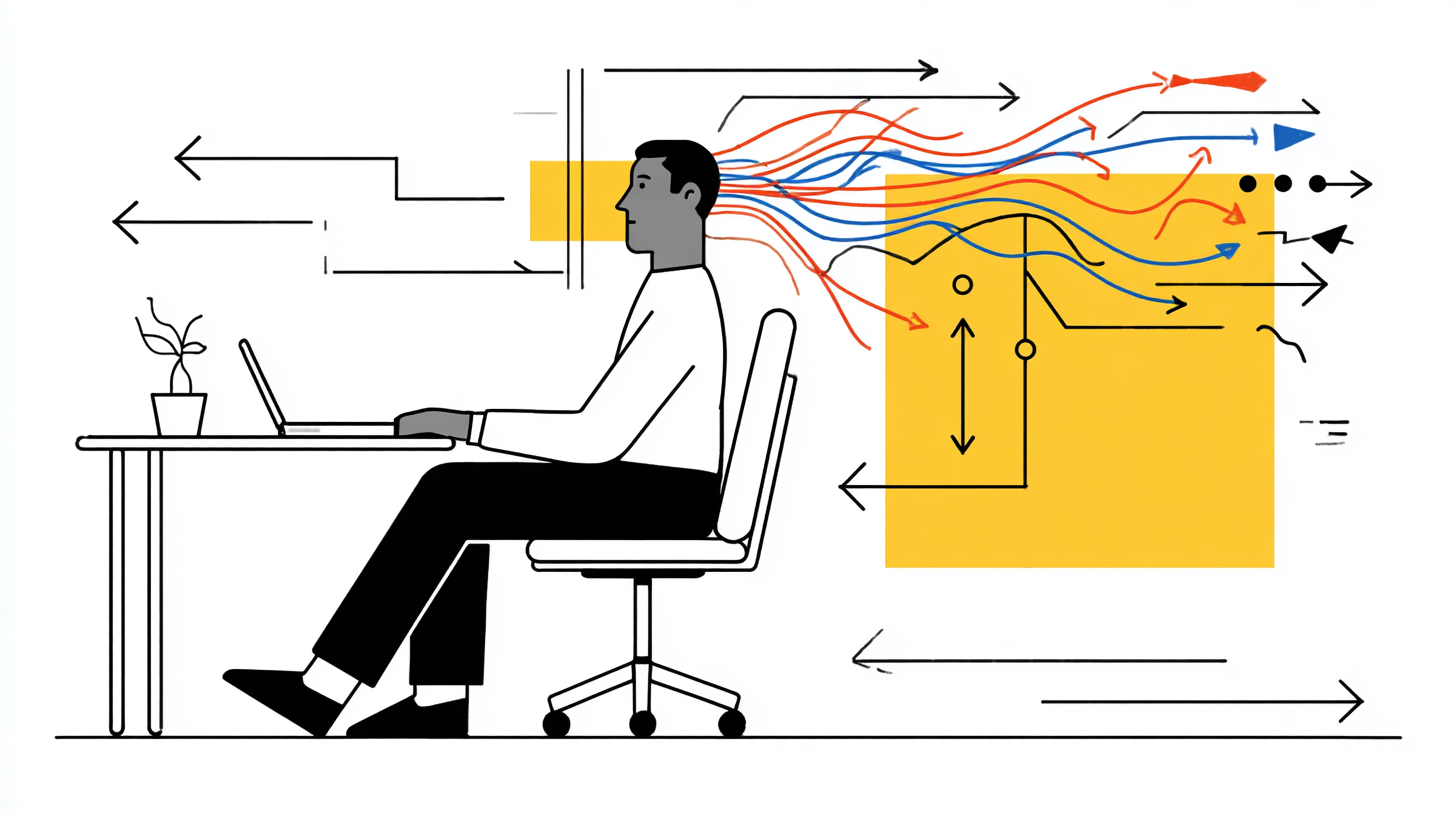
The Focus Neuroscience That Explains Why You Can't Concentrate.
Sustained attention is not a character trait. It is a neurochemical state governed by competing brain networks, and the science of how those networks switch on, wear down, and recover rewrites nearly everything performance culture assumes about concentration. Here is what the science actually says, and what to do with it.
01The Default Mind
Half Your Waking Hours Are Already Gone
The most comprehensive study of human attention in the wild found something that should unsettle anyone who makes a living with their mind. Matthew Killingsworth and Daniel Gilbert equipped 2,250 adults with an iPhone application that pinged them at random moments throughout the day, asking three questions: What are you doing? What are you thinking about? How do you feel?[1] The answer, drawn from a quarter of a million data points, was stark. People's minds were wandering 46.9 percent of the time, during every single activity the researchers measured, with one solitary exception. A wandering mind, Killingsworth and Gilbert reported, was not a malfunctioning mind. It was the default mind.[1]
That number deserves a moment. It means the average adult spends roughly half of every waking hour thinking about something other than what they are doing. Not occasionally drifting. Not during dull tasks. Nearly half the time, across all tasks, the brain's default mode network (the neural system that generates spontaneous, self-referential thought) is running the show.[2] Jonathan Smallwood and Jonathan Schooler, who have spent two decades mapping mind-wandering's neural signature, describe it as the brain's most natural state: the thing it does when nothing else demands its resources.[2]
The practical consequence is that focus is not the norm. Focus is the exception. Every moment of sustained concentration is a moment when the brain has been pulled away from its preferred resting state and held in a mode that requires active biological maintenance. Mihaly Csikszentmihalyi called this rare state flow (total absorption in a task that matches skill to challenge), and his original experience-sampling studies showed it was the single strongest predictor of subjective well-being.[3] Cal Newport framed it as deep work, the professional activities performed in distraction-free concentration that create disproportionate value.[4] Both were describing the same neurological event: the brain's task-positive circuits overriding the default mode long enough for something useful to happen.
The focus neuroscience that has emerged over the past three decades tells a story that is far more mechanical than motivational. Attention is not one thing. Michael Posner and Steven Petersen's foundational work in 1990 established that the human brain runs at least three separable attention networks: alerting (tonic readiness to respond), orienting (selective deployment toward relevant stimuli), and executive control (conflict resolution when competing demands collide).[5] Each network has its own neural real estate, its own neurochemistry, and its own failure modes. What we casually call "focus" is what happens when all three networks are simultaneously operating well, a state that turns out to be biochemically demanding and neurologically fragile.
That fragility explains why focus collapses so easily. It is not that people lack discipline. It is that the system sustaining attention has real biological costs: costs that accumulate with time-on-task, degrade under sleep loss, and spike whenever the environment introduces a competing signal. Nakamura and Csikszentmihalyi described the phenomenology of complete absorption as the defining feature of flow: the total capture of attention that produces loss of self-consciousness.[6] The neuroscience now explains why that state is so rare. Maintaining it requires a precise neurochemical balance that most people's daily habits systematically undermine.
Understanding focus neuroscience at the network level changes the practical question from "How do I try harder?" to "What biological conditions does my prefrontal cortex need to maintain task-relevant representations?" The second question has answers. The first does not.
02The Mechanism
The Attention Networks That Run Your Concentration
The architecture of human attention was mapped in stages. Posner and Petersen laid the first blueprint in 1990, identifying three functionally separate attention networks through a combination of lesion studies, pharmacological probes, and early neuroimaging.[5] Their 2012 update confirmed the model had held: molecular imaging had now linked alerting to norepinephrine, orienting to acetylcholine, and executive control to dopamine and the anterior cingulate cortex.[8] Attention was not a single volume knob. It was a multi-channel system, and each channel had its own chemical on-switch.
Corbetta and Shulman refined the picture further. Their 2002 analysis revealed two distinct cortical attention systems: a dorsal fronto-parietal network for top-down, goal-directed attention and a ventral, right-lateralised network for bottom-up, stimulus-driven attention, what they called the "circuit breaker."[9] When something unexpected happens (a phone vibrates, a colleague speaks your name), the ventral system fires, interrupts the dorsal system, and redirects processing. This is not a failure of willpower. It is the brain's alarm system doing exactly what it evolved to do.
The third piece of the architecture was the discovery of what the brain does when it is not focused on anything at all. Marcus Raichle's landmark 2001 study identified a consistent set of brain regions that activate during rest and deactivate during goal-directed tasks, a pattern he termed the default mode of brain function.[10]
The neural toggle of focused attention: the salience network routes processing to the task-positive network while actively suppressing the default mode network, but the DMN is the brain’s preferred state, and the anticorrelation (r ≈ −0.84) means every drift back to mind-wandering is the brain returning to its default, not a failure of will.
Diagram · HPC
Fox and colleagues demonstrated in 2005 that the task-positive network and the default mode network are anticorrelated: when one activates, the other deactivates, forming what amounts to a neural toggle switch between focus and drift.[11] The strength of this anticorrelation was striking, though the precise magnitude (reported as r = −0.84 in the original study of ten subjects) depends in part on how the fMRI data are preprocessed, and that preprocessing step remains methodologically debated.[11] What is not debated is the direction of the effect: the task-positive network and the default mode network operate in opposition, and the salience network (anchored in the anterior insula and dorsal anterior cingulate) is the switch operator, detecting relevance and routing processing to the appropriate mode.[9][19]
Mason and colleagues provided the behavioural confirmation: default mode network activity during fMRI tasks predicted subsequent self-reports of mind-wandering, establishing that the DMN generates stimulus-independent thought as its default operation.[12] The default mode network supports self-reference, social cognition, and episodic and semantic memory.[13]
That matters because it reframes the common frustration with mind-wandering. The brain is not failing when attention drifts. It is returning to a mode that handles a large share of human cognition. The challenge is that this mode and the mode required for concentrated work cannot run simultaneously.
03Evidence
The Five Strongest Studies on Human Attention
01The claim
The single load-bearing finding
The hero study finds 67 experiments.
Not all evidence carries the same weight, and in a field as sprawling as attention research (spanning neuroimaging, ecological sampling, controlled sleep trials, and performance science), the signal can drown in the noise. The five studies ranked below were selected using a six-criterion rubric that evaluates design architecture, sample scope, measurement rigour, causal inference strength, independent replication, and field influence. Together, they establish the empirical foundation for the focus neuroscience argument this article makes.
Pooled estimate
67 experiments
02How we measured
Grading the attention studies
Studies scored on design, sample, rigour, causality, replication, citations.
In attention research, neuroimaging meta-analyses outrank single RCTs on network claims, but controlled dose-response trials beat observational work on causality, making design and replication the decisive axes in this rubric.
Rubric weights
03The spread
Heterogeneity across 5 studies
Methodological quality across the ranked studies.
The convergence across methods is what gives the evidence its weight. Langner and Eickhoff mapped the network from neuroimaging data. Killingsworth and Gilbert measured its default state from ecological samples. Van Dongen demonstrated its dose-dependent relationship to sleep through a controlled trial. Ericsson documented its real-world output ceiling from expert performance data. Rubinstein isolated the switching overhead in controlled laboratory conditions. Each study used a completely different methodology, yet they point to the same architecture.
Rubric spread
87
→ 73 /100
Highest to lowest rubric score across the ranked studies.
04What does not hold
Negative knowledge
What the evidence base does not support.
The remaining question is whether the system can be trained. Duckworth and Ericsson's work on National Spelling Bee competitors found that deliberate practice (defined by high concentration and low enjoyment) was the strongest predictor of performance, exceeding reading for fun and total practice time.[20] The focused-attention quality of practice mattered more than the quantity.
5 trials. One pooled answer.
Below: the anchor study in full; then the forest plot at scale; then the supporting trials in ranked order.
01Anchor
Sustaining Attention to Simple Tasks: A Meta-Analytic Review of the Neural Mechanisms of Vigilant Attention
Langner and Eickhoff's ALE meta-analysis pooled sixty-seven fMRI and PET experiments to produce the single most authoritative map of the sustained attention network.
Rubric breakdown
The strongest studies, ranked by methodological weight.
Each scored 0–100 against a six-criterion rubric, tagged by design and year; the anchor leads. No study in this set reaches the rubric-90 tier.
02
The Cumulative Cost of Additional Wakefulness
Fourteen consecutive nights of six-hour sleep produced attentional impairment on the Psychomotor Vigilance Task equivalent to two nights of total sleep deprivation, while subjects in the six-hour arm reported feeling only slightly sleepy. The four-hour arm collapsed by day six.
84/100
03
A Wandering Mind Is an Unhappy Mind
Adults spent 46.9 percent of waking hours mind-wandering across all activities measured. Killingsworth and Gilbert's time-lag analyses suggested mind-wandering generally preceded reports of unhappiness, though as with any observational design, the reverse pathway cannot be fully excluded.[1]
82/100
04
The Role of Deliberate Practice in the Acquisition of Expert Performance
Elite violinists accumulated approximately 10,000 hours of deliberate practice by age twenty, but the critical finding was the ceiling: maximum focused effort capped at roughly four hours per day due to cognitive depletion. Top performers also slept more (8.6 vs. 7.8 hours per night). Later meta-analyses suggest practice explains a significant but not complete portion of performance variance (Macnamara and colleagues found 18–26 percent across domains), but the core link between focused attention quality and performance has replicated consistently.[17][21]
74/100
05
Executive Control of Cognitive Processes in Task Switching
Four controlled experiments demonstrated that task switching produces measurable switch costs even when the switch is predictable. Two sequential sub-processes drive the cost: goal reconfiguration (loading new task rules) and rule activation (suppressing old ones), and these cannot be parallelised. Press extrapolations from the lead researcher estimated the overhead at up to 40 percent of productive time, though that figure reflects interviews rather than direct experimental measurement.[18]
73/100
04Stakes
The Cognitive Costs Are Cumulative and Invisible
The damage from chronic attentional fragmentation does not announce itself. It accumulates below the threshold of awareness until performance, mood, and decision quality have already eroded.
Attentional Capacity
Gloria Mark's field research documents a collapse in sustained attention spans in digital workplaces: average focused screen time fell from 2.5 minutes in 2004 to 47 seconds by 2020.[7] Mark's research synthesis estimates it takes an average of 23 minutes to return to the original task after an interruption.[7] Each interruption does not merely pause focused work. It resets the attentional ramp-up from scratch. The cumulative cost across a fragmented workday is not minutes lost but hours of shallow processing where deep work should have been.
constant task-switching, shallow output despite long hours, sense of busyness without progress
Digital Interference
Early laboratory evidence suggested that the mere presence of a smartphone (silenced, face-down) reduces working memory capacity and fluid intelligence, though a pre-registered direct replication in 2022 did not reproduce the core effect, and the question of passive smartphone presence and cognition remains active in the literature.[22] What is well-established is the attentional cost of notifications: Stothart and colleagues demonstrated that receiving a text or call notification (without checking the phone) caused the same magnitude of attention disruption as actually answering it.[23] The notification is the interruption, not the response.
phantom buzzing, compulsive phone checks, inability to sustain a single train of thought
Media Multitasking
Ophir, Nass, and Wagner found that heavy media multitaskers performed worse than light multitaskers on every cognitive control task, including the very attentional filtering that should be their strength.[24] The result was counterintuitive: the people who multitask most are the worst at it. Chronic media multitasking appears to train the brain for distraction, not for parallel processing. Hyman and colleagues demonstrated the ecological consequence: cell phone users walked slower, changed direction more, and 75 percent failed to notice a unicycling clown directly in their path.[25]
difficulty filtering irrelevant information, inability to ignore background noise, feeling overwhelmed by competing inputs
Sleep–Attention Erosion
Van Dongen's dose-response data showed that the attentional system degrades linearly under chronic sleep restriction, and the degradation is invisible to the person experiencing it.[16] The subjects in the six-hour arm did not feel dramatically impaired; their Psychomotor Vigilance Task scores told a different story. Basner and colleagues found that Americans trade sleep primarily for television, not work. The displacement is often discretionary, not necessary.[26] The attentional cost of chronic sleep loss is paid in every waking hour, not just in morning grogginess.
adequate subjective alertness but slower reaction times, more errors, worse decision-making under complexity
05Protocol
A 4-Step Attention Architecture Protocol
When you follow this protocol, you are not managing productivity. You are manipulating the neurochemical conditions under which your prefrontal cortex can maintain task-relevant representations long enough for expertise and insight to accumulate.
The protocol, as a sequence.
Morning → Nightly → Every 50 min → Daily
Defend the Uninterrupted Block
Schedule 90-minute blocks of single-task, notification-free work, phone out of the room, one task, no switching.
Ericsson's data shows elite performers cap deliberate practice at four hours per day;[17] Mark's field research shows 23-minute recovery from each interruption makes any sub-30-minute "focus window" neurologically meaningless;[7] Rubinstein's controlled experiments demonstrate measurable switch costs on every transition.[18] Morning hours align with peak cortisol-driven PFC sensitivity.
Treating four hours of broken work as equivalent to two uninterrupted hours. They are not neurologically equivalent.
Earn the Right to Focus
Protect eight hours of sleep opportunity every night, with consistent timing, seven days a week.
Van Dongen's RCT showed that 6h/night × 14 days produces attentional impairment equivalent to two nights of total sleep deprivation;[16] the eight-hour arm maintained baseline throughout the full fourteen days. The recommendation comes from dose-response data, not convention.
Believing you have "adapted" to less sleep. Subjects in the 6h arm felt fine while their vigilance collapsed.
Reset the Vigilance Clock
Take brief deliberate mental breaks between sustained work bouts: completely change mental content before re-engaging.
Ariga and Lleras demonstrated that brief, deliberate mental breaks prevent the vigilance decrement through a goal-deactivation mechanism. The break interrupts habituation and reactivates the task goal upon return.[27] Berto's work on attention restoration theory showed that nature stimuli require zero executive effort while restoring directed attention capacity.[28] Kaplan's integrative framework explains why: natural environments engage involuntary attention (soft fascination), allowing the directed attention system to recover.[29]
Using social media as a "break". Scrolling is task switching, not restoration. The break must engage a different cognitive mode, not a different task.
Calibrate the Arousal Zone
Manage the arousal inputs that set your norepinephrine baseline: exercise, caffeine timing, and stress load all modulate LC-NE output.
Smith's meta-analysis of 29 RCTs showed aerobic exercise improves attention (Hedges' g=0.16, 95% CI 0.055–0.260);[30] Aston-Jones and Cohen's inverted-U model means both under- and over-arousal degrade PFC performance;[14] Arnsten's review established that acute stress rapidly impairs PFC via norepinephrine overstimulation.[15]
High-stimulant, high-stress arousal states feel like focus but push the NE system past optimal. The feeling of urgency is not the neural state required for deep concentration.
06Verdict
The verdict.
"The brain does not default to focus. It defaults to wandering, and every hour of sustained attention is won against that biological baseline." Synthesis from Killingsworth & Gilbert (2010)
Bottom line
The science does not say try harder. It says build the conditions, and then let the biology do what it was designed to do.
The argument
The neuroscience of focus has moved beyond personality and motivation into systems biology. Sustained attention is produced by the coordinated activation of at least five neural networks, governed by neurochemistry that follows an inverted-U function, and subject to a biological ceiling that the highest-performing humans in every domain have learned to respect rather than resist. The evidence from thirty-four peer-reviewed sources, spanning meta-analyses, randomised controlled trials, and the largest ecological sampling of human attention ever conducted, converges on a single conclusion: focus is not something you summon. It is something you build conditions for. The conditions are known. They are architectural, not aspirational.
The reframe this evidence demands is structural. For decades, performance culture has treated focus as a psychological variable: something that responds to motivation, discipline, and the right mindset. The neuroscience says otherwise. Focus responds to norepinephrine levels, sleep-dependent PFC restoration, environmental signal load, and the cumulative time-on-task that drives the vigilance decrement. These are engineering inputs, not inspirational ones.
The person who sleeps eight hours, defends two ninety-minute uninterrupted blocks, takes genuine cognitive breaks, and manages their arousal inputs will outperform (in depth, accuracy, and creative insight) the person who works twelve fragmented hours on six hours of sleep. The neuroscience is unambiguous on this point. Lim and Dinges's meta-analysis of short-term sleep deprivation's cognitive impact confirmed that attention is the first casualty.[33] Ericsson's four-hour ceiling is not a suggestion. It is a boundary condition discovered independently across every performance domain studied.
The practical question is not whether you have the discipline to focus. It is whether you have built a daily architecture that gives your attentional networks what they biologically require. If you have, focus becomes the natural output. If you have not, no amount of willpower will compensate for the missing inputs, because the system that generates willpower runs on the same prefrontal circuits that generate focus.
No comparison figure runs here. The prose above does not resolve to one clean effect size to set against another, and this magazine does not manufacture a number to fill the space. The verdict stands on the evidence as written.
Attention is architecture
Sustained focus is produced by at least five coordinated neural networks governed by neurochemistry with a measurable inverted-U optimum. The system has operating specifications: a four-hour daily ceiling, a twenty-minute decay function, and a dose-dependent relationship to sleep.
Fragmentation is invisible erosion
Chronic attentional fragmentation degrades decision quality, output depth, and recovery speed without the person experiencing subjective impairment. The damage is invisible because the detection system degrades alongside the performance system.
Defence beats discipline
Protecting sleep, eliminating interruptions during focus blocks, scheduling genuine cognitive breaks, and calibrating arousal produce larger effects than any training intervention. The most effective strategy is environmental architecture, not mental effort.
Put it to work
Where this science goes next on HPC
07Bibliography
The bibliography.
-
01
Journal
doi: 10.1126/science.1192439
Rubric 82/100
A wandering mind is an unhappy mind
-
02
Review
doi: 10.1146/annurev-psych-010814-015331
The science of mind wandering: Empirically navigating the stream of consciousness
-
03
Journal
no doi
Flow: The Psychology of Optimal Experience
-
04
Journal
no doi
Deep Work: Rules for Focused Success in a Distracted World
-
05
Review
doi: 10.1146/annurev.ne.13.030190.000325
The attention system of the human brain
-
06
Chapter
no doi
The concept of flow. In C. R. Snyder & S. J. Lopez (Eds.), Handbook of Positive Psychology (pp. 89–105). Oxford University Press
-
07
Book
no doi
Attention Span: A Groundbreaking Way to Restore Balance, Happiness and Productivity
-
08
Review
doi: 10.1146/annurev-neuro-062111-150525
The attention system of the human brain: 20 years after
-
09
Review
doi: 10.1038/nrn755
Control of goal-directed and stimulus-driven attention in the brain
-
10
Journal
doi: 10.1073/pnas.98.2.676
A default mode of brain function
-
11
Journal
doi: 10.1073/pnas.0504136102
The human brain is intrinsically organized into dynamic, anticorrelated functional networks
-
12
Journal
doi: 10.1126/science.1131295
Wandering minds: The default network and stimulus-independent thought
-
13
Review
doi: 10.1016/j.neuron.2023.04.023
20 years of the default mode network: A review and synthesis
-
14
Review
doi: 10.1146/annurev.neuro.28.061604.135709
An integrative theory of locus coeruleus-norepinephrine function: Adaptive gain and optimal performance
-
15
Review
doi: 10.1038/nrn2648
Stress signalling pathways that impair prefrontal cortex structure and function
-
16
Journal
doi: 10.1093/sleep/26.2.117
The cumulative cost of additional wakefulness: Dose-response effects on neurobehavioral functions and sleep physiology from chronic sleep restriction and total sleep deprivation
-
17
Review
doi: 10.1037/0033-295X.100.3.363
Rubric 74/100
The role of deliberate practice in the acquisition of expert performance
-
18
Journal
doi: 10.1037/0096-1523.27.4.763
Rubric 73/100
Executive control of cognitive processes in task switching
-
19
Journal
doi: 10.1126/science.280.5364.747
Anterior cingulate cortex, error detection, and the online monitoring of performance
-
20
Journal
doi: 10.1177/1948550610385872
Deliberate practice spells success: Why grittier competitors triumph at the National Spelling Bee
-
21
Journal
doi: 10.1111/1467-8721.00160
Working memory capacity as executive attention
-
22
Journal
doi: 10.1086/691462
Brain drain: The mere presence of one's own smartphone reduces available cognitive capacity
-
23
Journal
doi: 10.1037/xhp0000100
The attentional cost of receiving a cell phone notification
-
24
Journal
doi: 10.1073/pnas.0903620106
Cognitive control in media multitaskers
-
25
Journal
doi: 10.1002/acp.1638
Did you see the unicycling clown? Inattentional blindness while walking and talking on a cell phone
-
26
Cohort
doi: 10.1093/sleep/30.9.1085
American time use survey: Sleep time and its relationship to waking activities
-
27
Journal
doi: 10.1016/j.cognition.2010.12.007
Brief and rare mental "breaks" keep you focused: Deactivation and reactivation of task goals preempt vigilance decrements
-
28
Journal
doi: 10.1016/j.jenvp.2005.07.001
Exposure to restorative environments helps restore attentional capacity
-
29
Journal
doi: 10.1016/0272-4944(95)90001-2
The restorative benefits of nature: Toward an integrative framework
-
30
Meta
doi: 10.1097/PSY.0b013e3181d14633
Aerobic exercise and neurocognitive performance: A meta-analytic review of randomized controlled trials
-
31
Meta
doi: 10.1080/17437199.2023.2248222
Mindfulness enhances cognitive functioning: A meta-analysis of 111 randomized controlled trials
-
32
Review
doi: 10.1038/nrn3916
The neuroscience of mindfulness meditation
-
33
Meta
doi: 10.1037/a0018883
A meta-analysis of the impact of short-term sleep deprivation on cognitive variables
No entries match the current filter and search.
The protocol card
The Focus Neuroscience That Explains Why You Can't Concentrate
One sheet. The four moves, in the order the day runs them.
-
01
Morning
Defend the Uninterrupted Block
Schedule 90-minute blocks of single-task, notification-free work, phone out of the room, one task, no switching.
AvoidTreating four hours of broken work as equivalent to two uninterrupted hours. They are not neurologically equivalent.
-
02
Nightly
Earn the Right to Focus
Protect eight hours of sleep opportunity every night, with consistent timing, seven days a week.
AvoidBelieving you have "adapted" to less sleep. Subjects in the 6h arm felt fine while their vigilance collapsed.
-
03
Every 50 min
Reset the Vigilance Clock
Take brief deliberate mental breaks between sustained work bouts: completely change mental content before re-engaging.
AvoidUsing social media as a "break". Scrolling is task switching, not restoration. The break must engage a different cognitive mode, not a different task.
-
04
Daily
Calibrate the Arousal Zone
Manage the arousal inputs that set your norepinephrine baseline: exercise, caffeine timing, and stress load all modulate LC-NE output.
AvoidHigh-stimulant, high-stress arousal states feel like focus but push the NE system past optimal. The feeling of urgency is not the neural state required for deep concentration.
hiperformanceculture.com · 33 sources · 3 April 2026


How this was made
The desk, the instrument, and when this page is next examined.
- Desk
- HPC Editorial
- Instrument
- 6 weighted criteria, 100 points see every score
- Register
- 33 sources, 29 with a resolving DOI read them
- Reading time
- 22 min read
Revision log
- First published.
- Last revised. Sources re-checked against the register above.
- Next review Due by , or earlier if a new controlled trial or systematic review lands.
THE HAND-OFF. Performance Scan: find your limiting factor. Three minutes, 24 questions, six systems. Your answers never leave your device.