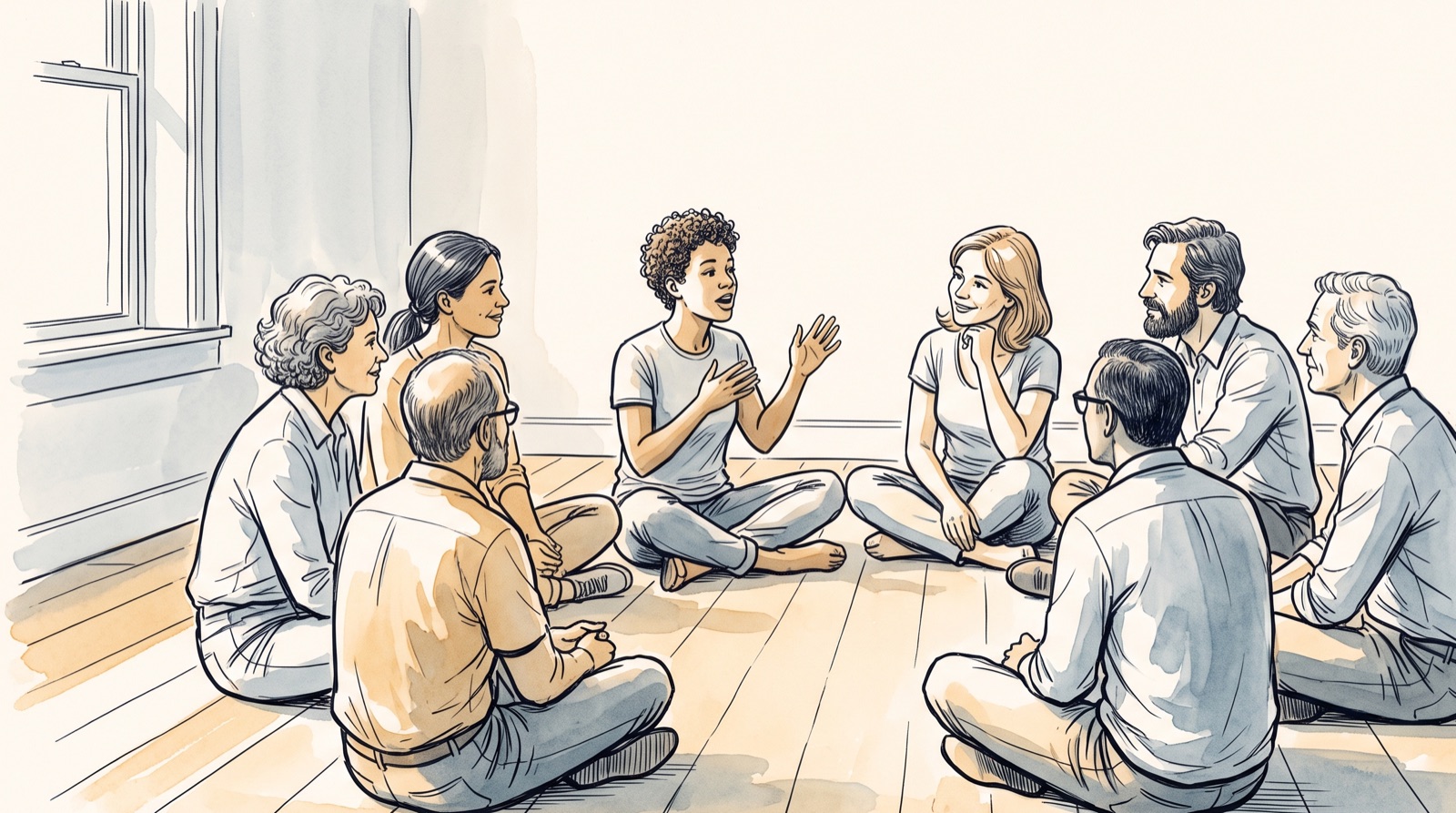
Psychological Safety n.
Psychological safety does not mean the absence of conflict; high-safety teams disagree vigorously but without interpersonal fear.
The definition
Psychological Safety is a shared team-level belief that the interpersonal climate permits members to speak up, ask questions, and acknowledge mistakes without fear of ridicule or retaliation. It is a collective property rather than an individual trait, and it predicts team learning behaviour, which in turn drives output quality and adaptive performance.1
136
independent samples confirming psychological safety predicts team performance
FRAZIER ET AL. · 20162
The mechanism
Psychological safety is a team-level construct, not a personality trait. It reflects a shared perception that the climate tolerates interpersonal risk-taking: the willingness to offer an unformed idea, challenge a manager's assumption, or report a near miss without calculating whether doing so will damage one's reputation or standing.1 Each member's behaviour is shaped by their reading of the collective climate, which is why a single highly critical leader can suppress voice across an entire group even if most colleagues are receptive.
The mechanism by which psychological safety improves performance runs through learning behaviour. When perceived social costs are low, team members admit errors, seek feedback, and test provisional ideas, the activities Edmondson terms collective learning.13 Safety enables this learning; learning, in turn, drives output quality. The causal chain is not direct: safety alone does not produce high performance, but it removes the interpersonal barrier that suppresses the learning without which improvement is impossible.
The strongest predictor of psychological safety within a team is leader behaviour. Meta-analytic synthesis confirms that inclusive leadership, coaching, and modelling of fallibility consistently raise team safety scores.23 Leaders who publicly acknowledge their own mistakes, explicitly invite dissenting views before decisions are finalised, and use structured turn-taking lower the perceived cost of speaking up for every member below them.
In practice
The difference between a psychologically safe team and an unsafe one rarely shows up in normal operations. It becomes visible the moment someone spots a problem that is costly to raise.
Worked example
A junior engineer on a product team spots a critical flaw in a release candidate two days before launch. Uncertain whether raising the issue will mark her as obstructive, she stays silent. The flaw ships, triggers a recall, and results in costly remediation. In a team where speaking up carries no social penalty, the same observation surfaces immediately and the release is held.
The variable was not the engineer's competence or the severity of the flaw; it was whether the team climate made it safe to name what she saw.
Why it matters
The empirical case for psychological safety is unusually robust. A meta-analysis spanning 136 independent samples and more than 22,000 individuals found consistent positive associations with team learning, creativity, and performance across cultures and industries.2 Counterintuitively, teams with high safety tend to report more errors than low-safety teams, not because they make more mistakes, but because they are more willing to surface them.14 Better error visibility produces better corrective action and faster learning curves.
The cost of its absence is equally well-documented. Where psychological safety is low, employees suppress concerns, withhold error reports, and avoid questions that might expose ignorance.3 Each suppressed signal compounds organisational risk and slows adaptive response. Google's internal Project Aristotle research reinforced the point at scale: across hundreds of teams, psychological safety was the single strongest differentiator of high performance, outranking individual talent, personality mix, and seniority.4
Questions of record
How is psychological safety different from being nice or avoiding conflict?
Psychological safety has no connection to conflict avoidance. Teams with high safety are often more willing to disagree, challenge assumptions, and surface difficult truths than low-safety teams. The difference is that disagreement in a safe team targets ideas and problems rather than people, and carries no social penalty for the person who raises it.
How do leaders build psychological safety in their teams?
Self-disclosure is the most powerful lever available to a leader: openly naming your own mistakes resets the team's estimate of how safe it is to be fallible. Pairing that with meeting structures that equalise speaking time and require critical input before any decision is locked consolidates a lasting safety shift.42
What behaviours undermine psychological safety?
Behaviours that reliably lower team psychological safety are those that signal interpersonal risk-taking carries a cost: dismissing an unconventional idea, responding to an error report with blame rather than curiosity, and making silence seem safer than speaking. Once a team reads that signal, voice behaviour drops across the group, not just for the individual who was penalised.31
How is psychological safety measured in organisations?
Psychological safety is measured through team-level survey instruments, with individual responses aggregated to produce a single team score. The construct has been assessed across 136 independent samples in peer-reviewed research, demonstrating consistent associations with performance across industries and national contexts.23
Appears in
- Five Dysfunctions of a TeamGlossary
- Radical CandorGlossary
- Difficult ConversationsGlossary