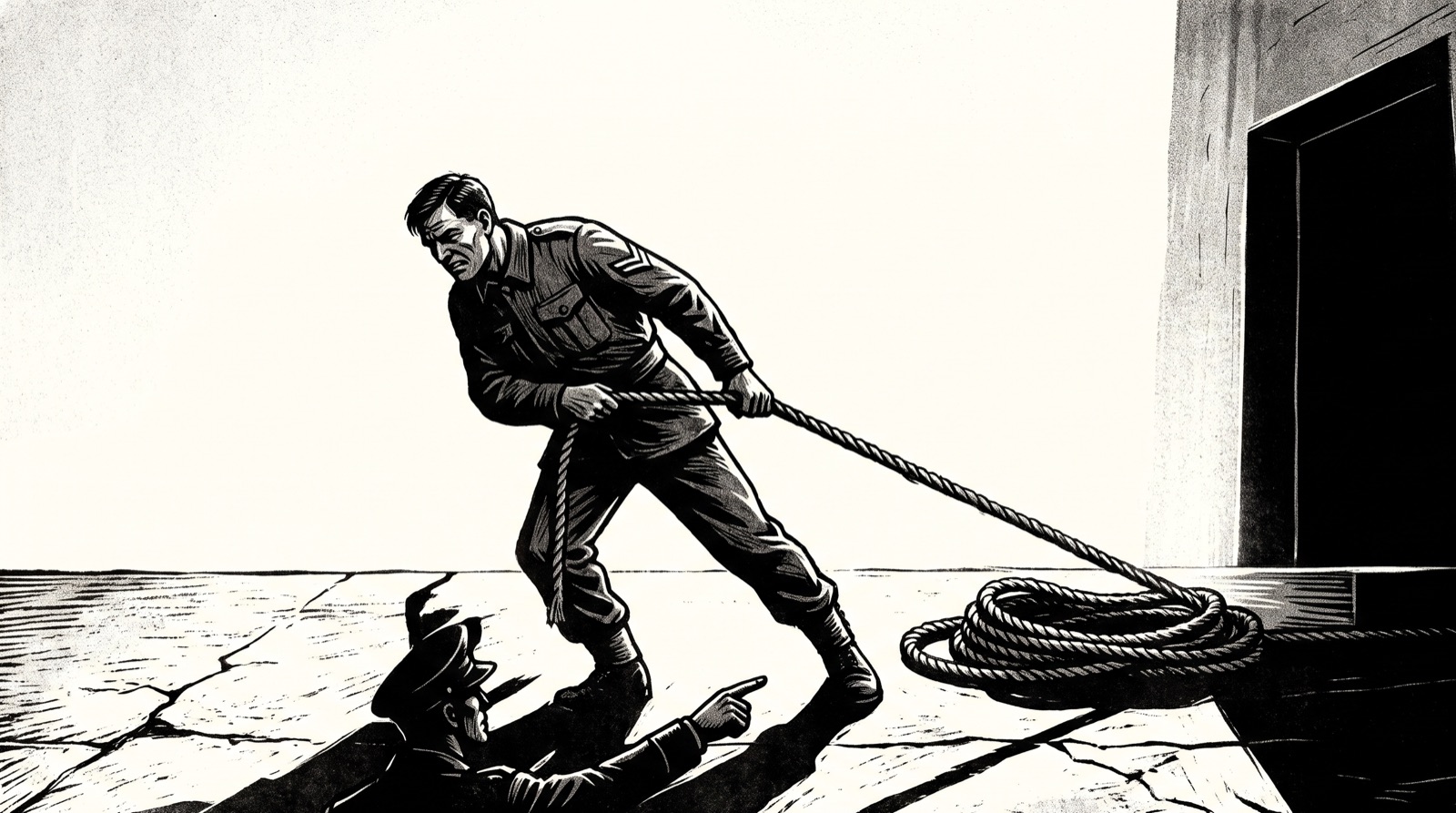
Obedience n.
The contemporary engaged followership model holds that harmful obedience often reflects active identification with an authority's cause rather than passive, mindless compliance.
The definition
Obedience is the social influence process by which an individual follows the explicit directives of a perceived authority figure, even when those directives conflict with personal conscience or ethical judgement. Milgram's 1963 experiments established that situational factors, including the physical proximity of authority and graduated demand escalation, reliably override autonomous moral reasoning in the majority of participants.
The mechanism
Milgram's foundational experiments placed participants in a situation where an experimenter in an institutional setting instructed them to administer what they believed were increasingly severe electric shocks to another person. In the baseline condition, 65% administered the maximum 450-volt shock when ordered to continue1. The key mechanism, which Milgram termed the agentic shift, involves a redefinition of self: the individual no longer acts as an autonomous moral agent but as an instrument of another's will, transferring felt responsibility upward to the authority giving the instructions.
Several situational variables modulate how strongly the authority pull operates. Physical proximity of the authority, the institutional legitimacy of the setting, graduated escalation of demands, and the absence of dissenting peers all amplify obedient behaviour1. Burger's 2009 partial replication, conducted under modern ethics protocols, found obedience rates only marginally lower than Milgram's original findings, despite 45 years of cultural change2. The durability of the effect across decades indicates that the situational pull toward compliance operates independently of era, nationality, or prior awareness of the experiments.
The 'blind obedience' narrative Milgram's work initially popularised has since been substantially revised. Haslam and Reicher's engaged followership model, drawing on reanalysis of archival transcripts and cross-cultural studies, argues that destructive obedience more often involves active moral reasoning in support of the authority's cause: participants harmed others because they believed the mission was worthwhile, not merely because they were ordered to3. Kaposi's 2022 critical review reinforces this, documenting that many original Milgram participants showed moral conflict, negotiation, and pushback before complying4. Obedience, on this account, is better understood as a dynamic social process than a simple binary switch.
Obedience to Authority — In Milgram's study, far more people obeyed authority to the maximum than observers predicted beforehand.
In practice
Obedience to authority is not confined to psychology laboratories. Consider a professional hierarchy where institutional pressure shapes individual action.
Worked example
A junior analyst on a trading desk disagrees with the risk assessment her senior manager has approved. The manager is confident, the deadline is tight, and everyone else in the room has nodded along. She raises a tentative objection, is met with mild impatience, and withdraws her concern. The trade is submitted as originally proposed.
Institutional hierarchy, time pressure, and the absence of dissenting peers replicate Milgram's core conditions without a laboratory.
Why it matters
The practical stakes of obedience research extend well beyond psychology. Corporate misconduct, medical hierarchies where junior staff remain silent about errors, and military atrocities share a common structural feature: individuals operating within authority gradients where personal moral agency has been ceded to institutional command13. The agentic state removes felt accountability from the person carrying out an act, which is precisely what makes destructive obedience so persistent and so difficult to interrupt from within a hierarchy.
Milgram's own data point toward the conditions that interrupt the compliance pull. When even one confederate refused to continue, obedience rates dropped sharply1. Burger's replication adds a further constraint: when the experimenter's phrasing shifted from suggestion to explicit command ('you have no choice, you must continue'), participants consistently disobeyed2. The practical implication is that the illusion of voluntary participation is central to destructive obedience. Creating genuine permission to object, naming the authority gradient explicitly, and ensuring at least one visible dissenter are among the structural interventions that can reduce it.
Questions of record
What did the Milgram experiment prove about obedience to authority?
Milgram's experiments demonstrated that ordinary people comply with authority directives to the point of administering what they believe are severe electric shocks. In the original 1963 study, 65% of participants reached the maximum 450-volt level when instructed, establishing that situational factors reliably override individual moral judgement.
Why do people obey authority even when it causes harm?
Two mechanisms account for most of the effect. The agentic shift causes individuals to redefine themselves as instruments of another's will, transferring felt moral responsibility upward to the authority figure. Haslam and Reicher's engaged followership model adds that people often actively identify with the authority's cause, believing their compliance serves a worthy purpose.
Is obedience the same as conformity?
Obedience and conformity are distinct social influence processes. Obedience involves following explicit directives from a recognised authority figure, whereas conformity involves adjusting one's behaviour to match a peer group without any direct command. Obedience requires a perceived hierarchy; conformity operates through social pressure and the desire to belong.
How can destructive obedience be resisted?
Resistance is most reliable when structural conditions change rather than when individuals rely solely on personal resolve. Visible peer dissent sharply reduces compliance rates. Removing the implicit assumption that participation is compulsory also helps: when authority figures use explicit coercion, obedience collapses. Naming the authority gradient openly is a further structural lever.
Appears in
- Authority BiasGlossary