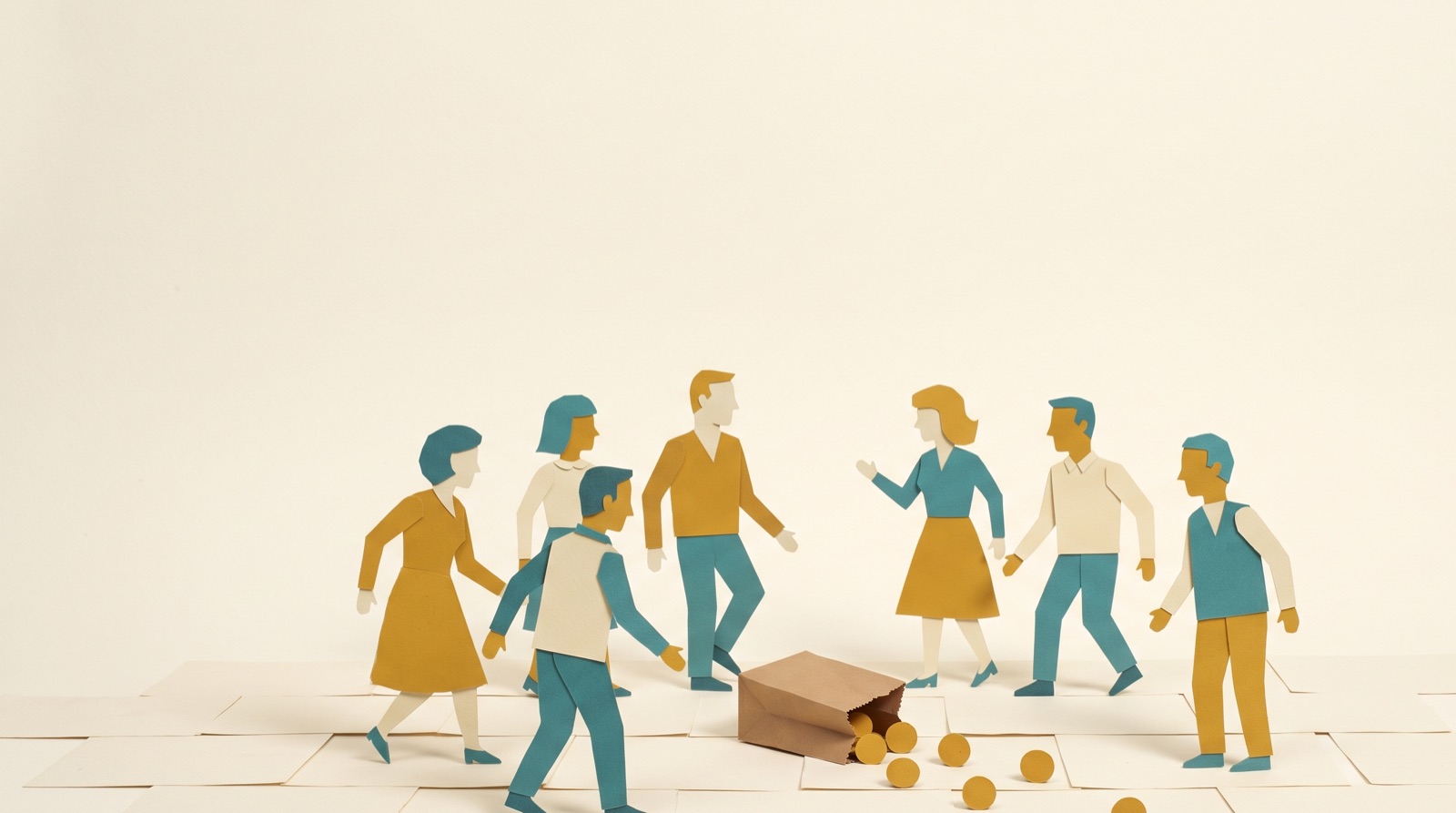
Bystander Effect n.
The term gained popular currency through the 1964 Kitty Genovese case, though subsequent scholarship has shown the canonical 38-witness account to be substantially inaccurate.
also known as bystander apathy
The definition
Bystander Effect is the well-documented tendency for individuals to be less likely to intervene in an emergency when other people are present. First formalised by Darley and Latané in 1968, it operates through three mechanisms: diffusion of responsibility, pluralistic ignorance, and evaluation apprehension. The more bystanders present, the stronger the inhibition on any individual to act.
85% vs 31%
lone bystanders helped vs those believing four others were present
DARLEY & LATANE · 19681
The mechanism
Three interlocking psychological mechanisms explain why group presence suppresses helping. Diffusion of responsibility occurs when each witness perceives that shared presence reduces their individual obligation to act: with five people watching, each feels only a fraction as responsible as they would alone1. Alongside this, pluralistic ignorance compounds the effect: bystanders scan one another's visible reactions for social cues about urgency, and when everyone appears calm, each individual interprets the group's passivity as evidence that the situation does not require action12. The result is collective inaction generated by a crowd of privately concerned people.
A third mechanism, evaluation apprehension, adds a social-threat dimension: witnesses fear that intervening and misreading the situation will expose them to embarrassment, so they suppress the impulse to help4. Hortensius and de Gelder extended the model by proposing a neural layer: the presence of other bystanders heightens personal distress and activates avoidance and freezing responses, suggesting that the inhibition reflects not only deliberate social calculation but also reflexive emotional reaction4.
Fischer et al. synthesised evidence from over 7,700 participants across 105 independent effect sizes and confirmed a reliable overall bystander-inhibition effect2. One critical nuance: the effect was attenuated in genuinely dangerous emergencies, where heightened arousal appears to override social inhibition. The textbook prediction of bystander apathy is therefore strongest in ambiguous situations, where the social cues that trigger pluralistic ignorance carry the greatest weight.
Diffusion of Responsibility — The more bystanders present, the less likely any one of them is to help — responsibility diffuses across the group.
In practice
The effect is visible in any setting where action requires individual initiative but group presence distributes accountability.
Worked example
A person collapses on a busy platform during rush hour. Dozens of commuters glance across, each waiting for someone else to act. Several privately feel concern; none steps forward. Two minutes pass before a commuter travelling alone at the far end of the crowd notices, has no group cues to defer to, and calls for help without hesitation.
Lone presence removed both the diffusion loop and the pluralistic-ignorance signal; without a crowd to read, the individual acted on their private concern.
Why it matters
The bystander effect has direct implications beyond street emergencies. Understanding it exposes a structural vulnerability in any group setting: accountability diffuses as headcount rises, without anyone consciously choosing to abdicate responsibility. The same dynamic that suppresses intervention in a public emergency can suppress honest dissent in a meeting room or timely reporting of a problem within an organisation4. The person who stays silent is not necessarily indifferent; they are waiting for a social signal that does not come. Naming individual owners of outcomes, rather than assigning collective responsibility, counteracts the mechanism at its source.
If you witness an emergency, address a specific person rather than the crowd: 'you in the blue coat, call an ambulance' rather than 'someone call for help'12. This singular address converts a diffused collective into an individually accountable actor. Levine, Philpot and Kovalenko's analysis of CCTV footage from real public conflicts found that bystander intervention is statistically the norm, and that the personal risk to those who help is far lower than common assumptions suggest5.
Questions of record
What causes the bystander effect?
Three mechanisms produce the bystander effect: diffusion of responsibility (shared presence reduces each person's felt obligation), pluralistic ignorance (bystanders read one another's passivity as evidence of non-emergency), and evaluation apprehension (fear of embarrassment if they misjudge the situation). All three operate simultaneously and reinforce each other14.
Is the Kitty Genovese '38 witnesses' story accurate?
No. Manning, Levine and Collins showed that the 38-witness account, the incident that sparked bystander research, was substantially inaccurate3. Available evidence does not support the presence of 38 witnesses who observed the murder and remained inactive. The research programme built on the case remains scientifically valid, but the founding narrative is a myth.
Does the bystander effect apply in dangerous situations?
To a lesser degree. Fischer et al.'s meta-analysis found the bystander-inhibition effect is attenuated in genuinely dangerous emergencies, where heightened arousal appears to override social inhibition2. CCTV-based studies of real public conflicts confirm that bystanders intervene more often than laboratory paradigms predict, and that personal risk to those who help is low5.
How can you overcome the bystander effect?
Address a specific person rather than the group. In an emergency, pointing at one individual and assigning them a task ('you, call an ambulance') eliminates diffusion of responsibility by creating a named, accountable actor1. Awareness of the mechanism also helps: knowing how the effect works partially neutralises it, and structured bystander-intervention training increases real-world helping behaviour5.