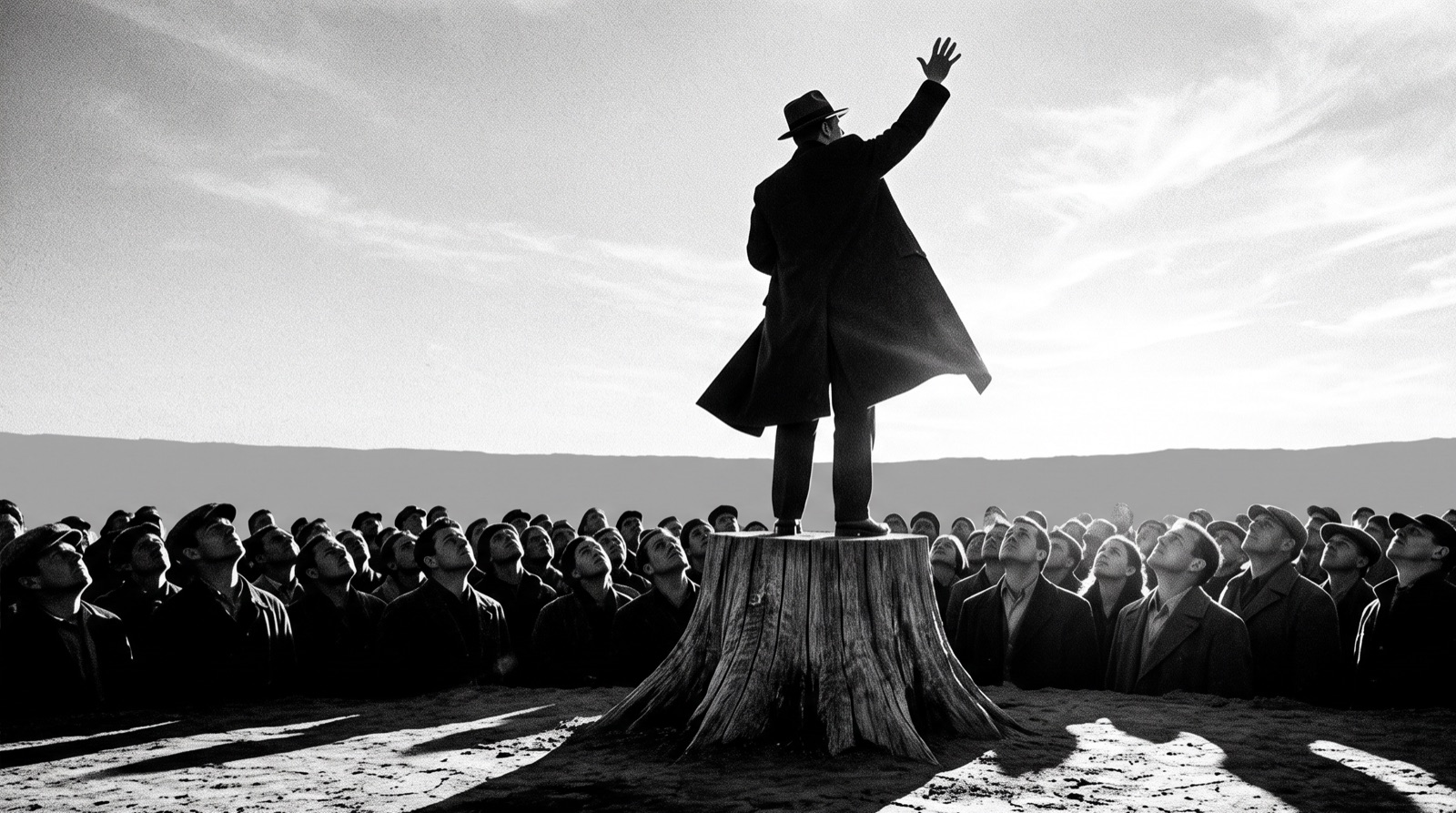
Authority Bias n.
The term is sometimes used interchangeably with obedience, though in decision science authority bias specifically denotes the cognitive mechanism underlying compliance, not the compliance itself.
The definition
Authority bias is the tendency to attribute greater accuracy to the opinion of a perceived authority figure, and to comply with their directives regardless of the quality of the underlying reasoning. Rooted in evolved social-deference hierarchies, it leads individuals to overweight credentials, titles, and status signals when evaluating claims, bypassing independent critical judgement.
The mechanism
Authority bias operates as a cognitive heuristic rather than a deliberate choice. When an individual encounters a title, uniform, credential, or other status signal, the brain shortcuts the effortful process of evaluating an argument on its merits and defers to the apparent source instead, conserving cognitive resources in the process.4 The bias is indifferent to whether the authority's expertise is relevant to the decision at hand: deference is triggered by the status cue itself, not by an assessment of actual domain competence.12
Milgram's foundational 1963 experiments provided the clearest demonstration of the bias's power. In those studies, 65% of participants administered what they believed were 450-volt shocks to another person when instructed to continue by an authority figure in a laboratory coat.1 Blass's 1999 meta-analysis across eight of Milgram's original experiments and multiple cross-cultural replications found average obedience rates of 60 to 65%, confirming that the pattern is a stable human disposition rather than an artefact of a particular era or culture.2
Burger's 2009 replication of the Milgram paradigm, conducted under updated ethical protocols, found contemporary participants showing obedience rates virtually identical to those recorded in 1963, confirming that authority bias is a stable feature of human social cognition rather than a product of any particular historical moment.3 Together, Milgram, Blass, and Burger establish that the bias persists across decades and cultures, a consequence of the heuristic's roots in social cognition rather than in any form of conscious choice.
In practice
Authority bias shapes how senior figures' assessments are received even in expert teams, often without team members noticing their own deference.
Worked example
A project team has spent three weeks developing a technical specification. During the review session, a senior director raises a concern about the core architecture without citing supporting evidence. Despite the team's combined expertise and months of context, the specification is revised to accommodate the director's view. No one asks for the director's reasoning in writing; the title alone carries the decision.
The team's deference was not a rational evaluation of the director's argument, but an automatic response to rank, illustrating authority bias operating below the threshold of conscious deliberation.
Why it matters
Authority bias carries substantial consequences in hierarchical organisations. When subordinates defer reflexively to senior figures, critical feedback is withheld and flawed decisions pass without challenge, creating systemic risk from uncorrected errors.4 The effect is most acute in safety-critical environments: in aviation and medicine, deference to authority has been directly linked to incidents in which qualified subordinates recognised an error but did not voice it.43
Leaders who recognise the distorting effect of authority bias can take deliberate steps to counteract it. Actively soliciting challenge from subordinates, deprioritising rank in decision discussions, and establishing psychological safety are each associated with reducing the suppressive effect of status on group deliberation.43 Structured counter-bias protocols, including devil's advocate roles and pre-mortem exercises, have been adopted in aviation crew resource management and surgical team briefings for the same purpose.4
Questions of record
Is authority bias the same as obedience?
Authority bias and obedience overlap but are distinct concepts. Obedience describes the act of complying with instructions; authority bias describes the cognitive mechanism that makes compliance feel warranted. Authority bias is the heuristic that leads an individual to interpret a directive as credible because of who issued it, not because of what it says.
How does authority bias affect decision-making in leadership teams?
In leadership teams, authority bias causes subordinates to withhold dissent when senior figures express a view, regardless of the view's actual merit. Senior opinions anchor group discussion before critical analysis can occur, and qualified team members suppress objections to avoid perceived conflict with a higher-ranked colleague.
Can authority bias be reduced?
Structured counter-bias protocols reduce the effect in practice. Devil's advocate roles, pre-mortem exercises, and explicit rank-neutral discussion norms interrupt the automatic compliance response. Leaders who deprioritise title when soliciting input and who establish psychological safety for dissent directly reduce the suppressive effect of status on group deliberation.
What signals trigger authority bias?
Authority bias is triggered by status cues: titles, credentials, and uniforms are sufficient to activate deference, even when the authority's expertise has no relevance to the decision at hand. The mechanism does not evaluate whether the signalled status is domain-appropriate; the cue alone produces the compliance response.