Social Jet Lag n.
The Munich Chronotype Questionnaire (MCTQ) is the standard instrument for assessing both chronotype and social jet lag in population research.
The definition
Social Jet Lag is the chronic discrepancy between an individual's endogenous circadian clock and the sleep-wake schedule imposed by social obligations such as work or school. Coined by Roenneberg and colleagues, it is quantified as the difference in sleep midpoint between free days and work days, and is most pronounced in evening chronotypes forced to rise early.
The mechanism
The endogenous circadian clock establishes each person's preferred timing for sleep, peak alertness, and hormonal release, a trait called chronotype1. Modern society is anchored to early morning start times that suit morning chronotypes but systematically conflict with those whose biological preference runs later3. The result is a weekly cycle in which evening chronotypes build a sleep deficit across the work week, then compensate by sleeping later on free days, shifting their sleep midpoint by an hour or more.
Social jet lag is measured using the Munich Chronotype Questionnaire (MCTQ) as the absolute difference in sleep midpoint between free days (corrected for accumulated sleep debt) and work days; values above one hour are considered clinically meaningful1. The disruption extends beyond subjective tiredness: peripheral clocks in the liver, muscle, and adipose tissue are reset by feeding and activity cues that shift with the social schedule, disturbing circadian-gated processes including cortisol secretion, glucose metabolism, and immune-cell trafficking3.
A methodological note concerns interpretation: the standard formula conflates true circadian misalignment with weekday sleep restriction, because both contribute to the midpoint shift. Jankowski proposed a sleep-corrected variant (SJLsc)5, though Roenneberg's group contends the correction is unnecessary. The dispute does not invalidate the construct, but it complicates precise attribution of effect sizes to circadian misalignment alone3.
In practice
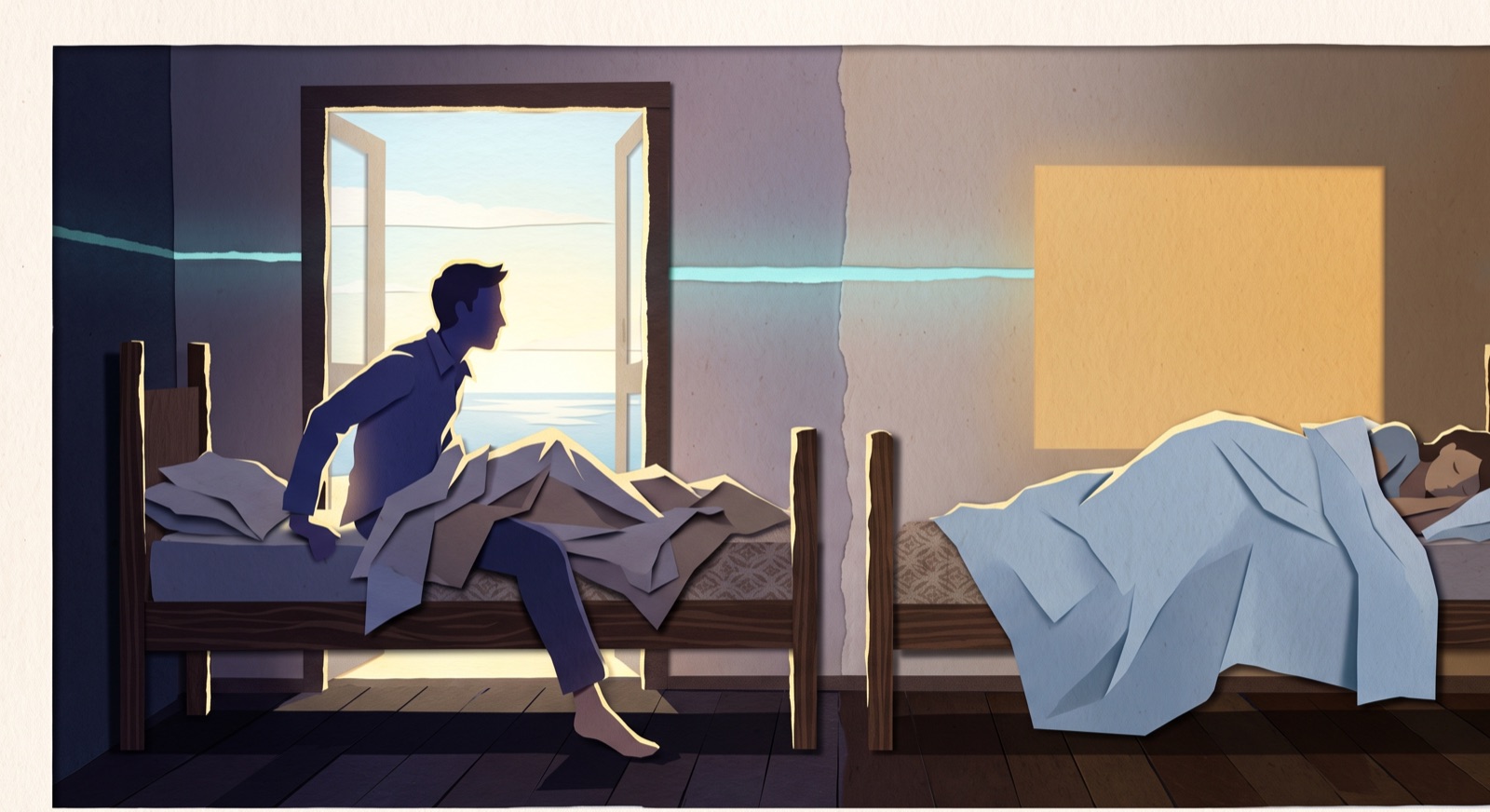
The weekly rhythm of social jet lag is clearest when an individual's biological sleep preference and work schedule sit at opposite ends of the day.
Worked example
A financial analyst whose circadian clock favours sleep from midnight to 08:00 is required on a trading floor by 07:00 five days a week. Each workday begins an hour or more before biological wake time, compressing total sleep and misaligning cortisol and glucose rhythms. Come the weekend, an unconstrained lie-in to 09:00 or 10:00 recalibrates the body clock, only for the cycle to restart Monday.
The recurring reset is the social jet lag loop: chronotype wins on free days, schedule wins on work days, and metabolic coherence never stabilises.
Why it matters
Roenneberg's analysis of over 65,000 adults found each additional hour of social jet lag associated with approximately 33% higher odds of overweight or obesity2, a figure corroborated by a 2024 meta-analysis of 43 studies totalling 231,648 participants, which confirmed positive associations with BMI, fat mass, waist circumference, and obesity risk4. The burden is not uniformly distributed: evening chronotypes, who generate the greatest misalignment under standard schedules, accumulate the largest lifetime exposure13.
The construct has policy implications that extend to institutional schedule design. Shifting work or school start times later by one to two hours could substantially reduce social jet lag for the population's latest chronotypes, with predicted improvements in alertness, mood, and metabolic health3. At the individual level, tracking sleep midpoint across a week of free days versus constrained days provides a practical estimate of circadian misalignment, with a shift greater than one hour signalling a meaningful deficit1.
Questions of record
How is social jet lag different from regular jet lag?
Regular jet lag arises from rapid transmeridian travel and resolves as the body re-synchronises with a new time zone; it is a one-time disruption. Social jet lag is chronic and cyclical: the circadian clock maintains its preferred biological timing while imposed work schedules override it each week, with no travel required and no automatic resolution.
Does social jet lag cause weight gain?
Greater social jet lag correlates with higher BMI, fat mass, and waist circumference across large-scale population data, including a meta-analysis of 43 studies with over 230,000 participants. Each additional hour of misalignment is associated with roughly 33% higher odds of overweight or obesity. Causality is not yet conclusively established, but the association is robust and dose-dependent.
How can you measure or reduce your social jet lag?
Social jet lag is estimated by comparing sleep midpoint on unconstrained free days with sleep midpoint on work days; a difference greater than one hour indicates meaningful misalignment. To reduce it, align obligations with chronotype where possible: negotiate later start times, use morning light to advance wake time, or gradually shift bedtime earlier on work nights.
Is social jet lag just sleep deprivation by another name?
The two overlap but are distinct. Sleep deprivation refers to insufficient total sleep duration; social jet lag refers specifically to the misalignment between circadian timing and the social clock. The debate about whether standard measurement conflates the two is ongoing, but even with sleep quantity controlled for, circadian misalignment shows independent associations with metabolic risk.