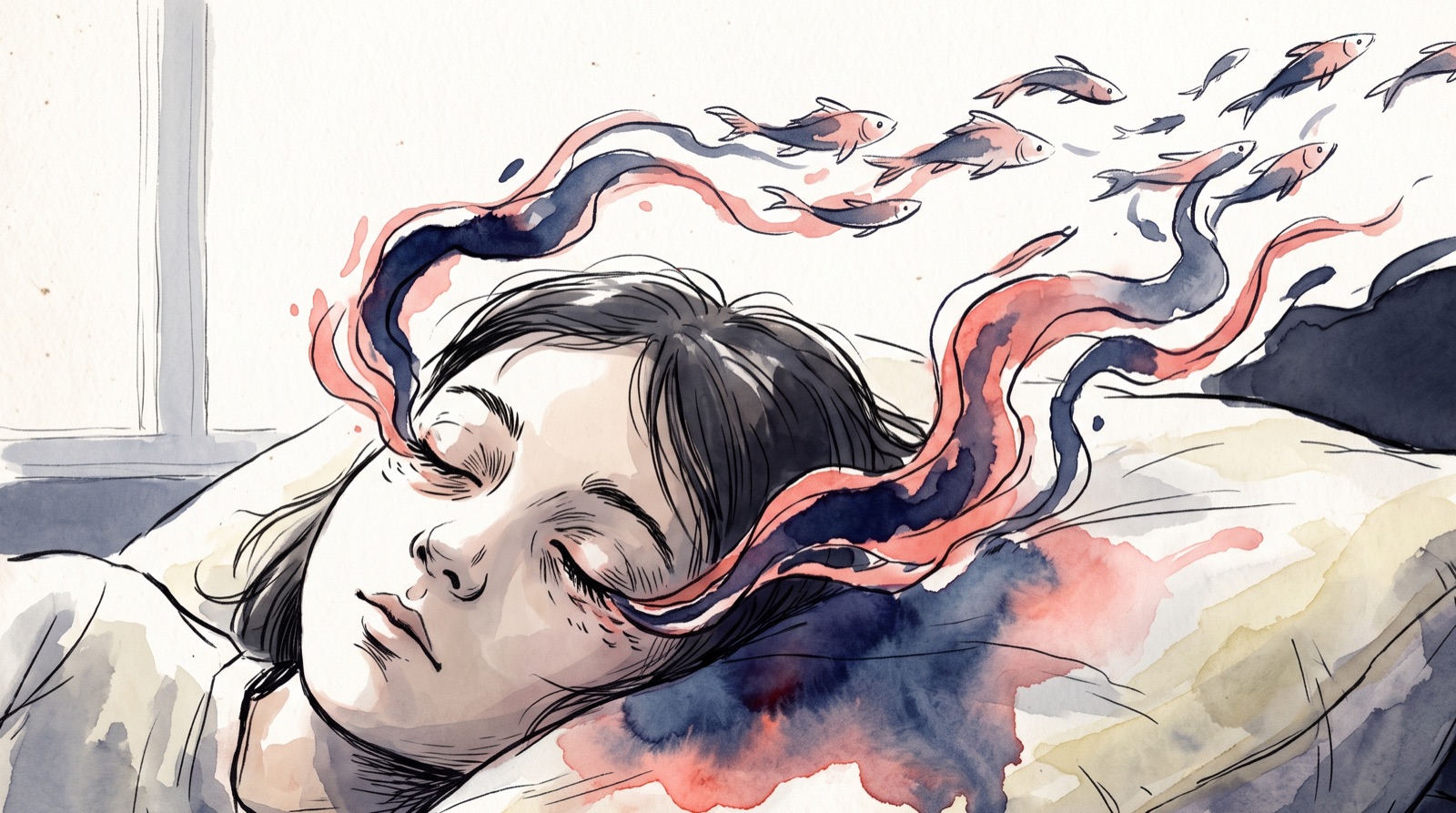
REM sleep n.
Also designated paradoxical sleep, the stage is paradoxical because its brain electrical activity closely resembles wakefulness despite the body being effectively paralysed.
also known as Paradoxical Sleep, Rapid Eye Movement Sleep
The definition
REM sleep is a cyclically recurring sleep stage characterised by rapid eye movements, near-complete skeletal muscle atonia, and brain electrical activity closely resembling wakefulness. Occurring four to six times per night and comprising roughly 20 to 25 per cent of total sleep time in adults, it is the primary stage for emotional memory consolidation, synaptic remodelling, and vivid dreaming.
The mechanism
REM sleep is generated by cholinergic neurons in the pontine tegmentum. Its defining neurochemical signature combines abundant acetylcholine with near-complete suppression of monoamine neurotransmitters, including serotonin, noradrenaline, and histamine3. This configuration distinguishes REM sharply from wakefulness, which uses all four chemical systems, and from NREM sleep, which retains more monoaminergic tone. Electroencephalographic recordings during REM reveal low-amplitude, mixed-frequency activity closely resembling waking patterns; this characteristic earned the stage its alternative designation, paradoxical sleep1.
Within REM, the amygdala, hippocampus, and anterior cingulate cortex are highly active while the dorsolateral prefrontal cortex is relatively suppressed2. This arrangement supports emotional memory processing without the executive filtering that governs waking cognition. Consider it a memory archive running in reduced-censorship mode: affectively significant material is re-processed and consolidated, but without the inhibitory gatekeeping of alert consciousness.
REM episodes recur approximately every 90 minutes through the night and grow longer with each successive cycle; most total REM accrues in the final two hours of an 8-hour sleep opportunity2. Cutting sleep from eight to six hours does not reduce REM by the proportional 25 per cent that arithmetic suggests. It eliminates roughly half of total REM while leaving early-night slow-wave sleep largely undisturbed.
In practice
The distribution of REM across a sleep period has direct consequences for anyone compressing their sleep window.
Worked example
An executive who regularly sleeps six hours instead of eight to extend working time assumes the loss is proportional. In fact, the early NREM-heavy cycles are largely preserved; it is the final two REM-rich hours that vanish. The result is a disproportionate deficit in emotional regulation and memory consolidation, with mood reactivity and impaired recall as the downstream costs.
Shortening sleep from the end of the night, as most schedules do, is effectively a targeted reduction of REM.
Why it matters
A systematic review of human and animal research documents that REM sleep disruption impairs consolidation of emotionally charged memories, heightens pain sensitivity, and elevates reactive aggression4. The mechanism proposed for this emotional processing function is a dual operation: the brain preserves the factual content of distressing experiences while attenuating their emotional charge, a framework sometimes described as 'sleep to forget, sleep to remember'2. When this process is disrupted, the attenuation fails; the resulting unprocessed affective load is implicated in the pathophysiology of post-traumatic stress disorder.
Alcohol, benzodiazepines, and many SSRIs suppress REM sleep acutely4. The subjective sense of sounder sleep that some of these substances produce does not reflect improved architecture; it reflects suppression of the stage most central to emotional and cognitive restoration. For any individual whose performance depends on stable affect, clear memory retrieval, and composed reasoning, protecting REM sleep is not a lifestyle preference. It is a structural requirement.
Questions of record
How much REM sleep do adults need per night?
Healthy adults accrue 20 to 25 per cent of total sleep time in REM, corresponding to roughly 90 to 120 minutes across an 8-hour sleep period. This proportion is not fixed; REM time declines with age and is acutely reduced by alcohol, many sedatives, and sleep restriction.
What happens if you do not get enough REM sleep?
Inadequate REM sleep impairs consolidation of emotionally charged memories, heightens pain sensitivity, and increases reactive aggression. In humans, acute REM disruption reliably degrades emotional processing and mood stability, with downstream effects on decision quality and interpersonal functioning. Animal studies suggest sustained deprivation produces lasting deficits in affective regulation.
Why does alcohol disrupt REM sleep?
Alcohol is a potent REM suppressant. During the first half of a sleep period, when sedative effects are strongest, REM stages are blunted or skipped. As the alcohol is metabolised in the second half, a rebound of lighter, fragmented sleep follows. The net result is reduced total REM and impaired sleep quality despite the ease of falling asleep.
What is the difference between REM and deep sleep?
Deep sleep, or slow-wave sleep, occurs predominantly in the first half of the night and is characterised by high-amplitude delta waves, physical restoration, and immune support. REM sleep, concentrated in the final hours, features near-waking brain activity, muscle paralysis, and emotional memory consolidation. The two stages serve complementary but distinct functions.
Appears in
- Sleep cyclesGlossary