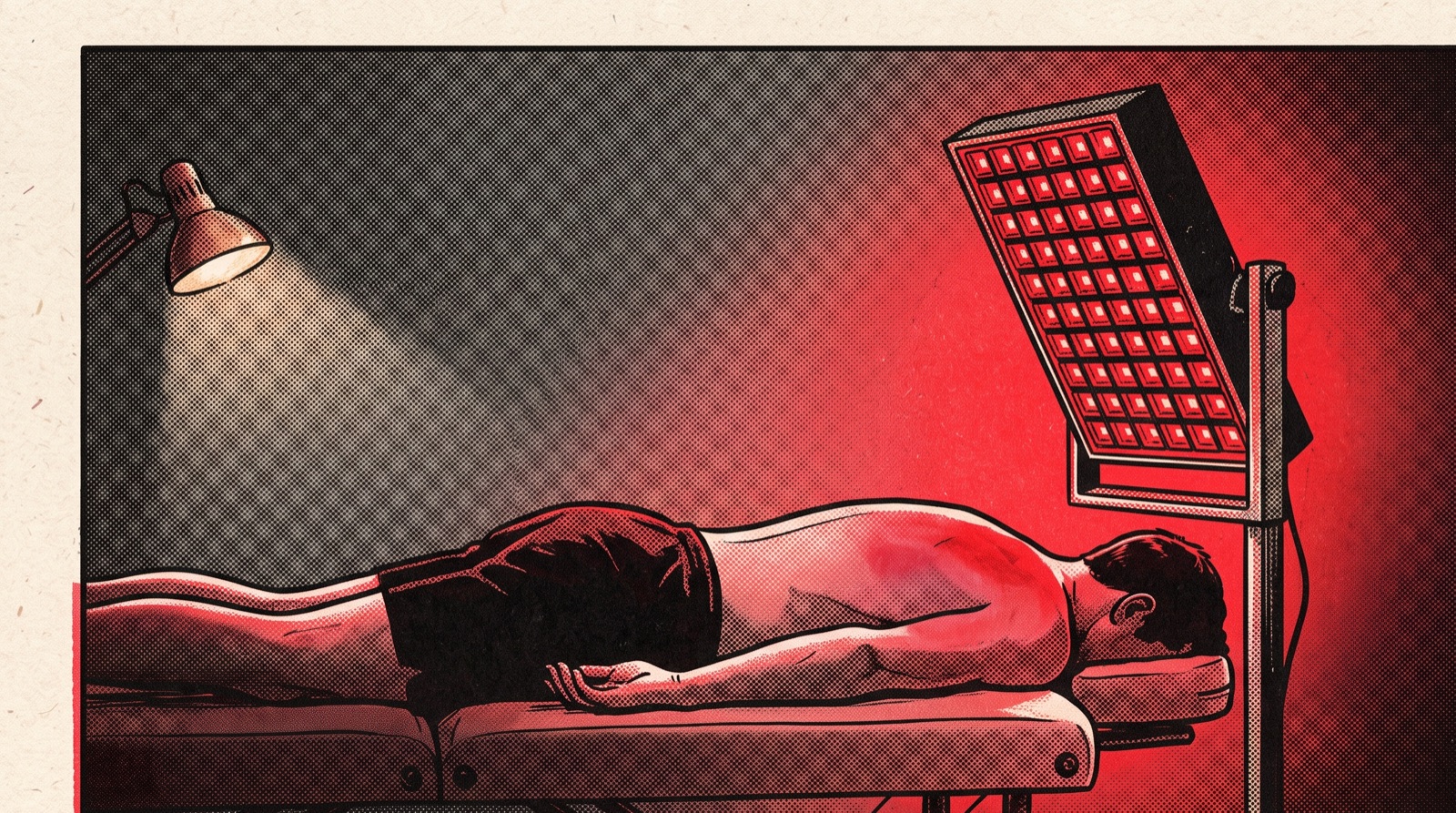
Red Light Therapy n.
Commercially, the term is sometimes applied to any visible-red LED device; technically, it denotes specific therapeutic wavelengths within the 630–950 nm optical window.
also known as Photobiomodulation, PBM
The definition
Red Light Therapy is the clinical application of red (630–670 nm) and near-infrared (810–850 nm) wavelengths to stimulate cellular energy production. Photons are absorbed by cytochrome c oxidase in the mitochondrial electron transport chain, increasing ATP synthesis and modulating reactive oxygen species and nitric oxide; these cascading signals activate transcription factors that support tissue repair and attenuate inflammation.
9 J/cm²
red-light dose producing significant collagen density increase in controlled trial
WUNSCH & MATUSCHKA · 20145
The mechanism
Photobiomodulation's primary mechanism operates through a single photoacceptor: cytochrome c oxidase (Complex IV of the mitochondrial electron transport chain). When red or near-infrared photons are absorbed by the enzyme's copper and haem centres, the mitochondrial redox state shifts, electron transfer accelerates, and ATP synthesis increases12. Think of cytochrome c oxidase as a molecular throttle: photon absorption releases a physiological brake, allowing the respiratory chain to run at higher efficiency without additional substrate.
Downstream of the photoacceptor, a controlled burst of reactive oxygen species, elevated nitric oxide, and increased intracellular calcium act as secondary messengers2. These activate transcription factors including NF-kB and AP-1, driving gene expression changes that promote cell survival, proliferation, and reduced inflammatory signalling. The same cascade that makes photobiomodulation useful for tissue repair also explains its dose sensitivity: the signalling molecules that trigger recovery at low concentrations become inhibitory at excess fluences.
Effective photobiomodulation depends on wavelength selection and dose calibration. The therapeutic optical window spans 630–950 nm: wavelengths below 630 nm are absorbed by haemoglobin and melanin before reaching target tissue; wavelengths above 950 nm are absorbed by water, limiting penetration depth2. Within this window, the biphasic dose response governs outcome: fluences of 1–10 J/cm² are stimulatory, while higher fluences suppress cellular activity2. Irradiance, session duration, and anatomical target site each determine where on that curve a given exposure falls.
In practice
The pre-exercise application of red light therapy illustrates how the photobiomodulation mechanism translates into measurable performance outcomes.
Worked example
An athlete applies a near-infrared panel to their quadriceps for several minutes before a resistance session. Over multiple weeks of this protocol, blood markers of muscle damage (creatine kinase) are lower after training, lactate accumulation is attenuated, and the athlete sustains output longer before reaching exhaustion. No ergogenic drug or supplement is involved: the preconditioning effect operates through the mitochondrial pathway activated during the irradiation window.
The reduction in damage markers and extended time to exhaustion align with the mitochondrial preconditioning effect measured across randomised resistance and endurance trials3.
Why it matters
The clinical case for photobiomodulation has broadened substantially as meta-analytic evidence accumulates. An umbrella review synthesising randomised controlled trial evidence found clinically meaningful benefits for fibromyalgia, osteoarthritis-related disability, and cognitive impairment, with musculoskeletal applications showing the strongest evidence quality4. For performance-oriented users, the practical implication is selectivity: the applications with the most robust evidence are musculoskeletal (pre-exercise conditioning, post-exercise recovery) and dermatological (collagen density, wound healing). Consumer claims that extend beyond these applications carry greater evidential uncertainty.
The field's central constraint is not efficacy but standardisation. Device parameters (wavelength, power density, pulse frequency, session duration, anatomical placement) vary so substantially across studies that pooling results is methodologically contentious4. A consumer purchasing a photobiomodulation device therefore faces a translation problem: the dose that generated the clinical result may differ meaningfully from what the product delivers. Attending to fluence (energy density, measured in J/cm²), wavelength specification, and anatomical target converts a general-purpose light purchase into a protocol-calibrated intervention.
Questions of record
What wavelength is most effective for red light therapy?
The 630–670 nm range (visible red) and 810–850 nm range (near-infrared) are the best-evidenced therapeutic bands. Both drive cytochrome c oxidase activation; near-infrared wavelengths penetrate tissue more deeply than visible red, making them more suitable for musculoskeletal targets beneath the skin12.
Can red light therapy reduce inflammation?
Photobiomodulation's secondary messenger cascade, particularly the modulation of nitric oxide and transcription factor NF-kB, produces downstream anti-inflammatory gene expression changes2. Umbrella review evidence supports meaningful benefits for inflammatory conditions including fibromyalgia and osteoarthritis, though evidence quality varies by condition and dose used4.
Does red light therapy improve athletic recovery?
Pre-exercise photobiomodulation applied to skeletal muscle reduces creatine kinase release, attenuates lactate accumulation, and extends time to exhaustion in randomised trials across resistance and endurance protocols3. The effect is attributed to mitochondrial preconditioning: higher baseline ATP availability buffers the metabolic demands of intense exercise.
How long does a red light therapy session need to be?
Session duration depends on the device's irradiance and the target fluence. A controlled skin trial achieving significant collagen improvement used approximately 9 J/cm² per session across 30 twice-weekly sessions5. At therapeutic irradiance levels, this translates to sessions of several minutes; lower-powered consumer devices require proportionally longer exposure to reach equivalent dose.