Growth Hormone n.
The term 'human growth hormone' (HGH) is commonly used in lay contexts but refers to the same molecule; clinically, 'GH' is the standard abbreviation.
also known as GH, HGH, somatotropin
The definition
Growth Hormone is a polypeptide of 191 amino acids, synthesised by somatotroph cells of the anterior pituitary and released in discrete pulsatile bursts. The largest of these bursts coincides with the first slow-wave sleep episode. It stimulates the liver to produce insulin-like growth factor 1 (IGF-1), which mediates anabolic effects on muscle, bone, and connective tissue.
The mechanism
A push-pull axis governs GH secretion: hypothalamic growth hormone-releasing hormone (GHRH) drives pulsatile release from pituitary somatotrophs, while somatostatin provides tonic inhibition between pulses.2 Ghrelin, the hunger-signalling peptide produced primarily in the gut, acts as a third input that amplifies the GHRH signal and increases burst amplitude. The result is a series of discrete secretory events distributed across the 24-hour day, with inter-pulse troughs approaching zero.
In adults, somatotroph cells secrete approximately 70% of the day's total GH during nocturnal sleep, with the dominant pulse arriving within the first hour of sleep onset, timed to the first slow-wave (NREM stage 3) episode.1 Because this pulse depends on slow-wave sleep onset, any factor that delays or curtails slow-wave sleep, including alcohol consumed in the evening, late bedtimes, or sleep restriction, reduces GH output proportionally for that night.
Once released into circulation, GH acts through two mechanisms. The liver converts GH signalling into IGF-1 secretion, which feeds back to suppress further GH release at both pituitary and hypothalamic levels, forming a closed negative feedback loop.2 GH also acts directly on peripheral tissues via GH receptor binding: in adipose tissue it mobilises free fatty acids; in skeletal muscle it augments amino acid uptake and protein synthesis.3
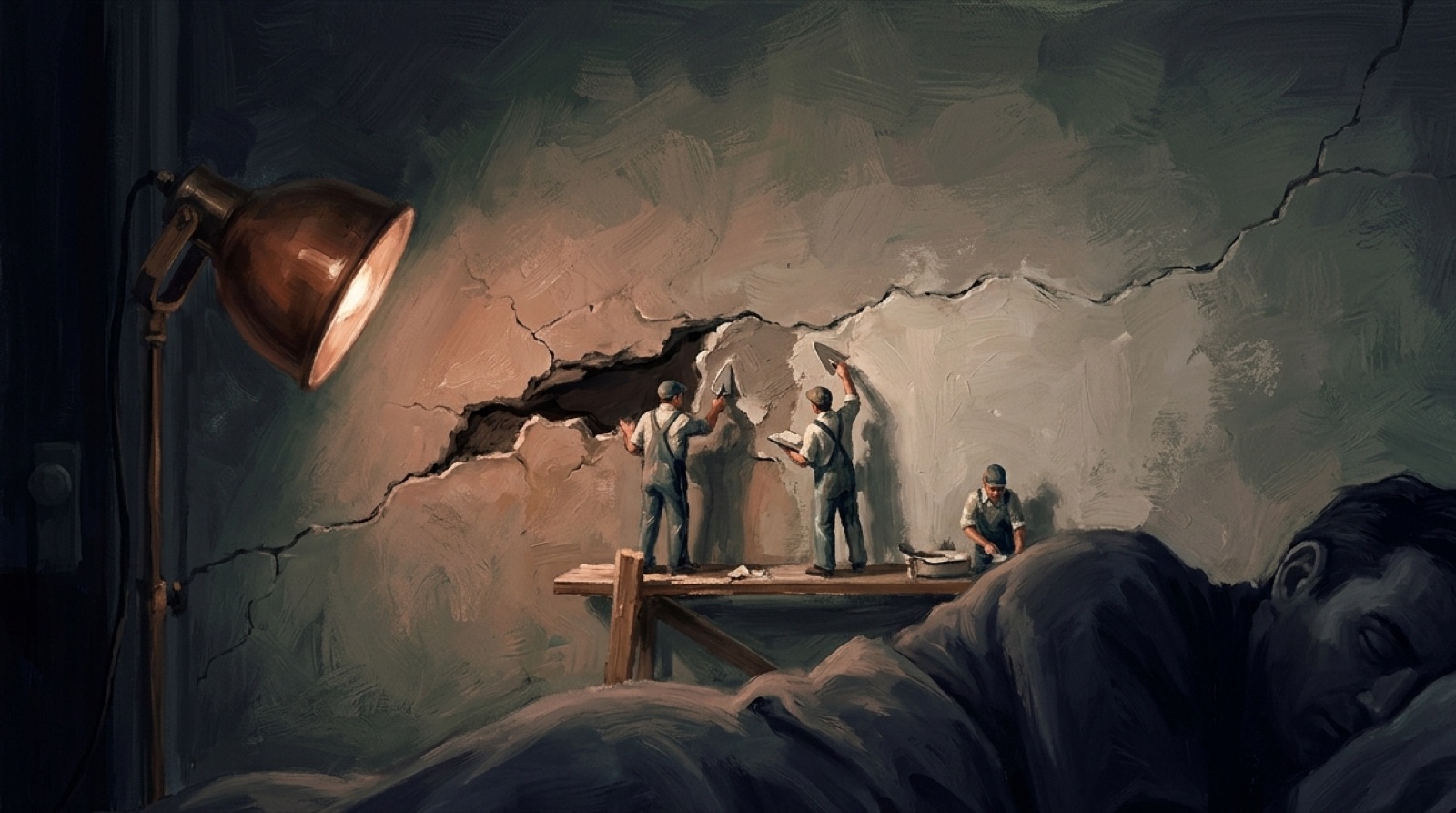
Nocturnal Pulse — Growth hormone is released in pulses — the largest in the first deep-sleep cycle of the night.
In practice
The sleep-dependence of GH release becomes consequential when life compresses the window available for deep sleep.
Worked example
Consider a recreational athlete training five mornings a week. On nights when work or social commitments push bedtime past midnight, the first slow-wave episode either arrives late or is shortened. The dominant GH pulse, which would ordinarily fire within the first hour of sleep onset, diminishes or fails to reach its normal amplitude. Muscle fibres stressed during training receive less anabolic signal, and full metabolic recovery spills into the following day.
Sleep architecture determines nocturnal GH output more directly than training volume or nutritional timing.
Why it matters
GH secretion declines progressively from the third decade of life, a phenomenon termed the somatopause. Van Cauter et al. demonstrated that men lose roughly 75% of slow-wave sleep between the ages of 25 and 45, with a near-parallel decline in nightly GH output.1 The downstream effects include increasing visceral adiposity, declining lean mass, and reduced bone mineral density.3 For performance-focused adults, this trajectory means that the recovery capacity available at 40 is substantially below what it was at 25, even when training load is held constant.
The popular notion that exogenous GH can compensate for this decline or meaningfully boost performance in healthy adults does not hold up under scrutiny. A systematic review of over 200 GH-treated individuals found that exogenous GH increased lean body mass by an average of 1.8 kg but produced no improvement in muscle strength, aerobic capacity, or sprint performance.4 Oedema, arthralgia, and insulin resistance were common side effects. Protecting the conditions for natural GH release, principally deep sleep, is both more effective and lower-risk than pharmacological supplementation.
Questions of record
How does sleep affect growth hormone release?
Around 70% of the day's GH is secreted during nocturnal sleep, with the largest pulse timed to the first slow-wave (NREM stage 3) episode. Chronic sleep restriction reduces total GH output substantially. Even a single night of curtailed sleep blunts the nocturnal surge, slowing tissue repair and metabolic recovery.
What stimulates growth hormone secretion?
The pituitary's somatotrophs respond primarily to GHRH from the hypothalamus, which triggers pulsatile GH bursts. Ghrelin amplifies these bursts, while somatostatin keeps inter-pulse concentrations low. Sleep onset, intense exercise, and fasting each stimulate GH release, with the slow-wave sleep pulse being the largest of the day.
Does growth hormone build muscle or boost athletic performance?
Not as effectively as commonly believed. A systematic review of exogenous GH in healthy adults found it increased lean mass by 1.8 kg on average but produced no improvement in strength, aerobic capacity, or sprint performance. Oedema and insulin resistance were common side effects. Exercise-induced GH spikes also offer no performance benefit beyond the training stimulus itself.
What happens to growth hormone levels as you age?
GH secretion declines progressively from the third decade of life, a process called the somatopause. Slow-wave sleep also diminishes with age, directly reducing the primary secretory window. By mid-life, nightly GH output may be a fraction of what it was at 20, correlating with increased visceral fat, reduced lean mass, and slower tissue repair.