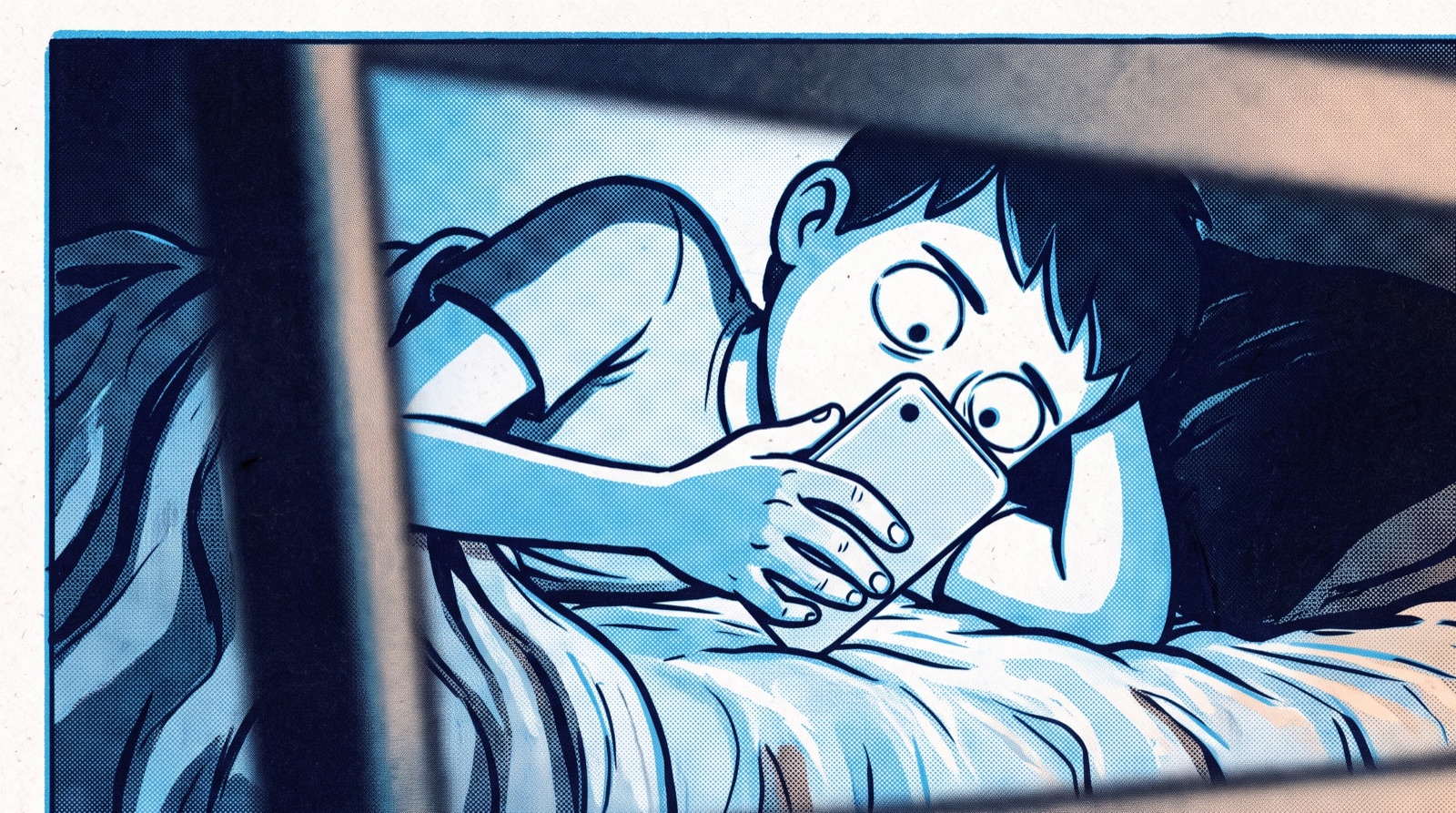
Blue light n.
Morning blue-light exposure has the opposite effect: it anchors the circadian clock earlier and reinforces daytime alertness, making it a tool in chronotherapy and sports-performance protocols.
The definition
Blue light is short-wavelength visible radiation occupying the 460–480 nanometre band of the electromagnetic spectrum. It preferentially activates melanopsin (OPN4), the photopigment in intrinsically photosensitive retinal ganglion cells, which signal the suprachiasmatic nucleus to suppress pineal melatonin output and reset the circadian clock, making evening exposure the principal light-based disruptor of human sleep.
The mechanism
The human circadian system is maximally sensitive to light at 459–480 nm, a finding established independently by Brainard et al. and Thapan et al. in landmark action-spectrum studies12. At these wavelengths, light activates melanopsin (OPN4), the photopigment expressed in intrinsically photosensitive retinal ganglion cells (ipRGCs). These cells differ from rod and cone photoreceptors: they respond directly to light without relaying signals through conventional visual pathways. Instead, they project via the retinohypothalamic tract to the suprachiasmatic nucleus (SCN), the brain’s master circadian pacemaker, where elevated blue-light input suppresses melatonin synthesis in the pineal gland and resets the clock’s timing.
The real-world magnitude of this effect became clear when Chang et al. demonstrated that using a light-emitting eReader for four hours each evening suppressed melatonin and delayed the circadian melatonin onset by approximately 1.5 hours compared with reading a printed book under dim light3. The effect persisted into the following morning: participants who had used the eReader reported feeling less alert despite spending the same total time in bed. A 2022 systematic review confirmed that blue-light exposure increases sleep latency in nearly half of controlled studies and reduces sleep duration in approximately one-third, while also noting that daytime exposure sharpens alertness and cognitive performance5.
Melatonin Suppression — Evening blue light suppresses melatonin — the brighter and bluer the exposure, the more sleep is delayed.
In practice
The pattern appears routinely in competitive sport, where high-intensity evening training is followed by extended screen time before bed.
Worked example
A competitive athlete finishes training at 8 pm and spends 90 minutes reviewing match footage on a bright laptop before bed. The screen’s blue-wavelength output suppresses melatonin throughout. By the time sleep arrives, the circadian clock has shifted later; REM sleep is compressed in the first half of the night, and the athlete wakes feeling under-recovered despite eight hours in bed.
Blue-light suppression does not register as wakefulness in the moment; it shows up as next-morning sluggishness, which is why the habit is consistently underestimated.
Why it matters
The stakes centre on sleep architecture, not merely sleep onset. Chang et al. documented reduced REM sleep and impaired morning alertness even after eight hours in bed following evening eReader use3. For an athlete or executive whose recovery and decision quality depend on sleep depth, a 1.5-hour circadian delay is not a nuisance; it is a structural tax on performance levied every night the habit continues. The dual nature of blue light compounds the problem: evening screen use feels acutely energising because blue light genuinely raises alertness5, which obscures the downstream cost until a sleep deficit accumulates.
Evidence for mitigation is encouraging. Shechter et al. found that wearing amber (blue-light-blocking) lenses for two hours before bedtime significantly improved sleep quality, total sleep time, and wellbeing over seven nights in a randomised crossover trial4. Amber lenses, screen night-mode filters, and warm-toned evening lighting all reduce blue-wavelength output and blunt the melatonin-suppressing signal. Morning exposure, deliberately timed, converts the same biological sensitivity into a tool for anchoring the circadian clock earlier5.
Questions of record
How does blue light suppress melatonin?
Blue light at 460–480 nm activates melanopsin (OPN4), the photopigment in intrinsically photosensitive retinal ganglion cells12. These cells project via the retinohypothalamic tract to the suprachiasmatic nucleus, which reduces pineal melatonin output. The sensitivity peaks in the evening when melatonin would otherwise begin rising in preparation for sleep.
What wavelength of blue light most disrupts sleep?
The human circadian system is maximally sensitive to light in the 459–480 nm range, as established by independent action-spectrum studies12. Wavelengths in this narrow band carry the highest melatonin-suppressing potency; light outside this range, even at equal intensity, has considerably less effect on the circadian clock.
Do blue light glasses actually work for sleep?
A randomised crossover trial found that wearing amber (blue-light-blocking) lenses for two hours before bedtime improved sleep quality, total sleep time, and wellbeing over seven nights4. Evidence at scale remains mixed5, so amber lenses are best treated as one component of a broader low-light evening routine rather than a standalone solution.
How long before bed should you avoid blue light?
Two hours before bedtime is the most consistently used window in controlled trials4. The circadian delay evidence suggests that even shorter windows carry benefit: a four-hour evening eReader session shifts melatonin onset by 1.5 hours3, so the response scales with exposure duration.