BDNF n.
A precursor form, pro-BDNF, has opposing effects: it binds the p75NTR receptor to promote synaptic depression rather than potentiation.
also known as brain-derived neurotrophic factor
The definition
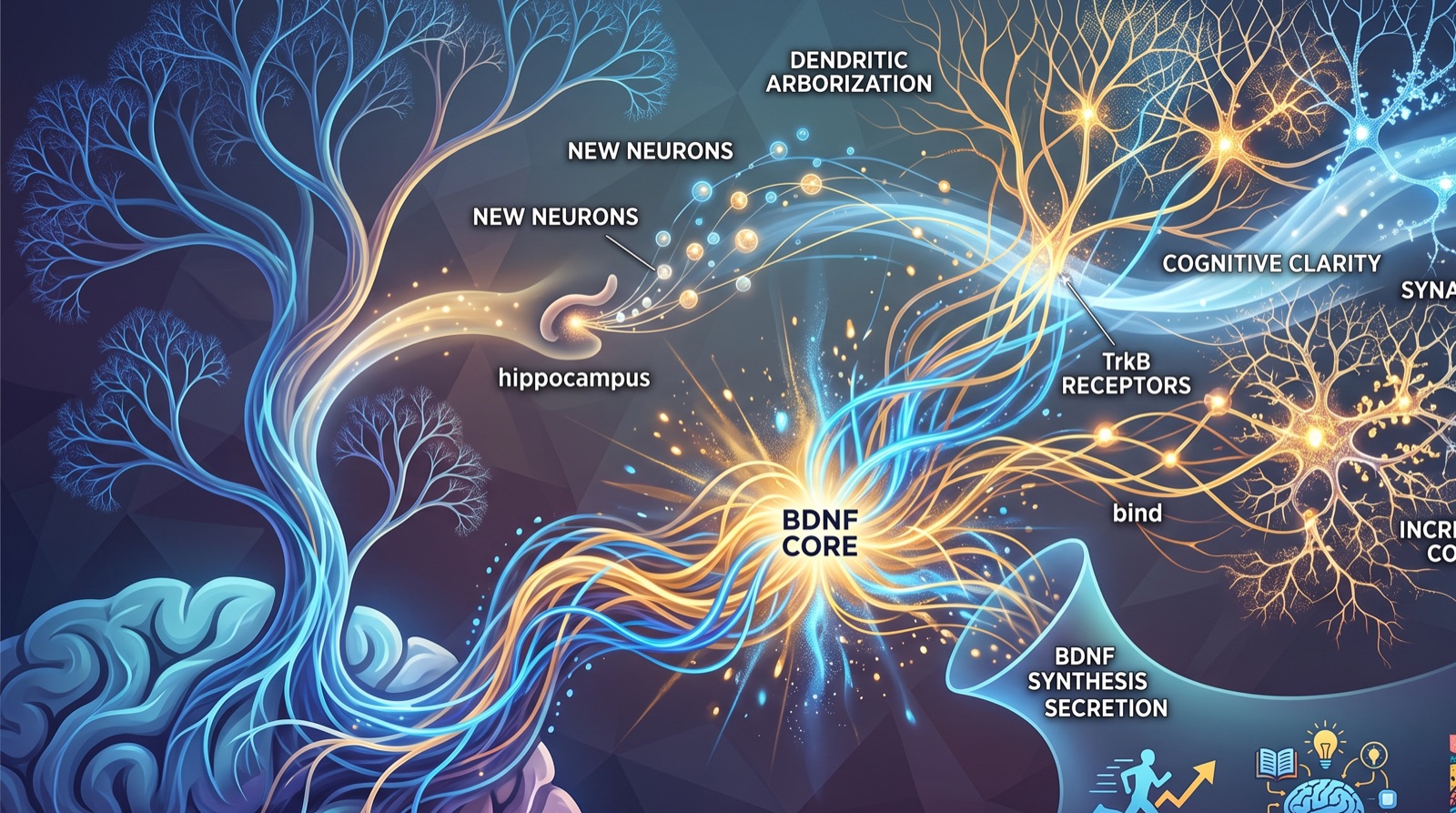
BDNF (brain-derived neurotrophic factor) is a protein of the neurotrophin family produced primarily in the hippocampus, cortex, and basal forebrain. It binds TrkB receptors to promote neuronal survival, stimulate synaptic plasticity, and support adult neurogenesis. Aerobic exercise, learning, and quality sleep upregulate BDNF expression; chronically low levels are linked to depression and accelerated cognitive decline.
The mechanism
BDNF was first purified from pig brain in 1982 and belongs to the neurotrophin family alongside nerve growth factor (NGF), neurotrophin-3, and neurotrophin-41. The mature protein signals primarily through the TrkB receptor, a high-affinity tyrosine kinase. Binding activates the MAPK/ERK and PI3K/Akt signalling cascades, which promote neuronal survival, dendritic spine growth, and long-term potentiation (LTP)2. A low-affinity receptor, p75NTR, preferentially binds the precursor form (pro-BDNF) and mediates opposite outcomes: synaptic depression and apoptosis.
In the hippocampal dentate gyrus, BDNF is a central regulator of adult neurogenesis, governing the survival and integration of newly born neurons24. Think of BDNF as the maintenance budget for the brain's most plastic real estate: without adequate levels, new cells fail to take hold, episodic memory consolidation suffers, and stress resilience erodes.
Expression is not fixed. Aerobic exercise, caloric restriction, and cognitive enrichment all upregulate BDNF; chronic stress, high-fat diets, and sleep deprivation suppress it23. This bidirectional sensitivity makes BDNF a dynamic readout of lifestyle load rather than a static genetic endowment, and a practical target for behavioural intervention.
In practice
The practical significance of BDNF becomes clear when considering what consistent aerobic training does to the brain over weeks.
Worked example
A recreational athlete completes three 30-minute aerobic sessions per week for eight weeks. By week four, subjective recall accuracy on morning memory assessments improves noticeably. By week eight, resting serum BDNF has risen above baseline. No pharmaceutical intervention was involved; the training protocol itself shifted the neurochemical environment that underlies learning and memory consolidation.
The training load, not a drug, altered the brain's growth-factor environment.
Why it matters
BDNF deficiency sits at the intersection of mood disorders, cognitive ageing, and neurodegeneration. In major depressive disorder, circulating BDNF is consistently reduced; effective treatments including SSRIs, aerobic exercise, and ketamine converge on restoring BDNF/TrkB signalling, lending weight to the neurotrophic hypothesis of depression4. Beyond mood, declining BDNF expression is implicated in Alzheimer's disease, Parkinson's disease, and Huntington's disease, suggesting that low BDNF is not merely a correlate of impaired cognition but a contributing factor2.
Genetic variation adds another dimension. Carriers of the Val66Met polymorphism (rs6265) in the BDNF gene show impaired activity-dependent secretion, reduced hippocampal volume, and worse episodic memory performance than Val/Val homozygotes, according to a broad neurobiological review2. For practitioners working on performance or resilience, the finding underscores a practical asymmetry: genetics sets a floor, but lifestyle factors (exercise load, sleep quality, dietary composition) determine how much of the ceiling is reached.
Questions of record
How does exercise increase BDNF in the brain?
Aerobic exercise upregulates BDNF gene expression in the hippocampus and cortex, increasing both local brain and circulating serum levels3. A meta-analysis of 29 studies confirmed that a single 20-40 minute moderate-to-vigorous bout produces an acute measurable rise; regular training further amplifies this response, establishing a dose-response relationship.
What happens when BDNF levels are chronically low?
Chronically low BDNF is consistently observed in major depressive disorder and is implicated in neurodegeneration in Alzheimer's, Parkinson's, and Huntington's diseases42. Reduced BDNF/TrkB signalling impairs hippocampal neurogenesis, compromising episodic memory consolidation and stress resilience. Effective antidepressant treatments, including SSRIs and exercise, restore this pathway.
Why is BDNF called Miracle-Gro for the brain?
The 'Miracle-Gro' label is a popular analogy for BDNF's role in neuronal survival, dendritic growth, and hippocampal neurogenesis. Just as fertiliser sustains plant growth, BDNF maintains structural conditions for learning and memory. It is an accessible heuristic used in popular science communication, not a precise scientific designation.
Can you boost BDNF without exercise?
Yes. Sleep quality, caloric restriction, and cognitive enrichment all upregulate BDNF expression2. Antidepressant medications including SSRIs also restore BDNF/TrkB signalling4. Aerobic exercise remains the most robustly evidenced behavioural strategy, but sleep optimisation and dietary modification are meaningful alternatives for those with exercise limitations.
Appears in
- NeuroplasticityGlossary