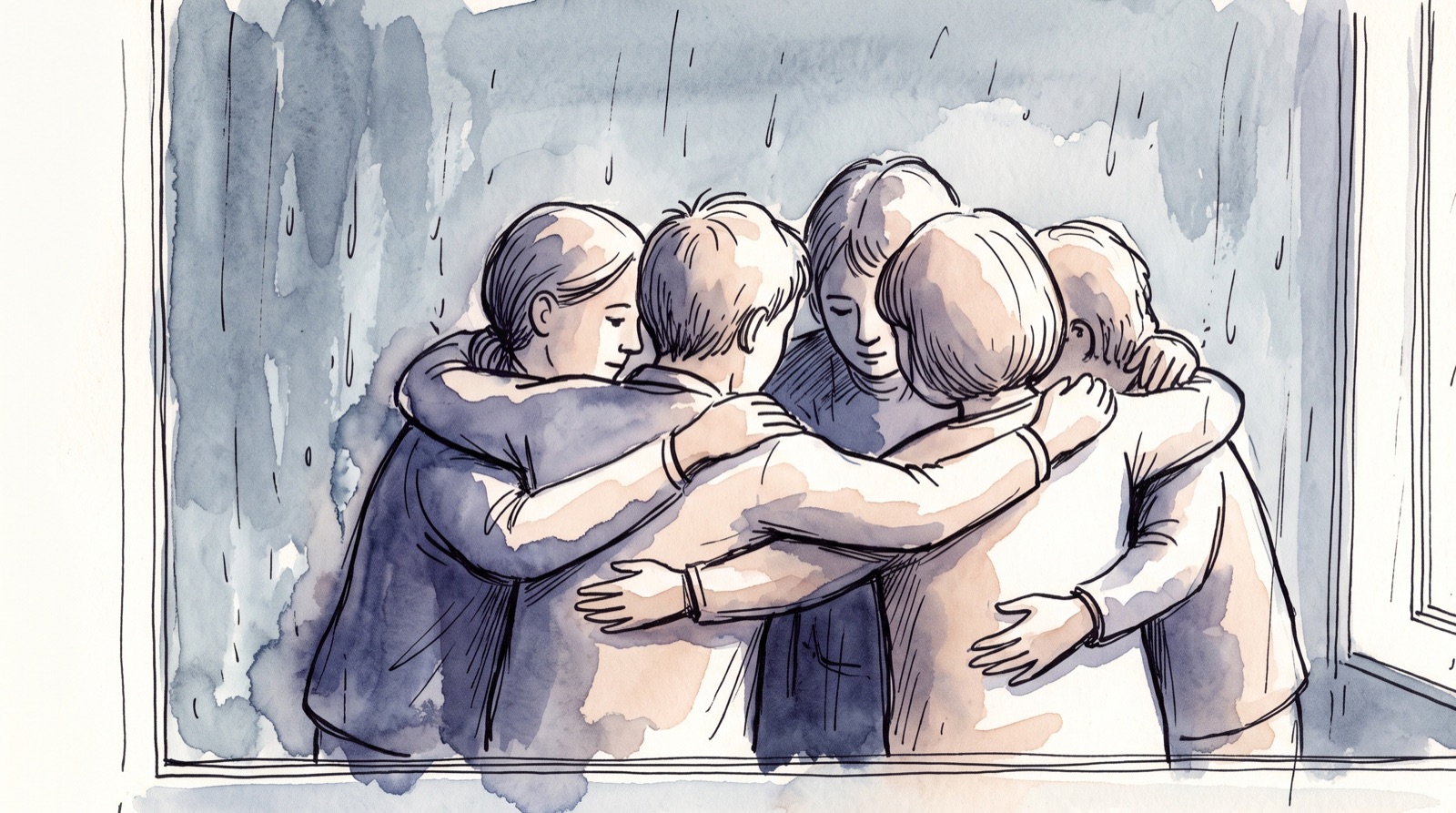
Tend-and-Befriend n.
The sex-difference framing describes a statistical tendency, not a biological absolute; socialisation and attachment history shape whether the response manifests in any given individual.
The definition
Tend-and-Befriend is a stress-response pattern, first described by Shelley Taylor and colleagues, in which individuals under threat respond by nurturing dependants and seeking social alliances rather than fighting or fleeing. Driven by oxytocin amplified by oestrogen, the pattern is expressed more strongly in females and represents an evolved alternative to the fight-or-flight axis.
The mechanism
Under acute stress, the hypothalamic-pituitary-adrenal axis elevates cortisol alongside a simultaneous release of oxytocin. In females, oestrogen potentiates oxytocin receptor binding, shifting the behavioural output away from aggression and towards affiliative caregiving and social approach.12 Testosterone and vasopressin, by contrast, are associated with male stress responses that bias towards territorial defence and fight-or-flight activation.1
Oxytocin dampens amygdala reactivity, reduces fear, and promotes social-approach behaviours, forming the neuroendocrine core of both tending (protective caregiving) and befriending (alliance-building) under stress.24 A laboratory study demonstrated that stress-induced oxytocin reactivity predicted greater support-seeking behaviour across a two-week diary period, providing direct physiological evidence for the link between the hormone and tend-and-befriend responses in humans.4
Taylor and colleagues proposed tend-and-befriend as an evolutionary adaptation shaped by the particular vulnerabilities of pregnant and lactating females.1 Sustained fight-or-flight activation carries high energetic costs and risks injury; keeping offspring close and embedding within a protective social group offered superior survival odds at lower physiological cost.12 Attachment history also moderates expression of the response: securely attached individuals show more robust affiliative reactions to stress, while anxious or avoidant attachment suppresses them.3
In practice
The tend-and-befriend pattern becomes visible when a performance environment generates acute competitive pressure for a group of female athletes.
Worked example
A team preparing for a high-stakes regional competition encounters a series of setbacks in the final training week: an injury to a key player, a change in schedule, and a difficult exchange with coaching staff. Rather than withdrawing or intensifying individual preparation in isolation, the female athletes spontaneously increase physical contact, check in on each other, and consolidate around shared preparation routines, redistributing attention and energy toward the group.
The social consolidation is not a distraction from preparation; it is an evolved stress-management circuit lowering cortisol reactivity through social buffering.
Why it matters
Tend-and-Befriend challenged a foundational assumption in stress physiology: that fight-or-flight represented the universal human stress response. Because the canonical stress literature was built predominantly on male subjects, female response patterns were systematically underdescribed.1 Recognising sex-differentiated stress biology carries clinical consequences for anxiety, post-traumatic stress disorder, and occupational burnout; treatment and management frameworks calibrated on a male stress model may be poorly suited to the majority of the affected population.
At the performance level, social support is not merely a psychological comfort; befriending behaviour is associated with attenuated cortisol output and reduced sympathetic arousal.2 High-performance environments that cultivate peer cohesion and team-based support structures may activate the tend-and-befriend circuit in female competitors, sustaining performance quality under competitive pressure. The response is not a vulnerability to be engineered out of competitive settings; it is a physiological resource.
Questions of record
What triggers the tend-and-befriend response?
The response is triggered by acute psychological or physical threat. Under stress, the hypothalamic-pituitary-adrenal axis releases cortisol alongside oxytocin; in females, oestrogen amplifies oxytocin receptor binding.12 The combined neuroendocrine signal promotes caregiving towards dependants and social affiliation with allies rather than fight or flight.
Is tend-and-befriend only found in women?
Tend-and-befriend describes a sex-differentiated tendency rather than a strict binary. Male stress responses are more consistently biased towards fight-or-flight via testosterone and vasopressin.1 Some males exhibit affiliative responses under stress, and attachment style moderates expression in both sexes,3 but the pattern is most robustly observed in females.
How does oxytocin drive the tend-and-befriend response?
Oxytocin acts on the amygdala to reduce fear responses and promote social-approach behaviour.2 A laboratory study confirmed that stress-induced oxytocin reactivity predicted greater support-seeking over the following two weeks,4 providing direct physiological evidence for the link between the hormone and the affiliative stress response.
What is the difference between tend-and-befriend and fight-or-flight?
Fight-or-flight mobilises the body for confrontation or escape: heart rate rises, glucose is released, and social engagement decreases. Tend-and-befriend mobilises the affiliative system instead: oxytocin promotes caregiving and alliance-seeking, cortisol reactivity is attenuated by social support, and threat is managed through group rather than individual resources.1