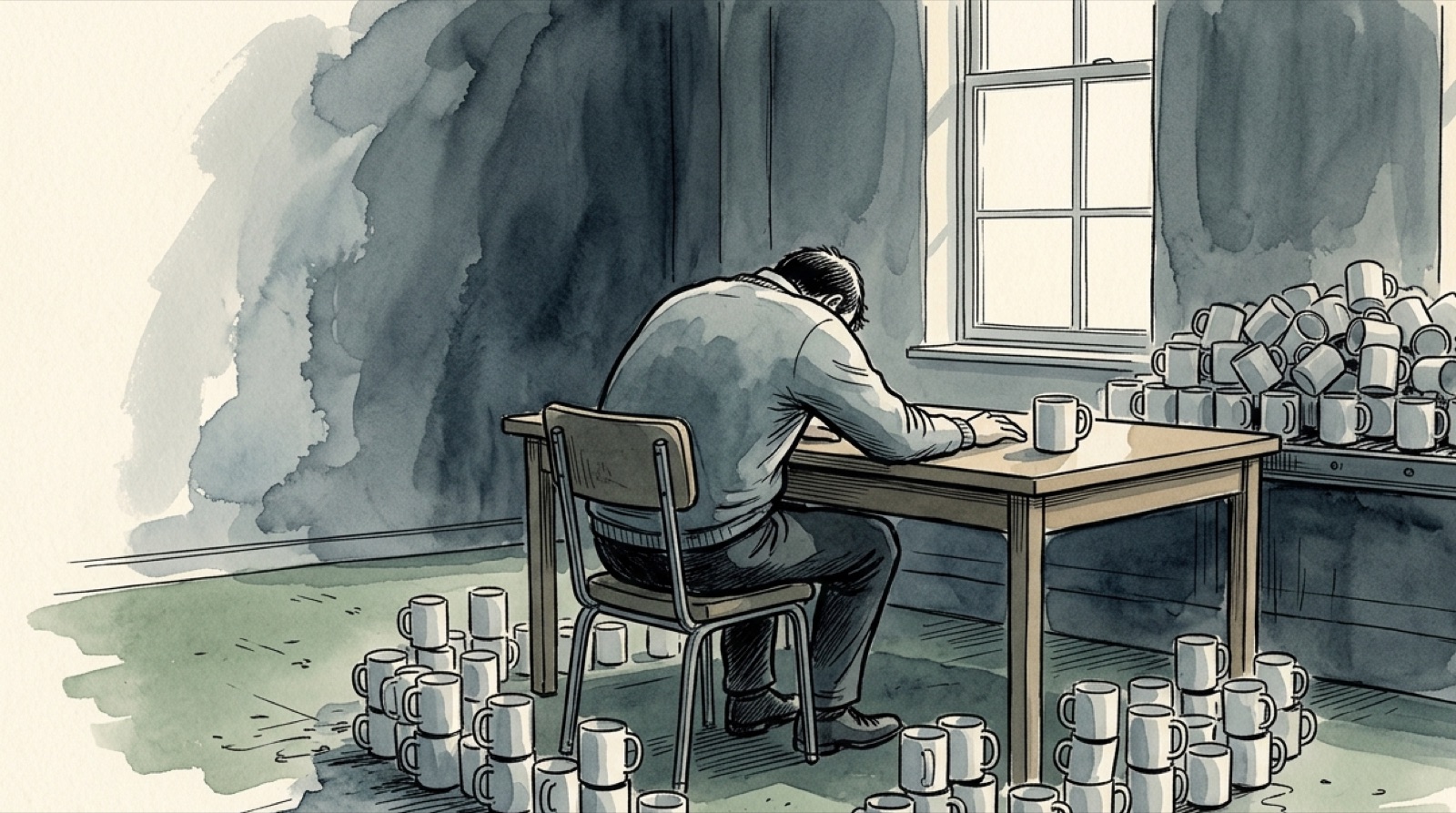
Burnout n.
The WHO classification situates burnout as a factor influencing health contact with services, not as a disease or mental health condition. This distinction has direct clinical and legal implications.
The definition
Burnout is a work-related syndrome arising from chronic occupational stress that has not been successfully managed. Classified by the WHO as an occupational phenomenon rather than a medical condition, it is characterised by three core dimensions: emotional exhaustion, cynicism and mental distancing from one's role, and a reduced sense of personal efficacy.
r = 0.80
correlation between burnout exhaustion and depressive symptoms across 12,417 participants
BIANCHI ET AL. · 20214
The mechanism
The Maslach Burnout Inventory, introduced in 1981, operationalises burnout through three subscales: emotional exhaustion, depersonalisation, and reduced personal accomplishment.1 Emotional exhaustion is considered the core dimension; depersonalisation (a detached, cynical orientation toward one's work and colleagues) and diminished personal accomplishment typically follow as the syndrome progresses. The MBI remains the dominant research instrument, its three-factor architecture replicated across dozens of occupational groups and cultural contexts.
Burnout develops from sustained imbalance between an individual and their job. Maslach's area-of-worklife model identifies six mismatch domains: workload, control, reward, community, fairness, and values.2 The Job Demands-Resources model frames the same dynamic as a health-impairment process: when high job demands (heavy workload, emotional strain, role conflict) persistently outpace available job resources (autonomy, social support, feedback), the resulting strain accumulates over months and years rather than resolving after rest.32 The longer and more severe the mismatch, the greater the erosion of engagement.
A more recent framework, Schaufeli's 2020 Burnout Assessment Tool, reframes burnout as four core dimensions: exhaustion (inability to engage), mental distance (unwillingness to engage), and impaired cognitive and emotional regulation.3 The four-factor model adds cognitive and emotional impairment subscales absent from the original MBI, improving sensitivity for early-stage detection. The BAT is not yet universally adopted; the MBI's three-factor structure remains the primary research standard, and clinicians and researchers should note which instrument a study or assessment uses.
In practice
Burnout's three dimensions rarely announce themselves simultaneously. Exhaustion typically arrives first, followed by cynicism once the individual begins pulling back from their work.
Worked example
A product director at a technology firm has managed back-to-back major launches over eighteen months with no significant recovery period between them. Workload consistently exceeds capacity, and requests for additional headcount are declined. By month fourteen, she completes tasks mechanically, shows little interest in outcomes, and reports feeling professionally ineffective despite receiving strong performance reviews.
All three MBI dimensions are present: exhaustion from sustained overload, depersonalisation through mechanical task completion, and reduced personal accomplishment in the gap between output and felt competence.
Why it matters
The stakes of unaddressed burnout extend well beyond work dissatisfaction. Burnout is associated with elevated risk of cardiovascular disease, impaired immune function, insomnia, anxiety, and clinical depression.2 Unlike acute stress, which resolves once a demand passes, untreated burnout accumulates biological load over months or years. The overlap with depression is substantial: a meta-analysis across 14 samples and 12,417 participants found that burnout's exhaustion dimension correlates with depressive symptoms at r = 0.80.4 The two constructs remain statistically separable, but the proximity means that untreated burnout frequently precedes clinical depression.
Burnout also carries systemic organisational costs. It predicts turnover intention, reduced productivity, increased absenteeism, and poorer safety outcomes across industries.23 Conflating burnout with depression delays appropriate intervention: burnout primarily requires workplace restructuring, whereas depression typically requires clinical treatment.4 The ICD-11's classification of burnout as an occupational phenomenon rather than a medical condition codifies this distinction, directing health services toward organisational remedies rather than purely clinical ones.
Questions of record
What is the difference between burnout and stress?
Stress is typically a response to a specific demand and resolves once the demand passes. Burnout arises from chronic, unmanaged occupational stress and does not resolve with rest alone. Where stress leaves a person feeling pressured but still engaged, burnout erodes engagement itself, producing exhaustion, cynicism, and a sense of inefficacy.
What are the three dimensions of burnout?
The three dimensions of burnout, as operationalised by the Maslach Burnout Inventory, are emotional exhaustion (depletion of one's emotional resources), depersonalisation (a cynical or detached orientation toward one's work and colleagues), and reduced personal accomplishment (a diminished sense of efficacy and achievement in one's role).
Is burnout a medical diagnosis or illness?
Burnout is not classified as a disease or mental health condition. The WHO includes it in ICD-11 as an occupational phenomenon, code QD85, meaning it is a factor influencing health contact with services rather than a diagnosable illness. Assessment and treatment therefore centre on workplace change rather than medical intervention.
Is burnout the same as depression?
Burnout and depression are distinct constructs, though they overlap significantly. A meta-analysis across 12,417 participants found the exhaustion dimension of burnout correlates with depressive symptoms at r = 0.80, yet they remain statistically separable. Burnout primarily demands workplace change; depression typically requires clinical or pharmacological treatment. Treating one as the other delays recovery.