The Social Neuroscience of Networks: How Your Brain Maps Influence, Connection, and Capital.
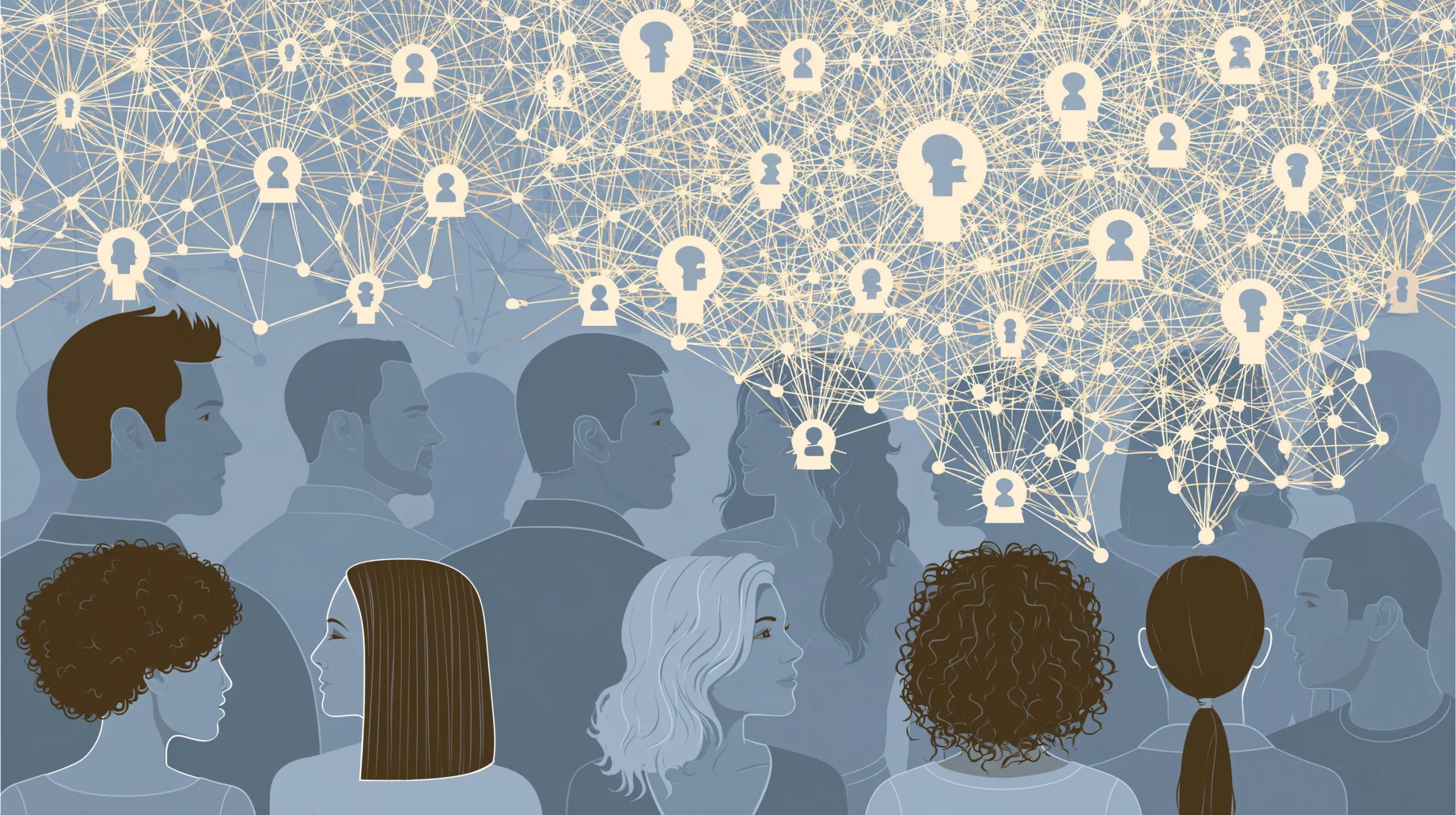
Your brain does not passively participate in social networks, it actively maps them, prices every connection, and adjusts its biology based on where you sit in the web. Here is what the science actually says, and what to do with it.
01The 2022 LinkedIn Experiment
A 20-million-person trial finally proved what Granovetter predicted in 1973
In 2022, a team at LinkedIn and MIT ran the largest randomised experiment in the history of social science. They altered the algorithm behind "People You May Know" (the suggestion engine that proposes new connections) for more than 20 million users over five years, then tracked what happened to 600,000 job transitions.[1] The question was simple: do weak ties (the acquaintances, the second-circle contacts, the people you barely know) actually help you get a job? Mark Granovetter had predicted they would in 1973, in a paper that has since accumulated roughly 70,000 citations.[7] For half a century, the evidence was observational. Rajkumar and colleagues made it causal. Weak ties do help, but the relationship is not a straight line. Measured by the number of mutual connections, an inverted-U places the optimum at approximately 10 shared contacts: the middle zone your intuition probably ignores.[1]
That experiment alone would justify a close look at social neuroscience, the study of how neural systems process, maintain, and exploit social information.[16] But the LinkedIn result sits inside a much larger evidentiary structure. A meta-analysis of 148 longitudinal studies found that adequate social relationships are associated with approximately 50% greater odds of survival, with fully adjusted analyses of more recent large cohort data yielding a 26–32% mortality risk increase for social isolation.[2][20] Population-scale data from 72.2 million Facebook users showed that cross-class friendship (what researchers call economic connectedness) is associated with approximately 20% higher adult incomes for children from low-income backgrounds, though this is a correlational finding, not a controlled experiment.[3][4] A 2024 meta-analysis of more than 600,000 individuals linked loneliness to a 31% increase in all-cause dementia risk.[24]
These are structural claims about how the architecture of your social network shapes your biology, your cognition, and your economic trajectory.
Treating social connection as psychologically nice but biologically optional is wrong, and the error has consequences. In 1979, Lisa Berkman and Leonard Syme published a nine-year follow-up of 6,928 residents of Alameda County, California. Socially isolated men had an age-adjusted relative risk of mortality 2.3 times higher than the most connected; for women, the figure was 2.8.[8] That was before social media, before remote work, before the pandemic sealed millions into their apartments. The 2023 U.S. Surgeon General's Advisory estimated that roughly half of American adults were experiencing measurable loneliness before COVID-19, and that social isolation costs Medicare an additional $6.7 billion annually in healthcare spending.[23][31]
The neuroscience is what elevates these numbers beyond sociology. Your brain does not simply register that you are alone. It changes its threat architecture. Loneliness (the perceived gap between desired and actual social contact) activates the hypothalamic-pituitary-adrenal axis, elevates cortisol, suppresses antiviral gene expression, and upregulates pro-inflammatory signalling through a process researchers call the conserved transcriptional response to adversity (CTRA).[21][22] The body does not distinguish between being hunted and being excluded. It runs the same stress response for both.
Robert Putnam documented the collapse of American civic participation in Bowling Alone, noting a roughly 60% decline in social capital indicators from the 1970s to 2000.[26] The neuroscience now shows what Putnam described as a sociological crisis is also a biological one. The organ most affected by your network position is the brain itself, which determines what kind of biological day you are allowed to have.
02The Mechanism
The Social Brain That Maps Your Network
The idea that the brain has specialised hardware for social processing is now about three decades old. Robin Dunbar formalised it in 1998 as the social brain hypothesis: the observation that across primate species, neocortex size predicts social group size.[11] The logic was evolutionary. Larger groups require more sophisticated tracking of alliances, hierarchies, and reciprocity, and the neocortex expanded to meet the demand. Dunbar's famous prediction (that human cognitive constraints limit stable social groups to roughly 150 individuals) has since been contested by Bayesian reanalysis, which found confidence intervals spanning 4 to 520, making any single number unreliable.[10] The specific number matters less than the principle: the brain allocates neural real estate to social computation in proportion to the complexity of the social world it inhabits.
Matthew Lieberman's 2007 review identified the core circuits of the social brain: the medial prefrontal cortex (mPFC), the temporoparietal junction (TPJ), the superior temporal sulcus (STS), and the amygdala.[16] These regions are preferentially recruited during social cognition (inferring other people's intentions, predicting their behaviour, evaluating their trustworthiness) compared with general cognitive tasks. Mars and colleagues later showed that this social brain network substantially overlaps with the default mode network (DMN), the set of regions active when the brain is not engaged in any external task.[15] When you are doing nothing, your brain defaults to social computation. It is running simulations of other people.
Early neuroimaging work by Bickart and colleagues found that amygdala volume correlates with social network size and complexity, a relationship specific to the amygdala versus other subcortical structures.[6] Subsequent replication attempts have produced mixed results: a 2024 high-field MRI study (N = 128, 7-Tesla) found only inconclusive support for the relationship. What appears more robust is the functional connectivity finding. Bickart's 2012 follow-up showed that intrinsic amygdala–orbitofrontal cortex connectivity stably predicts social network size, suggesting the link is in the wiring between regions, not just their volume.[12]
The social brain valuation relay, the default mode network defaults to modelling other minds at rest; the amygdala monitors threat and its OFC connectivity predicts network size; the VTA fires on social prediction errors releasing dopamine; and the nucleus accumbens prices each relationship against its alternatives in real time.
Diagram · HPC
What the brain does when social connections break has been studied most intensively through the Cyberball paradigm, a virtual ball-tossing game in which the participant is suddenly excluded. Naomi Eisenberger's 2003 fMRI study of 13 participants reported that social exclusion activated the dorsal anterior cingulate cortex (dACC), a region associated with physical pain, leading to the influential claim that social and physical pain share neural circuitry.[9] The finding was widely cited. Subsequent work showed it was also considerably more complicated than the headline implied.
A meta-analysis of 53 Cyberball studies totalling 1,817 participants found no reliable dACC activation across studies.[29] The default mode network (particularly the ventral anterior cingulate, posterior insula, and inferior frontal gyrus) was the most consistently engaged system, showing overlapping neural activation in regions associated with pain processing, though researchers debate whether this reflects shared subjective experience or a broader salience response.[29] Exclusion clearly triggers a neural alarm; the alarm just appears to run through the brain's self-referential and mentalizing systems rather than a dedicated pain channel.
The brain's response to social exclusion is not a simple pain signal. It is a reconfiguration of how the brain processes self-relevant information, a shift from social engagement toward social threat.
03Evidence
The Five Strongest Studies on Social Networks and Outcomes
01The claim
The single load-bearing finding
The hero study finds ~10 mutual friends.
Pooled estimate
~10 mutual friends
02How we measured
Ranking the network studies
Studies scored on design, sample, rigour, causality, replication, citations.
In social network research, causal identification is the decisive challenge: you cannot randomly assign people to isolation, so the field leans on platform experiments and massive cohort meta-analyses, where confounding persists and direction of effect is rarely settled.
Rubric weights
03The spread
Heterogeneity across 5 studies
Methodological quality across the ranked studies.
Rubric spread
89
→ 52 /100
Highest to lowest rubric score across the ranked studies.
04What does not hold
Negative knowledge
What the evidence base does not support.
Worth noting separately is the social contagion literature. Fowler and Christakis demonstrated in the Framingham Heart Study that happiness clusters in social networks to three degrees of separation; a direct friend living nearby increases your happiness probability by approximately 15%.[18] Their earlier work showed that having an obese friend increases own obesity risk by 57%.[19] The implication that behaviours and states spread through networks generated enormous interest and equally vigorous methodological critique.
5 trials. One pooled answer.
Below: the anchor study in full; then the forest plot at scale; then the supporting trials in ranked order.
01Anchor
A causal test of the strength of weak ties
The first causal confirmation that weak ties drive career mobility, validating a half-century of sociological prediction with experimental evidence at unprecedented scale.
The only genuinely causal study in the entire social-networks-and-outcomes literature. N = 20 million dwarfs every competitor. Platform randomisation provides gold-standard causal identification in a field where randomisation is nearly impossible.
Rubric breakdown
The strongest studies, ranked by methodological weight.
Each scored 0–100 against a six-criterion rubric, tagged by design and year; the anchor leads. No study in this set reaches the rubric-90 tier.
02
Social Relationships and Mortality Risk: A Meta-analytic Review
Adequate social relationships are associated with 50% greater odds of survival (OR = 1.50, 95% CI 1.42–1.59). This is the unadjusted pooled estimate; fully adjusted analyses in Wang et al.'s 2023 meta-analysis of 90 cohorts (N = 2,205,199) yield HR = 1.32 for social isolation, a more conservative but methodologically stronger figure.
83/100
03
Loneliness and Social Isolation as Risk Factors for Mortality
Social isolation OR = 1.29; loneliness OR = 1.26; living alone OR = 1.32, all significant independent predictors of mortality after controlling for other risk factors.
76/100
04
Social Capital I: Measurement and Associations with Economic Mobility
Children from low-income backgrounds who grew up in counties with high economic connectedness, cross-class friendship, measured through 21 billion Facebook friendships, had incomes approximately 20% higher in adulthood. This is a correlational finding from a predictive model; children in high-connectedness areas may differ in unmeasured ways.
74/100
05
Amygdala Volume and Social Network Size in Humans
Amygdala volume (corrected for total intracranial volume) positively correlated with the size and complexity of social networks, specific to the amygdala versus other subcortical structures. Subsequent replication attempts have produced mixed results: a 2024 high-field MRI study (N = 128, 7-Tesla) found only inconclusive support for the relationship.
52/100
04Stakes
The biological cost of disconnection
Social isolation and loneliness do not merely reduce quality of life. They alter gene expression, accelerate cognitive decline, increase mortality, and impose measurable economic costs, across four distinct systems.
Mortality & Cardiovascular
Wang et al.'s 2023 meta-analysis of 90 cohort studies (N = 2,205,199) found that social isolation is associated with a 32% increase in mortality risk (HR = 1.32, 95% CI 1.26–1.39), with loneliness carrying an independent 14% increase (HR = 1.14).[20] Holt-Lunstad's 2015 meta-analysis confirmed that isolation, loneliness, and living alone are each independent mortality predictors.[5] The effect magnitude is comparable to smoking 15 cigarettes per day, a risk equivalence now cited in the U.S. Surgeon General's national advisory.[23] Social support is also consistently linked to more favourable cardiovascular and neuroendocrine profiles.[27]
persistent fatigue, elevated resting heart rate, unexplained cardiovascular strain
Cognitive & Dementia
Loneliness is associated with a 31% increase in all-cause dementia risk (HR = 1.306, 95% CI 1.197–1.426), rising to 39% for Alzheimer's disease (HR = 1.393) and 73% for vascular dementia (HR = 1.735).[24] A cross-national longitudinal study of 101,581 participants across 24 countries confirmed that social isolation accelerates cognitive decline independently of other risk factors.[28] The brain does not just lose stimulation, it loses the computational load that maintains its social circuits.
difficulty concentrating, slower recall, shrinking curiosity, mental fog
Immune & Inflammatory
Loneliness activates the conserved transcriptional response to adversity (CTRA): pro-inflammatory genes upregulate while antiviral genes downregulate.[22] Cacioppo's longitudinal study of 141 older adults showed that loneliness predicts future CTRA gene expression, not the reverse, establishing temporal precedence.[22] The HPA axis elevates cortisol; the sympathetic nervous system shifts toward chronic activation, driving neuroinflammation.[21] The body enters a threat-ready state calibrated for predation, not infection, leaving it vulnerable to the actual pathogens it encounters.
frequent illness, slow wound healing, chronic low-grade inflammation, disrupted sleep
Economic & Structural
Social isolation costs Medicare an estimated $6.7 billion annually in additional healthcare spending.[23] Cross-class disconnection is associated with approximately 20% lower adult incomes for children from disadvantaged backgrounds, though this is a correlational finding from observational data.[3] Thin networks produce fewer weak ties, fewer structural holes, and fewer opportunities for the non-redundant information transfer that drives career mobility and innovation.[1][17]
career stagnation, missed opportunities, narrowing professional world, sense of being stuck
05Protocol
A 4-Part Social Network Maintenance Protocol
This is not a friendship optimisation guide. It is a signal-engineering framework, four evidence-informed actions that maintain the neural and structural conditions under which social networks produce their documented benefits.
The protocol, as a sequence.
Weekly → Monthly → Daily → Quarterly
Weak-Tie Activation
Contact one acquaintance per week outside your immediate circle. Prioritise professional contacts with approximately 5–15 mutual connections, the zone Rajkumar's experiment identified as optimal for information transfer.[1]
Weak ties provide non-redundant information that strong ties cannot.[7] Granovetter's 1974 study found that 56% of people who found jobs through contacts used ties they saw occasionally or rarely.[25] The career mobility benefit is causally established.
Maintaining only strong ties. Close friends provide emotional support but redundant information, the same career leads, the same perspectives, the same network position.
Bridge Audit
Map the groups in your network and identify whether you bridge any that would otherwise be disconnected. Burt's structural holes research showed that brokerage positions predict better pay, stronger evaluations, and higher-rated ideas.[17]
Information advantage flows to people who sit between disconnected clusters, not to those with the most connections. Bridging capital is more valuable than bonding capital for career and creative outcomes.[17][32]
Maximising connection count instead of connection diversity. A network of 500 similar contacts is worth less than 100 contacts spanning five disconnected domains.
Active Engagement
Replace passive social media consumption with one direct, reciprocal interaction per day. The evidence on loneliness interventions shows that cognitive behavioural approaches and active group participation outperform passive social support.[33]
Social connection activates reward circuits only when it involves genuine reciprocity and prediction.[30] Passive scrolling does not trigger the opioid and dopamine responses associated with real social engagement.[13][14]
Confusing network size with network quality. Follower counts are not a proxy for the social engagement that produces neurochemical reward and health protection.
Loneliness Check
Assess your perceived social connection honestly, using the distinction between isolation (objective) and loneliness (subjective). Holt-Lunstad's 2015 meta-analysis showed both are independent mortality predictors; you can be socially active and still lonely.[5]
The brain's threat response is calibrated to perceived isolation, not objective network size.[21] CTRA gene expression tracks subjective loneliness, not contact frequency.[22] If the perception is "not enough," the biology responds regardless.
Assuming busyness equals connection. A full social calendar with no felt reciprocity activates threat circuits, not reward circuits.
06Verdict
The verdict.
"Social isolation carries a mortality risk comparable to smoking fifteen cigarettes a day.", Adapted from Vivek Murthy, U.S. Surgeon General (2023)
Bottom line
The brain does not care whether you call it networking or friendship. It runs the same circuits, the same chemistry, the same survival calculus and it has been keeping score all along.
The argument
The evidence reviewed here, spanning a 20-million-person platform experiment, meta-analyses of more than 2.2 million participants, population-scale social network data from 72.2 million Facebook users, and structural and functional neuroimaging of the social brain, converges on a single claim: the architecture of your social network is a biological variable with measurable consequences for survival, cognition, economic mobility, and brain structure. Social neuroscience has moved this from intuition to mechanism. The brain runs dedicated neural hardware for social computation, prices every connection through the same reward circuits it uses for food and money, and shifts to a threat-ready inflammatory state when the network thins. Managing your [social network](/social/mastery-guide/) is not a lifestyle upgrade. It is maintenance of a system your biology treats as essential infrastructure.
What stands out about this evidence base is not any single finding but the convergence. Career mobility, mortality, cognitive decline, gene expression, economic opportunity, and brain architecture all point the same direction, across different methodologies, populations, and decades. The weak-tie experiment validates a 50-year-old sociological prediction. The mortality meta-analyses confirm what Berkman and Syme observed in Alameda County in 1979. The neuroimaging, despite its replication challenges, shows that the brain physically adapts to the social world it inhabits.
Most people think of their social network as a set of relationships they happen to have: accumulated by accident, maintained by habit, valued by sentiment. That framing misses something important. Your network is infrastructure. It has an architecture. That architecture has measurable biological consequences, and the brain is its active manager, running social computation as its default operation and pricing every connection against its alternatives.
Why clinical medicine has been so slow to treat social connection with the same seriousness it gives to blood pressure, cholesterol, or blood glucose is the real open question. The Surgeon General's 2023 advisory was a start.[23] The science reviewed here suggests it was long overdue.
Disconnection carries a measurable mortality price.
The Brain Maps Networks
The brain runs dedicated neural hardware, mentalizing circuits, amygdala-OFC connectivity, corticostriatal reward systems, that maps social network structure, prices every connection, and defaults to social computation when idle. Social neuroscience has established the mechanism; the remaining gap is causal directionality in the neuroimaging evidence.
Disconnection Is Biological
When the network thins, the brain does not simply register loneliness. It activates inflammatory gene expression, suppresses antiviral pathways, elevates cortisol, and accelerates cognitive decline, a compound biological cost that increases mortality risk by 26–32% in adjusted analyses.[20][5]
Architecture Over Volume
The evidence does not support maximising connection count. It supports maintaining information diversity (weak ties), structural brokerage (bridging disconnected groups), and perceived reciprocity (felt connection). The highest-leverage intervention is not adding contacts, it is engineering the architecture of the connections you already have.[1][17]
Put it to work
Where this science goes next on HPC
07Bibliography
The bibliography.
-
01
Journal
doi: 10.1126/science.abl4476
Rubric 89/100
A causal test of the strength of weak ties
-
02
Meta
doi: 10.1371/journal.pmed.1000316
Social relationships and mortality risk: A meta-analytic review
-
03
Journal
doi: 10.1038/s41586-022-04996-4
Social capital I: Measurement and associations with economic mobility
-
04
Journal
doi: 10.1038/s41586-022-04997-3
Social capital II: Determinants of economic connectedness
-
05
Meta
doi: 10.1177/1745691614568352
Loneliness and social isolation as risk factors for mortality: A meta-analytic review
-
06
Journal
doi: 10.1038/nn.2724
Amygdala volume and social network size in humans
-
07
Journal
doi: 10.1086/225469
The strength of weak ties
-
08
Journal
doi: 10.1093/oxfordjournals.aje.a112674
Social networks, host resistance, and mortality: A nine-year follow-up study of Alameda County residents
-
09
Journal
doi: 10.1126/science.1089134
Does rejection hurt? An fMRI study of social exclusion
-
10
Journal
doi: 10.1098/rsbl.2021.0158
'Dunbar's number' deconstructed
-
11
Journal
doi: 10.1002/(SICI)1520-6505(1998)6:5<178::AID-EVAN5>3.0.CO;2-8
The social brain hypothesis
-
12
Journal
doi: 10.1523/JNEUROSCI.1599-12.2012
Intrinsic amygdala–cortical functional connectivity predicts social network size in humans
-
13
Journal
doi: 10.1016/j.neuroimage.2016.05.063
Social touch modulates endogenous μ-opioid system activity in humans
-
14
Journal
doi: 10.1111/bph.13812
Opioid system and human emotions
-
15
Journal
doi: 10.3389/fnhum.2012.00189
On the relationship between the "default mode network" and the "social brain." Frontiers in Human Neuroscience, 6, 189
-
16
Review
doi: 10.1146/annurev.psych.58.110405.085654
Social cognitive neuroscience: A review of core processes
-
17
Journal
doi: 10.1086/421787
Structural holes and good ideas
-
18
Journal
doi: 10.1136/bmj.a2338
Dynamic spread of happiness in a large social network
-
19
Journal
doi: 10.1056/NEJMsa066082
The spread of obesity in a large social network over 32 years
-
20
Meta
doi: 10.1038/s41562-023-01617-6
A systematic review and meta-analysis of 90 cohort studies of social isolation, loneliness and mortality
-
21
Review
doi: 10.1146/annurev-psych-010814-015240
The neuroendocrinology of social isolation
-
22
Journal
doi: 10.1073/pnas.1514249112
Myeloid differentiation architecture of leukocyte transcriptome dynamics in perceived social isolation
-
23
Journal
no doi
Our Epidemic of Loneliness and Isolation: The U.S. Surgeon General's Advisory on the Healing Effects of Social Connection and Community
-
24
Meta
doi: 10.1038/s44220-024-00328-9
A meta-analysis of loneliness and risk of dementia using longitudinal data from >600,000 individuals
-
25
Book
no doi
Getting a Job: A Study of Contacts and Careers
-
26
Journal
no doi
Bowling Alone: The Collapse and Revival of American Community
-
27
Review
doi: 10.1007/s10865-006-9056-5
Social support and health: A review of physiological processes potentially underlying links to disease outcomes
-
28
Journal
doi: 10.1186/s12877-025-06430-6
Social isolation and cognitive decline across 24 countries
-
29
Meta
doi: 10.1016/j.neuroimage.2020.117666
Social exclusion reliably engages the default network: A meta-analysis of Cyberball
-
30
Journal
doi: 10.1016/j.neuron.2023.07.009
Characterizing the mechanisms of social connection
-
31
Journal
no doi
Loneliness, lack of social and emotional support, and mental health issues, United States, 2022
-
32
Journal
doi: 10.5465/amj.2019.1209
Networks, creativity, and time: Staying creative through brokerage and network rejuvenation
-
33
Meta
no doi
What works to reduce loneliness: A rapid systematic review of 101 interventions
No entries match the current filter and search.
The protocol card
The Social Neuroscience of Networks: How Your Brain Maps Influence, Connection, and Capital
One sheet. The four moves, in the order the day runs them.
-
01
Weekly
Weak-Tie Activation
Contact one acquaintance per week outside your immediate circle. Prioritise professional contacts with approximately 5–15 mutual connections, the zone Rajkumar's experiment identified as optimal for information transfer.
AvoidMaintaining only strong ties. Close friends provide emotional support but redundant information, the same career leads, the same perspectives, the same network position.
-
02
Monthly
Bridge Audit
Map the groups in your network and identify whether you bridge any that would otherwise be disconnected. Burt's structural holes research showed that brokerage positions predict better pay, stronger evaluations, and higher-rated ideas.
AvoidMaximising connection count instead of connection diversity. A network of 500 similar contacts is worth less than 100 contacts spanning five disconnected domains.
-
03
Daily
Active Engagement
Replace passive social media consumption with one direct, reciprocal interaction per day. The evidence on loneliness interventions shows that cognitive behavioural approaches and active group participation outperform passive social support.
AvoidConfusing network size with network quality. Follower counts are not a proxy for the social engagement that produces neurochemical reward and health protection.
-
04
Quarterly
Loneliness Check
Assess your perceived social connection honestly, using the distinction between isolation (objective) and loneliness (subjective). Holt-Lunstad's 2015 meta-analysis showed both are independent mortality predictors; you can be socially active and still lonely.
AvoidAssuming busyness equals connection. A full social calendar with no felt reciprocity activates threat circuits, not reward circuits.
hiperformanceculture.com · 33 sources · 6 April 2026


How this was made
The desk, the instrument, and when this page is next examined.
- Desk
- HPC Editorial
- Instrument
- 6 weighted criteria, 100 points see every score
- Register
- 33 sources, 28 with a resolving DOI read them
- Reading time
- 22 min read
Revision log
- First published.
- Last revised. Sources re-checked against the register above.
- Next review Due by , or earlier if a new controlled trial or systematic review lands.
THE HAND-OFF. Performance Scan: find your limiting factor. Three minutes, 24 questions, six systems. Your answers never leave your device.