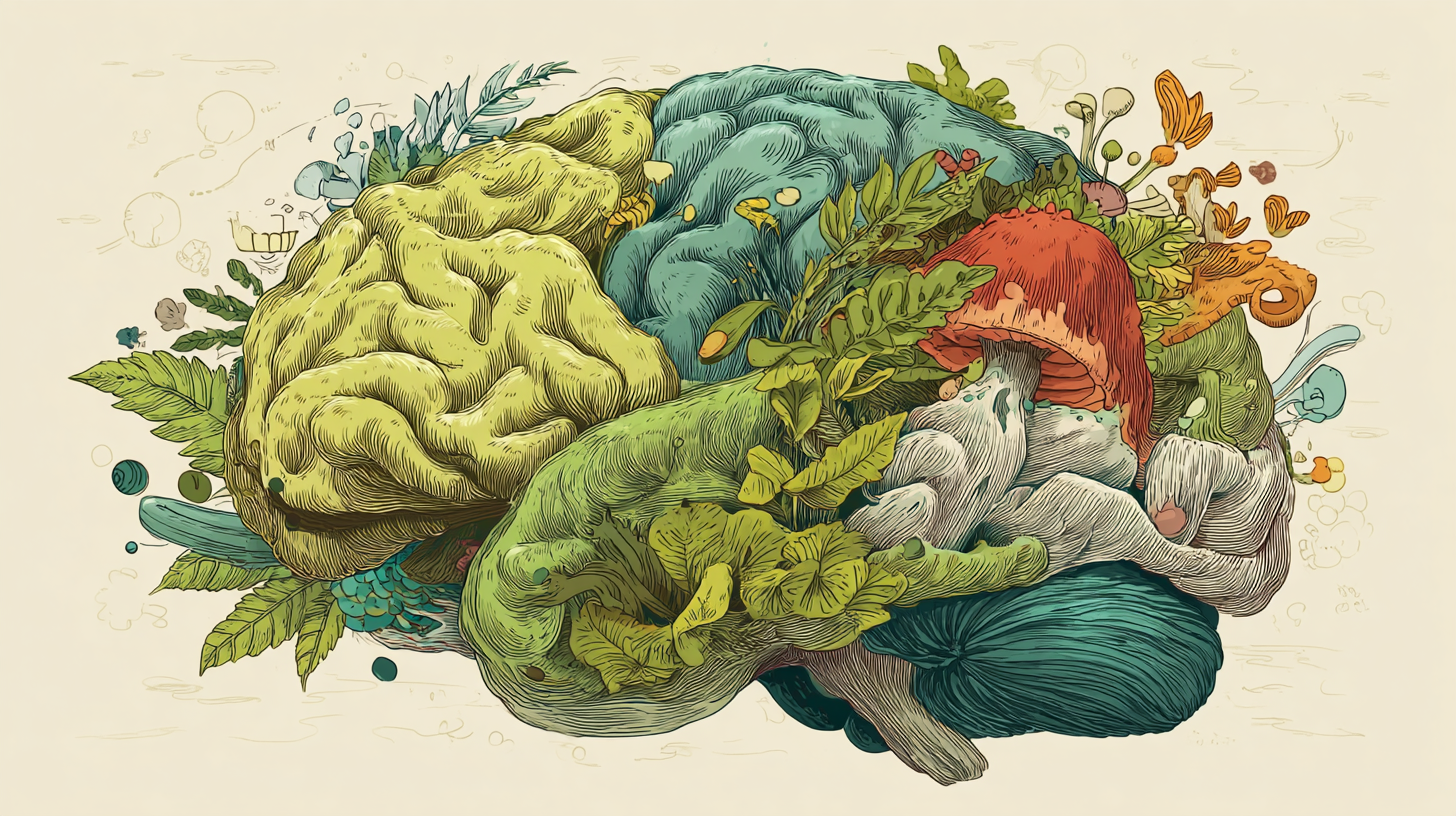
The Neuroscience of Habits: How the Basal Ganglia Automates Behaviour.
Nearly half of daily behaviour runs on neural autopilot, and the corticostriatal circuit that builds it operates faster than conscious thought. Here is what the science actually says, and what to do with it.
01The Efficiency Architecture
The brain delegates nearly half of daily life to autopilot
You tie your shoes without looking. You navigate your morning commute while planning the afternoon. You reach for your phone at the first hint of boredom, and catch yourself mid-gesture, hand already moving before the thought has fully formed. These are not lapses of attention. They are the output of a neural architecture so efficient that it operates below the threshold of awareness, executing complex action sequences with less cortical overhead than a single conscious decision would require.[1][2] The neuroscience of habits begins with a deceptively simple observation: nearly 43% of what people do each day is habitual, performed in the same location, at roughly the same time, with minimal deliberation.[1][3] That figure, drawn from experience-sampling studies at the University of Southern California, represents not a deficiency but a design feature.[2]
The popular understanding of habits, as character flaws to break or productivity hacks to install, misses the biology entirely. A habit is not a behaviour that someone is too lazy to think about. It is a behaviour that the brain has deemed reliable enough to move from an expensive, flexible control system to a cheap, automatic one.[4][5] The architecture behind that transition is the basal ganglia, a set of subcortical nuclei that sit at the junction of cognition, motivation, and movement, and that have been building behavioural routines since before primates walked upright.[6]
The question this article answers is not whether habits exist. It is how the brain decides which behaviours to automate, what neural machinery handles the transition, and what happens, physiologically rather than metaphorically, when the system that builds good habits also builds destructive ones.
The neuroscience of habits sits at the intersection of three research traditions that rarely speak to one another. The first is systems neuroscience: the study of how brain circuits encode, retrieve, and execute behaviour. The second is reinforcement learning, a computational framework that models how organisms update behaviour based on prediction errors.[4][10] The third is behavioural science, the field-level study of what people actually do in their daily lives, measured not by brain scans but by diaries, wristwatch prompts, and longitudinal tracking.[1][3]
What makes the habit literature unusually powerful is that these three traditions converge. Primate electrophysiology from Wolfram Schultz's lab reveals the dopamine signal that writes habit associations.[4] Rodent lesion studies from Ann Graybiel's lab reveal the striatal architecture that stores them.[6][7] Human fMRI from O'Doherty's group confirms the same circuit in our species.[16] And diary studies from Wendy Wood's programme measure the behavioural output at population scale.[1][2][3] The result is a mechanistic account that runs from single neurons to daily routines, one of the most complete causal chains in all of psychology.
That convergence is rare. Most psychological phenomena have either strong neuroscience or strong field data. The neuroscience of habits has both, and the two tell the same story.
02The Mechanism
The Corticostriatal Switch That Builds Automatic Behaviour
Every new behaviour begins as a deliberate act. When you first learn to drive, every mirror check, gear change, and lane merge requires conscious attention, routed through the prefrontal cortex and the dorsomedial striatum (DMS), the brain's goal-directed control system.[5][11] The DMS evaluates outcomes. It asks, continuously, whether the action produced what was expected. If it did, the behaviour is reinforced. If it did not, the behaviour is revised. This is flexible, accurate, and expensive: it demands cortical resources that could be used for something else.[10][12]
With repetition, something shifts. The neural locus of control migrates from the DMS to a neighbouring structure: the dorsolateral striatum (DLS), a region that does not evaluate outcomes at all.[5][8] The DLS encodes stimulus-response associations, executing a motor sequence when a cue appears, without reference to the value of the result. Ann Graybiel's laboratory at MIT has spent three decades mapping this transition, and the picture that emerges is precise: DLS neurons fire at the onset and offset of action sequences, bracketing the habit like bookends around a chapter, while mid-sequence firing drops by approximately 60%.[8][9]
This pattern, called task-bracketing, is the neural signature of an automated behaviour. The brain does not monitor every step. It fires a "start" signal, executes the compressed sequence, and fires a "stop" signal.[8] Everything between the brackets runs without cortical supervision.
New behaviour is routed through the prefrontal cortex and DMS; dopamine prediction-error signals stamp the sequence into the DLS, which then executes the chunked routine automatically, freeing cortical resources.
Diagram · HPC
The engine of this transition is dopamine, specifically a teaching signal called reward prediction error (RPE). In 1997, Wolfram Schultz, Peter Dayan, and Read Montague published what remains the foundational mechanistic paper in habit neuroscience: a demonstration that midbrain dopamine neurons encode not reward itself, but the difference between expected and received reward.[4] When a reward arrives unexpectedly, dopamine neurons fire in a sharp burst. When a predicted reward arrives exactly on schedule, the neurons return to baseline: the prediction was correct, and there is nothing new to learn. When an expected reward fails to arrive, firing dips below baseline, signalling a negative prediction error.[4]
That three-part signal is the computational engine of habit formation. It does not operate in the time domain of conscious thought. Phasic dopamine neurons respond to a conditioned stimulus within 70–100 milliseconds, a burst lasting 100–200 milliseconds, well below the 300–500 millisecond threshold for conscious awareness.[4] The striatum is being taught before the prefrontal cortex has registered what happened.
The RPE signal is critical during habit acquisition. But established habits in the DLS become remarkably dopamine-independent: they can persist even after dopamine depletion in rodent models, a finding with direct relevance to Parkinson's disease presentations where long-standing habits survive the loss of dopaminergic neurons.[5] Dopamine is the engine of acquisition, not necessarily the fuel of execution.
03Evidence
The Five Studies That Map the Habit Circuit
01The claim
The single load-bearing finding
The hero study finds ~100 ms.
Not all evidence carries equal weight. A single diary study cannot establish a neural mechanism; a primate electrophysiology experiment cannot tell you how long habits take to form in humans. The neuroscience of habits draws its authority from the convergence of multiple study designs, each answering a different question, each compensating for the limitations of the others.[4][5][17] The five studies ranked below were selected for design strength, measurement precision, causal clarity, and replication value.
Pooled estimate
~100 ms
02How we measured
Mapping the habit circuit evidence
Studies scored on design, sample, rigour, causality, replication, citations.
Design breadth is the key criterion here: single-neuron primate recordings establish the teaching signal with causal certainty that human fMRI cannot match, so the hierarchy weights mechanistic animal data alongside human neuroimaging and population meta-analysis to triangulate the same circuit at every level.
Rubric weights
03The spread
Heterogeneity across 5 studies
Methodological quality across the ranked studies.
What the hierarchy reveals is not just five good studies. It is the architecture of a complete argument, running from molecular signal to population behaviour. Schultz provides the teaching signal. Graybiel maps the circuit that stores what the signal writes. Tricomi confirms the circuit in living human brains. Lally measures the timescale. Singh validates it at meta-analytic power.[4][8][16][17][18] Each study answers a question the others cannot. Primate electrophysiology can isolate a single neuron's firing pattern but cannot follow a human through their morning routine.
Rubric spread
90 → 59 /100
Highest to lowest rubric score across the ranked studies.
04What does not hold
Negative knowledge
What the evidence base does not support.
One nuance the hierarchy forces into view: the outcome devaluation paradigm, the gold-standard test for whether a behaviour is habitual or goal-directed, produces cleaner results in the laboratory than in everyday life.[11][16] In Tricomi's scanner, participants pressed levers for food rewards that were subsequently devalued. The habitual responders kept pressing. In the real world, habits rarely involve such discrete stimulus-response pairings.
5 trials. One pooled answer.
Below: the anchor study in full; then the forest plot at scale; then the supporting trials in ranked order.
01Anchor
A Neural Substrate for Prediction and Reward
Schultz and colleagues demonstrated that midbrain dopamine neurons in macaques encode a reward prediction error: firing when rewards are unexpected, falling silent when predictions are met, and dipping below baseline when expected rewards are omitted.
Rubric breakdown
The strongest studies, ranked by methodological weight.
Each scored 0–100 against a six-criterion rubric, tagged by design and year; the anchor leads.
02
The Striatum: Where Skills and Habits Meet
Mid-sequence firing in DLS neurons drops approximately 60% once behaviour is chunked: task-bracketing compresses multi-step sequences into single executable units, with DLS neurons firing only at action onset and offset.
83/100
03
How Are Habits Formed: Modelling Habit Formation in the Real World
Habit automaticity follows an asymptotic curve with a median plateau at 66 days (range 18–254). Missing a single repetition did not derail the trajectory. The popular "21-day" claim has no empirical basis.
66/100
04
A Specific Role for Posterior Dorsolateral Striatum in Human Habit Learning
After 20 overtraining sessions, participants continued pressing a devalued lever with posterior DLS (putamen) activation dominating, while anterior caudate (DMS homolog) showed the reverse pattern, activating for goal-directed responses.
62/100
05
Time to Form a Habit
Pooled estimate across 20 studies (N = 2,601): median habit formation time of 59–66 days. Standardised mean difference of 0.69 for habit strength at follow-up versus baseline. Physical activity habits formed more slowly than dietary habits.
59/100
04Stakes
The habit circuit is powerful because it is indifferent, and that indifference has consequences.
The same architecture that automates your morning routine can automate substance use, compulsive behaviour, and health-destroying patterns with equal efficiency.
The DLS Entrenchment Trap
Substance use follows the same DMS-to-DLS transition as any habit, but accelerated. Everitt and Robbins documented that drug-seeking behaviour shifts from goal-directed to DLS-dependent control, becoming resistant to outcome devaluation.[21][22] Once drug-taking is DLS-controlled, the user continues seeking even when the drug is no longer rewarding, because the habit circuit does not check. Cortical override capacity progressively degrades with chronic exposure.[23]
automatic reaching for substance, cravings triggered by locations or routines, continued use despite negative consequences
The Behavioural Mortality Burden
Four habit-driven behaviours (tobacco use, poor diet, physical inactivity, and excessive alcohol) account for more than 7.4 million attributable deaths globally each year.[25] Khaw and colleagues demonstrated in the EPIC-Norfolk cohort that behavioural habit clusters predict a 4-fold difference in 14-year survival.[24] These are not individual failures of willpower. They are population-scale consequences of a circuit that automates whatever it is repeatedly fed.
chronic health deterioration, lifestyle diseases that accumulate invisibly, difficulty changing entrenched patterns
The Flexibility Deficit
The same DLS dominance that characterises established habits appears in compulsive disorders (OCD, binge eating, compulsive checking).[23] Posterior DLS volume predicts habitual over goal-directed responding in OCD-analog tasks.[23] When the habit system is overactive relative to the goal-directed system, behaviour becomes rigid even when outcomes are aversive. The person knows the behaviour is unproductive. The striatum does not care.
repetitive behaviours that feel driven rather than chosen, difficulty stopping routines that are clearly unhelpful
The Context Trap
Established habits are triggered by context: the same environment, the same time, the same preceding action.[14][31] When contexts remain stable, habits persist even when intentions change. Wood and Neal showed that habitual responding is cued by context perception alone; goal pursuit is not required once associations are established.[14] The same contextual stability that makes good habits effortless makes bad habits invisible.
doing things "on autopilot" that you intended to change, reverting to old patterns in familiar environments
05Protocol
A Signal-Engineering Protocol for Habit Architecture
These four steps work with the corticostriatal circuit rather than against it: designing cues, front-loading decisions, and using context to steer what the DLS eventually automates.
The protocol, as a sequence.
Day 1 → Day 1–14 → Day 14–66 → Ongoing
Anchor the Cue
Design a single, specific environmental cue for the target behaviour: same location, same preceding action, same time.
The DLS learns stimulus-response associations, not intentions. A stable, repeated cue is the only input the habit circuit accepts. Wood and colleagues showed context stability is the primary moderator of habit strength.[1][14]
Relying on motivation or reminders instead of physical environment design. The habit circuit does not read to-do lists.
Pre-commit the Response
Write an explicit if-then plan: "When [cue], I will [specific action]."
Implementation intentions (Gollwitzer & Sheeran, 2006) produce a d = 0.65 effect in controlled settings by pre-loading the cue-response link that the DLS will eventually automate.[26] In field conditions for repeated behaviours, the effect is smaller (d ≈ 0.2–0.3) but still the strongest behavioural tool available.[26]
Writing vague goals ("exercise more") instead of specific if-then cue-response pairs. The DLS encodes specifics, not aspirations.
Protect the Repetition Window
Repeat the cue-response sequence daily for at least 66 days, the empirical median for automaticity.
Lally's longitudinal data shows an asymptotic learning curve: habit strength rises steeply in early repetitions and plateaus around 66 days (range 18–254).[17][18] Missing a single day does not derail the trajectory, but consistency in the early weeks is critical for DLS encoding.[17]
Quitting at day 21 because a self-help book said the habit should be formed by now. It almost certainly is not.
Disrupt Unwanted Contexts
When breaking a habit, change the physical environment: disrupt the cue, not the response.
Wood, Tam, and Witt showed that context disruption (moving locations) increases the probability of forming new habits by approximately 35% over matched controls.[27] The DLS is cue-triggered; remove the cue and the automated sequence has no launch signal.[14][27]
Trying to suppress the habitual response through willpower alone. The DLS does not respond to willpower; it responds to cues.
06Verdict
The verdict.
Bottom line
You do not rise to the level of your intentions. You fall to the level of what your striatum has automated.
The neuroscience of habits reveals something that the self-help industry has consistently misunderstood: a habit is not a behaviour you have chosen to repeat. It is a behaviour the basal ganglia has automated, transferred from a flexible, outcome-evaluating cortical system to a fast, cue-triggered striatal system that executes without consulting your current intentions. The corticostriatal circuit that makes your morning routine effortless is the same circuit that sustains addictive and compulsive patterns. The difference is not architectural; it is what was loaded into the system during the critical acquisition window. Understanding this reframes the entire conversation about behaviour change: the question is not how to summon more willpower, but how to engineer the cues, repetitions, and contexts that determine what the DLS encodes.
The reframe is structural, not motivational. When someone fails to break a habit, the standard explanation is insufficient discipline. The neuroscience suggests a different diagnosis: the goal-directed system (DMS/prefrontal) has updated (the person genuinely intends to change) but the habit system (DLS) has not, because it was never asked.[5][14] The DLS does not respond to decisions. It responds to cues in context. Until the cue is disrupted or a competing cue-response sequence is installed, the habitual behaviour will continue to fire, not because the person lacks willpower, but because devaluation insensitivity is a feature of the system, not a bug.[11][16]
This has direct implications for how performance cultures approach behaviour design. The organisations and individuals who build the most durable behavioural systems are not the ones with the strongest motivation. They are the ones who have, consciously or accidentally, engineered environments where the right cues trigger the right sequences, and where the DLS is loaded with routines worth automating.[3][28]
The neuroscience of habits does not promise easy change. It promises something more useful: a mechanistic map of why change is hard, what the circuit actually responds to, and where the intervention points are. The rest is repetition.
No comparison figure runs here. The prose above does not resolve to one clean effect size to set against another, and this magazine does not manufacture a number to fill the space. The verdict stands on the evidence as written.
The Circuit Is Indifferent
The DLS automates behaviour based on cue-response frequency, not outcome value. It does not distinguish between a morning exercise routine and a compulsive checking pattern. The architecture is the same; only the inputs differ.
Willpower Is the Wrong Target
Attempting to override a DLS-controlled habit with prefrontal intention is fighting the circuit's design. Under cognitive load, fatigue, or stress, the DLS wins, producing the familiar experience of relapsing into unwanted patterns despite strong resolve.
Engineer the Inputs
The strongest intervention point is the cue, not the response. Design the environmental trigger, pre-load the if-then response, and protect the 66-day repetition window. The DLS will automate whatever it is consistently fed.
Put it to work
Where this science goes next on HPC
07Bibliography
The bibliography.
-
01
Journal
doi: 10.1037/0022-3514.83.6.1281
Habits in everyday life: Thought, emotion, and action
-
02
Journal
doi: 10.1111/j.1467-8721.2006.00435.x
Habits, a repeat performance
-
03
Journal
Good habits, bad habits: The science of making positive changes that stick
-
04
Journal
doi: 10.1126/science.275.5306.1593
A neural substrate for prediction and reward
-
05
Review
doi: 10.1038/nrn1919
The role of the basal ganglia in habit formation
-
06
Journal
doi: 10.1006/nlme.1998.3843
The basal ganglia and chunking of action repertoires
-
07
Journal
doi: 10.1016/j.tics.2010.02.001
Cortical and basal ganglia contributions to habit learning and automaticity
-
08
Journal
doi: 10.1101/cshperspect.a021691
The striatum: Where skills and habits meet
-
09
Journal
doi: 10.1038/npp.2009.129
The reward circuit: Linking primate anatomy and human imaging
-
10
Review
doi: 10.1146/annurev.neuro.29.051605.112851
Habits, rituals, and the evaluative brain
-
11
Journal
doi: 10.1016/s0028-3908(98)00033-1
Goal-directed instrumental action: Contingency and incentive learning and their cortical substrates
-
12
Journal
doi: 10.1038/nn1560
Uncertainty-based competition between prefrontal and dorsolateral striatal systems for behavioral control
-
14
Review
doi: 10.1037/0033-295X.114.4.843
A new look at habits and the habit-goal interface
-
16
Journal
doi: 10.1111/j.1460-9568.2009.06796.x
A specific role for posterior dorsolateral striatum in human habit learning
-
17
Journal
doi: 10.1002/ejsp.674
How are habits formed: Modelling habit formation in the real world
-
18
Journal
doi: 10.3390/healthcare12232488
Time to form a habit
-
21
Journal
doi: 10.1038/nn1579
Neural systems of reinforcement for drug addiction: From actions to habits to compulsion
-
22
Review
doi: 10.1146/annurev-psych-122414-033457
Drug addiction: Updating actions to habits to compulsions ten years on
-
23
Journal
doi: 10.1016/j.pnpbp.2016.06.003
Behavioural and neural mechanisms underlying habitual and compulsive drug seeking
-
24
Cohort
doi: 10.1371/journal.pmed.0050012
Combined impact of health behaviours and mortality in men and women: The EPIC-Norfolk prospective population study
-
25
Journal
doi: 10.1016/S0140-6736(20)30752-2
Global burden of 87 risk factors in 204 countries and territories, 1990–2019: A systematic analysis for the Global Burden of Disease Study 2019
-
26
Meta
doi: 10.1016/S0065-2601(06)38002-1
Implementation intentions and goal achievement: A meta-analysis of effects and processes
-
27
Journal
doi: 10.1037/0022-3514.88.6.918
Changing circumstances, disrupting habits
-
28
Journal
doi: 10.1111/bjhp.12504
Which behaviour comes first? A theory-based N-of-1 study on physical activity and healthy eating
-
29
Journal
doi: 10.3399/bjgp12X659466
Making health habitual: The psychology of 'habit-formation' and general practice
-
30
Journal
doi: 10.1111/j.1559-1816.2003.tb01951.x
Reflections on past behavior: A self-report index of habit strength
-
31
Journal
doi: 10.1016/j.nlm.2021.107507
Evidence for a context-specific latent inhibition effect that is not due to disruption of acquired excitation
No entries match the current filter and search.


THE HAND-OFF — Performance Scan: find your limiting factor. Three minutes, 24 questions, six systems — and your answers never leave your device.