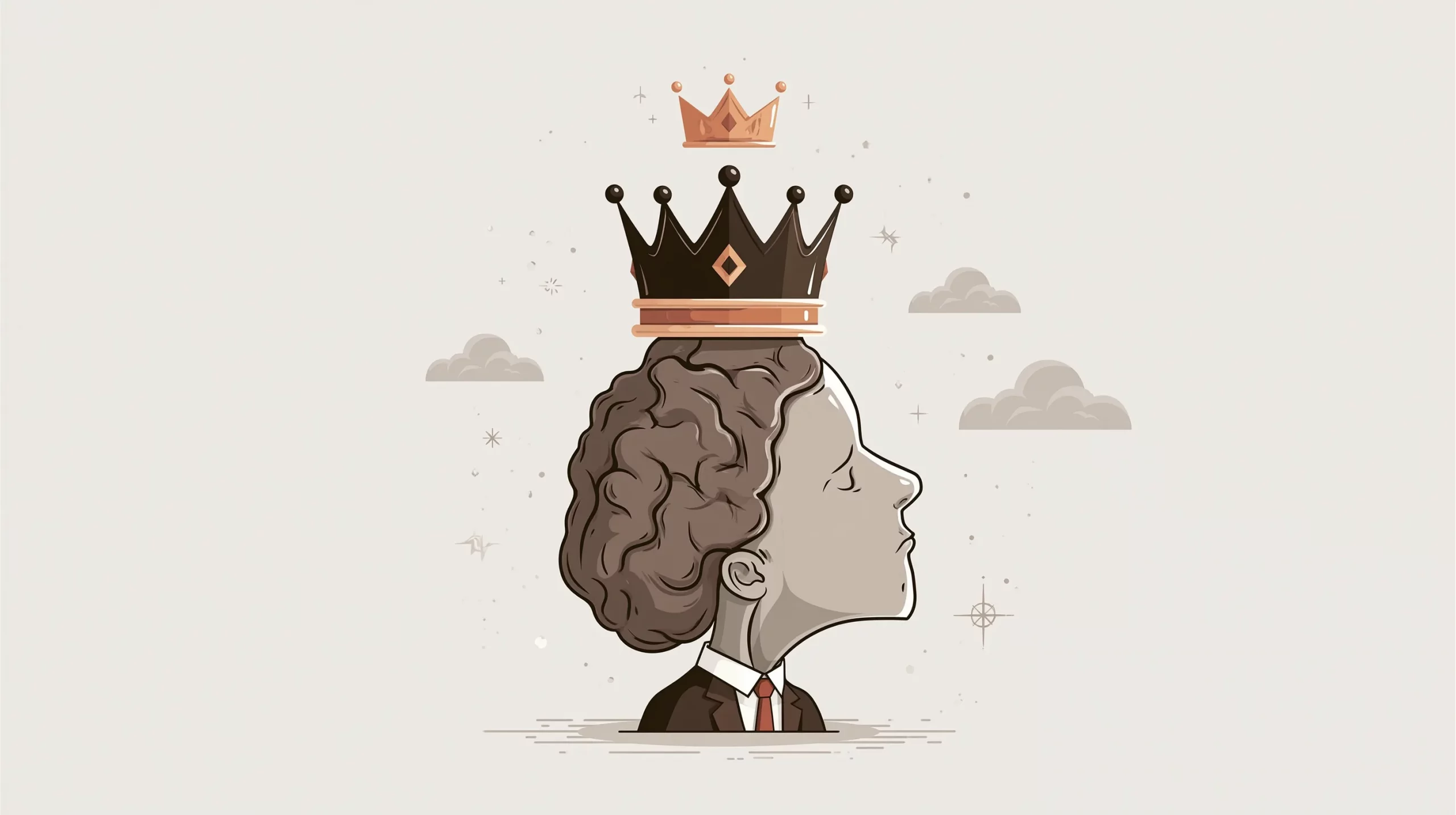
How Power Changes Your Brain: The Neuroscience of Authority.
Authority doesn't just change what leaders decide. It restructures the neural circuits that process empathy, reward, and risk. This is what the imaging data actually shows. Here is what the science actually says, and what to do with it.
01The Whitehall Staircase
How a civil-service payroll revealed rank as biology
In 1967, a team of epidemiologists began tracking 17,530 male civil servants in London. The men worked for the same government, lived in the same city, and used the same national health service. They were sorted not by income or education but by employment grade: a clean proxy for position in a bureaucratic hierarchy.[1]
The results, published over the next two decades, demolished a comfortable assumption. Men in the lowest grade did not merely report worse health. They died of coronary heart disease at 3.6 times the rate of men in the highest grade.[1] The gradient was not a cliff between rich and poor. It was a staircase: each step down in rank corresponded to a measurable increase in mortality, across more than twenty disease categories.[7] Subsequent analysis revealed that the gradient persisted after adjusting for smoking, blood pressure, cholesterol, and physical activity, and that the primary mediating variable was job control, the degree of autonomy and decision latitude a person exercised at work.[7][30]
The only variable that tracked the full staircase was position in the hierarchy itself.
Michael Marmot, the study's lead investigator, later condensed the finding into a single phrase: status syndrome, the observation that your place in a social hierarchy predicts your biology more reliably than your bank balance.[23][24]
The answer began to arrive forty years later, when neuroimaging studies revealed something the Whitehall epidemiologists could not have anticipated. The human brain does not process social rank as an abstract concept to be evaluated. It processes rank as a primary reward signal, recruiting the same ventral striatum circuitry it uses to evaluate food, sex, and money.[3] Your brain treats a change in your social standing with the same neural urgency it reserves for a change in your net worth.
This article traces what happens next. Power does not merely sit atop an organisational chart. It enters the brain through the reward system, reconfigures the stress axis, suppresses the circuits responsible for reading other people, and, if sustained long enough, produces a clinical syndrome first described not in a psychology journal but in Brain, the journal of neurology.[6] The evidence runs from fMRI scanners to primate field stations to a hundred years of political leaders. The convergence is difficult to dismiss.
The story of how authority changes your neurology is, at bottom, a story about what happens when a biological system optimised for social attunement gets reprogrammed for social dominance.[2][8]
---
02The Mechanism
The Power Neurochemistry Cascade: Four Stages from Status Elevation to Neural Restructuring
The first clue that power operates through the brain's reward architecture came from a controlled fMRI study by Zink and colleagues at the National Institute of Mental Health.[3] Seventy-two participants were placed in an artificial social hierarchy, their rank experimentally assigned rather than earned, and scanned while processing outcomes that affected either their rank or their money.
The finding was unequivocal. The ventral striatum, the brain's primary reward-valuation region, responded to hierarchy outcomes with statistically equivalent intensity to monetary outcomes.[3] The dorsolateral prefrontal cortex activated selectively when participants viewed a superior, and the amygdala recruited additional threat-processing resources when the hierarchy was unstable.[3] Critically, these patterns persisted even when participants were explicitly instructed to ignore relative rank.
The hierarchy signal was not optional. The brain processed it whether the person wanted to or not.
The theoretical framework for this finding had been articulated five years earlier by Keltner, Gruenfeld, and Anderson, whose approach-inhibition theory proposed that elevated power activates the brain's behavioural approach system, the dopamine-mediated circuit that drives reward-seeking, risk tolerance, and goal pursuit, while simultaneously dampening the behavioural inhibition system that governs threat sensitivity, punishment avoidance, and social vigilance.[2] A 2025 meta-analysis of 269,534 participants confirmed the theory's core predictions, though the effects were indirect, operating through attentional shifts and affective states rather than as a simple on-off switch.[2][27]
The power neurochemistry cascade: the ventral striatum values rank as intensely as it values money, a modest testosterone and cortisol shift follows, the empathy and mirror circuits quieten, and the prefrontal cortex recalibrates toward defending status, reassigning cognitive resources from social monitoring to hierarchy maintenance.
Diagram · HPC
The next stage of the cascade is hormonal. Popular accounts often describe a clean endocrine signature of power: testosterone rises, cortisol falls, and the leader operates in a state of confident, low-stress dominance. The evidence is more complicated.
A 2010 study by Carney, Cuddy, and Yap claimed that adopting expansive "power poses" for two minutes increased testosterone by approximately 19% and decreased cortisol by approximately 25%.[12] The finding became one of the most cited results in social psychology. It also did not replicate. A subsequent study with 200 participants found no significant hormonal effects.[32] The lead author publicly disavowed the hormonal findings in 2016, stating that the evidence did not support the original claims.[12] The subjective experience of feeling powerful after adopting an expansive posture may persist. The neuroendocrine mechanism does not replicate reliably.
The more rigorous evidence on power and hormones comes from the dual-hormone hypothesis, the proposal that dominant behaviour emerges specifically when testosterone is high and cortisol is low.[13] A 2019 meta-analysis by Dekkers and colleagues, spanning 30 studies and 8,538 participants, found that the interaction effect is real: r = -0.061, p = .026.[13] That is a statistically significant result. It is also a very small one. The "hormonal signature of power" is detectable at the population level. It explains a fraction of a percent of variance in dominant behaviour.
The dual-hormone story is not wrong. It is just much quieter than the popular version suggests.
The variable that transforms this quiet signal into a loud one is hierarchy stability. A study showed this in a randomised experiment with 118 participants.[11] Individuals assigned to high status in a stable hierarchy showed the expected profile: blunted cortisol reactivity to a social stressor and improved performance. Individuals assigned to high status in an unstable hierarchy showed the opposite: elevated cortisol, impaired performance, and a stress profile that resembled subordination.[11] The same rank produced opposite biology depending on whether the hierarchy felt secure.
Robert Sapolsky documented the same pattern in wild baboons decades earlier. Dominant males in stable hierarchies had the lowest cortisol in the troop. Dominant males during periods of rank instability had the highest.[14] "It is not rank per se that predicts the endocrine profile," Sapolsky later wrote. "It is rank in the context of stability."[34]
03Evidence
The 5 Strongest Studies on the Neuroscience of Power
01The claim
The single load-bearing finding
The hero study finds Equal neural salience.
Pooled estimate
Equal neural salience
02How we measured
Grading the hierarchy studies
Studies scored on design, sample, rigour, causality, replication, citations.
Causality is the hard problem in power neuroscience: most hierarchy studies use priming rather than real authority, so design strength and experimental control separate studies worth trusting from those worth merely citing.
Rubric weights
03The spread
Heterogeneity across 5 studies
Methodological quality across the ranked studies.
Rubric spread
86
→ 66 /100
Highest to lowest rubric score across the ranked studies.
04What does not hold
Negative knowledge
What the evidence base does not support.
The evidence also reveals what is not as reliable as popular accounts suggest. The power-pose hormonal findings have been retracted by the first author and failed multiple large replications. The broader "power posture" literature, examining non-verbal displays of dominance, shows effects on self-reported confidence that are more durable than the neuroendocrine claims, but these are behavioural self-assessments, not neural outcomes. Similarly, the moral corruption literature requires nuance.
5 trials. One pooled answer.
Below: the anchor study in full; then the forest plot at scale; then the supporting trials in ranked order.
01Anchor
Know Your Place: Neural Processing of Social Hierarchy in Humans · Neuron, 58(2), 273-283 · DOI: 10.1016/j.neuron.2008.01.025
The foundational causal demonstration that rank activates primary reward circuitry in humans, independently of material outcomes.
No other study in this literature combines controlled hierarchy assignment, whole-brain fMRI with ROI confirmation, and 400+ subsequent citing studies with NIMH endorsement.
Rubric breakdown
The strongest studies, ranked by methodological weight.
Each scored 0–100 against a six-criterion rubric, tagged by design and year; the anchor leads. No study in this set reaches the rubric-90 tier.
02
Power Changes How the Brain Responds to Others · J. Experimental Psychology: General, 143(2), 755-762 · DOI: 10.1037/a0033477
Experimentally induced power suppresses motor resonance, the neural mechanism through which we automatically simulate others' actions, even in participants explicitly told to empathise.[4]
78/100
03
Power and Perspectives Not Taken · Psychological Science, 17(12), 1068-1074 · DOI: 10.1111/j.1467-9280.2006.01824.x
Power reduces spontaneous perspective-taking across visual, epistemic, and emotional channels. The deficit is not domain-specific but reflects a general cognitive reorientation away from others' viewpoints.[5]
74/100
04
Hubris Syndrome: An Acquired Personality Disorder? · Brain, 132(5), 1396-1406 · DOI: 10.1093/brain/awp008
Hubris syndrome, a pattern of 14 behavioural changes including grandiosity, recklessness, and contempt for others, develops specifically after sustained exercise of power. It is described as an acquired condition, not an innate personality trait.[6][26]
66/100
05
Marmot et al. (1978/1991), The Whitehall Studies · J. Epidemiology & Community Health / Lancet · N = 17,530 + 10,308
Mortality tracks social rank even within the same profession, healthcare system, and city, isolating hierarchy position as a biological risk factor independent of poverty.[1][7] Subsequent analysis showed that low job control, not rank itself, explains most of the coronary heart disease gradient.[30]
72/100
04Stakes
The neuroscience of power carries four categories of consequence. Each represents not a failure of character but a predictable outcome of the neural reconfiguration described above.
When the cascade runs unchecked, the consequences scale from individual empathy failure to population-level health gradients, each mechanistically traceable to a stage of the power neurochemistry model.
The Blind Spot That Builds In
When van Kleef and colleagues measured compassionate responses to a suffering partner, high-power participants showed significantly reduced distress and compassion compared to controls, a difference mediated by autonomic emotion regulation, not conscious choice.[10] Combined with Hogeveen's TMS evidence of suppressed motor resonance[4] and Galinsky's behavioural data on impaired perspective-taking,[5] the pattern is consistent: power reduces the brain's allocation of resources to understanding other people's internal states. Keltner synthesised two decades of this research into the concept of the power paradox: the qualities that earn a person influence, empathy, social attunement, generosity, are precisely the qualities that erode once power is held.[8]
colleagues stop bringing problems, feedback arrives pre-filtered, the leader is the last to know about emerging failures
The Two-Mechanism Corruption Path
The corruption pathway operates through at least two mechanisms. The first is cognitive: power increases illusory pattern perception, the tendency to see meaningful structure in random noise, particularly when combined with feelings of powerlessness in adjacent domains.[33] The second is moral: in an fMRI bribery paradigm, Hu and colleagues found that power-holders accepted bribes at a rate of 61.6% in a dyadic condition, compared to 82.8% in a non-social control.[16] The ventromedial prefrontal cortex integrated moral costs during these decisions, while the anterior insula encoded the subjective violation of honesty norms.[16] Owen and Davidson's 100-year clinical review identified hubris syndrome as the endpoint: a pattern of grandiosity, recklessness, and contempt that develops specifically under sustained authority.[6]
overconfidence in pattern recognition, rationalisation of rule exceptions, contempt for subordinate caution
When High Status Becomes a Stressor
The Whitehall data demonstrate that hierarchy position predicts health at the population level.[1][7] But the relationship is not linear upward. Sapolsky's baboon research showed that dominant males during periods of hierarchy instability had the highest cortisol in the troop, higher than any subordinate.[14] A randomised experiment confirmed the same pattern in humans: high status in an unstable hierarchy produced worse cortisol profiles than low status. [11] Stable power protects. Contested power is biologically toxic.
chronic activation, difficulty disengaging from monitoring, sleep disruption despite apparent success
The Compounding Loop at the Top
Power concentrates decision-making authority while simultaneously eroding the social bonds that buffer stress.[17] Cacioppo and Hawkley's review established that both subjective loneliness and objective social isolation independently predict all-cause mortality, partly through chronic HPA axis activation.[17][29] Holt-Lunstad's meta-analysis confirmed the magnitude: weak social connections carry a mortality risk comparable to smoking fifteen cigarettes per day.[31] For leaders at the top of a hierarchy, the combination of empathy suppression and structural isolation creates a compounding cycle with measurable physiological costs.
a narrowing circle of candid advisers, growing reliance on formal reports over direct conversation, reduced recovery between high-stakes decisions
05Protocol
A 4-Step Counter-Cascade Protocol
Evidence-informed structural interventions that treat the power neurochemistry cascade as a programme to interrupt, not a character flaw to overcome. Each step targets a specific stage of the cascade with a specific counter-signal.
The protocol, as a sequence.
Before → Daily → Daily → Ongoing
Hierarchy Clarity
Establish clear, legitimate rank structures with transparent criteria for advancement and role boundaries. Ambiguity about who holds authority, how long they hold it, and what would change it generates the instability signal that converts power from a biological buffer into a biological stressor. Counter the Stage 3 hormone-shift cascade by ensuring hierarchy is stable before it is inhabited.
A study showed that hierarchy stability, not position, is the primary moderator of the cortisol response to status.[11] High-status individuals in stable hierarchies showed buffered stress and improved performance. High-status individuals in unstable hierarchies showed elevated cortisol and degraded performance.[11] Sapolsky documented the same gradient in wild baboons over decades.
Flat organisational rhetoric that leaves informal hierarchies unacknowledged. Research on reverse-dominance hierarchies in egalitarian societies suggests that humans suppress hierarchy rather than eliminate it.[22] Suppression creates ambiguity, not stability.
Perspective Reset
Schedule deliberate perspective-taking exercises before consequential decisions. The form matters less than the regularity: structured feedback sessions, psychological safety audits,[20] or explicit role-reversal protocols all counteract the default empathy suppression that Stage 4 of the cascade produces.
Galinsky's five experiments demonstrated that power-induced perspective-taking deficits are experimentally reversible: prompting high-power participants to take another person's perspective before a task eliminated the accuracy deficit.[5] Mascaro and colleagues showed that compassion training increased empathic accuracy in 8 of 13 participants, with corresponding increases in temporoparietal junction and insula activity.[18]
Relying on self-assessment of empathy. The Hogeveen TMS data show that the suppression operates below conscious awareness. The leader who reports feeling empathic may still show reduced neural resonance. Self-report is the lagging indicator, not the leading one.
Compassion Orientation
Orient leadership practice toward compassion (approach, action) rather than empathy absorption (feeling others' pain). The neurological distinction is consequential: compassion sustains engagement, while empathic distress produces the burnout that accelerates the cascade's erosive effects.[19]
Compassion and empathy activate different neural circuits. Empathic distress recruits pain-processing regions and produces withdrawal. Compassion activates reward-adjacent circuits, the insula and anterior cingulate cortex, and produces approach motivation.[19] Lutz and colleagues demonstrated that compassion training restructures these circuits even in novice meditators. A meta-analysis confirmed that meditation interventions produce medium-effect cortisol reductions in at-risk samples.[25]
Treating emotional intelligence as a stable trait rather than a practice requiring maintenance. The academic construct of EI is more limited than the popularised version,[21] and self-report measures correlate substantially with personality traits, raising questions about construct validity.
Accountability Architecture
Build external feedback mechanisms that cannot be suppressed by the power-holder. Formal 360-degree review processes, independent board oversight, and structured dissent protocols all create the accountability signals that counteract the brain's default tendency toward hierarchy maintenance at the expense of social monitoring.[20][28]
Hubris syndrome is more likely to manifest the longer a person exercises power and the greater the power they exercise.[26] Edmondson's research on psychological safety provides the structural counterweight: teams in which members can challenge authority without punishment show better learning outcomes and fewer errors.[20]
Voluntary self-reflection as the sole accountability mechanism. The neural evidence suggests that power recalibrates attention toward goal-relevant information and away from social cues.[15] The person most in need of external feedback is the least likely to seek it spontaneously.
06Verdict
The verdict.
"It is not rank per se that predicts the endocrine profile. It is rank in the context of stability.", Sapolsky (2017), *Behave*
Bottom line
The science of power does not tell leaders to be more empathic. It tells them that empathy requires infrastructure, and that infrastructure is the only thing the cascade cannot suppress.
The argument
The evidence reviewed here, 34 sources spanning fMRI imaging, TMS neurophysiology, randomised experiments, longitudinal epidemiology, animal models, and clinical case analysis, converges on a single conclusion. Power is not merely a social arrangement. It is a neurobiological state that reconfigures the brain's reward valuation, stress calibration, empathy circuitry, and prefrontal organisation.[3][4][9][11] The reconfiguration follows a predictable sequence. The reward system treats hierarchy position as a primary incentive.[3] The endocrine axis shifts toward a dominant profile, but only under conditions of hierarchy stability. Contested power produces the opposite.[11][14] The motor resonance system, which allows automatic simulation of others' actions, is suppressed.[4] Perspective-taking accuracy declines across cognitive channels.[5] And if the state is sustained without interruption, the clinical literature documents an acquired syndrome of grandiosity, recklessness, and empathic failure that meets criteria for a personality change published in Brain.[6]
None of this is destiny. The same literature that documents power's neural effects provides the corrective mechanisms. Stable hierarchies buffer cortisol.[11] Deliberate perspective-taking reverses empathy loss.[5] Compassion training restructures the relevant circuits.[18][19] Accountability structures interrupt the feedback loop before hubris consolidates.[20] The brain that power rewires is the same brain that can be rewired back, provided the counter-signals are deliberate, structural, and sustained.
The Whitehall studies established that hierarchy gets under the skin.[1] The neuroimaging work established how.[3] The intervention studies established that the process is reversible.[5][11][18] What remains is the question of whether the people who hold power will use what the science has revealed, or whether, as the evidence predicts, their reconfigured brains will find reasons not to.
The deeper lesson of the power neuroscience literature is that the brain holding authority is running a programme optimised for hierarchy maintenance, not social attunement. The mPFC is allocating resources to rank preservation. The stress axis is calibrated to hierarchy stability signals.[11] The motor resonance system has been dialled back.[4] Asking that brain to self-correct through reflection alone is asking a programme to debug itself. Structure does what intention cannot.
No comparison figure runs here. The prose above does not resolve to one clean effect size to set against another, and this magazine does not manufacture a number to fill the space. The verdict stands on the evidence as written.
Power runs a neural programme
Authority activates reward circuitry, recalibrates the stress axis, suppresses empathy circuits, and, if sustained, restructures prefrontal organisation. The cascade is not a metaphor, it is a sequence of measurable neural events. Each stage is supported by independent experimental or epidemiological evidence.
Unchecked cascade produces predictable failure
When the cascade runs without structural counter-signals, the result is not a character failing but a brain-level outcome: empathy deficits that are subcortical and automatic, judgment corruption that operates through at least two independent mechanisms, and, at the clinical extreme, an acquired syndrome with 14 diagnostic criteria published in a neurology journal.
Structure outperforms intention
The single highest-leverage intervention is structural: stable hierarchies, scheduled perspective-taking, compassion practice with measurable neural correlates, and external accountability that cannot be suppressed by the cascade itself. Wanting to be a better leader is necessary but not sufficient. The cascade does not yield to intention. It yields to architecture.
Put it to work
Where this science goes next on HPC
07Bibliography
The bibliography.
-
01
Journal
doi: 10.1136/jech.32.4.244
Rubric 72/100
Employment grade and coronary heart disease in British civil servants
-
02
Review
doi: 10.1037/0033-295x.110.2.265
Power, approach, and inhibition
-
03
Journal
doi: 10.1016/j.neuron.2008.01.025
Know your place: Neural processing of social hierarchy in humans
-
04
Journal
doi: 10.1037/a0033477
Rubric 78/100
Power changes how the brain responds to others
-
05
Journal
doi: 10.1111/j.1467-9280.2006.01824.x
Rubric 74/100
Power and perspectives not taken
-
06
Journal
doi: 10.1093/brain/awp008
Rubric 66/100
Hubris syndrome: An acquired personality disorder? A study of US Presidents and UK Prime Ministers over the last 100 years
-
07
Journal
doi: 10.1016/0140-6736(91)93068-K
Health inequalities among British civil servants: The Whitehall II study
-
08
Book
no doi
The power paradox: How we gain and lose influence
-
09
Journal
doi: 10.1126/science.1209951
Bidirectional control of social hierarchy by synaptic efficacy in medial prefrontal cortex
-
10
Journal
doi: 10.1111/j.1467-9280.2008.02241.x
Power, distress, and compassion: Turning a blind eye to the suffering of others
-
11
Journal
doi: 10.1073/pnas.1609811114
Hierarchy stability moderates the effect of status on stress and performance in humans
-
12
Journal
doi: 10.1177/0956797610383437
Power posing: Brief nonverbal displays affect neuroendocrine levels and risk tolerance
-
13
Meta
doi: 10.1016/j.neubiorev.2018.12.004
A meta-analytical evaluation of the dual-hormone hypothesis: Does cortisol moderate the relationship between testosterone and status, dominance, risk taking, aggression, and psychopathy?
-
14
Journal
doi: 10.1016/0306-4530(92)90008-X
Cortisol concentrations and the social significance of rank instability among wild baboons
-
15
Journal
doi: 10.1016/j.jesp.2006.06.013
Power affects basic cognition: Increased attentional inhibition and flexibility
-
16
Journal
doi: 10.7554/eLife.63922
Neural basis of corruption in power-holders
-
17
Review
doi: 10.1007/s12160-010-9210-8
Loneliness matters: A theoretical and empirical review of consequences and mechanisms
-
18
Journal
doi: 10.1093/scan/nss095
Compassion meditation enhances empathic accuracy and related neural activity
-
19
Journal
doi: 10.1371/journal.pone.0001897
Regulation of the neural circuitry of emotion by compassion meditation: Effects of meditative expertise
-
20
Journal
doi: 10.2307/2666999
Psychological safety and learning behavior in work teams
-
21
Review
no doi
What makes a leader? Harvard Business Review, 76(6), 93–102
-
22
Book
no doi
Hierarchy in the forest: The evolution of egalitarian behavior
-
23
Journal
doi: 10.1111/j.1740-9713.2004.00058.x
Status syndrome
-
24
Book
no doi
The status syndrome: How social standing affects our health and longevity
-
25
Meta
doi: 10.1080/17437199.2020.1760727
Meditation interventions efficiently reduce cortisol levels of at-risk samples: A meta-analysis
-
26
Journal
doi: 10.7861/clinmedicine.8-4-428
Hubris syndrome
-
27
Chapter
no doi
Power, approach, and inhibition: Empirical advances of a theory. In A. Guinote & T. K. Vescio (Eds.), The social psychology of power (pp. 71–96). Guilford Press
-
28
Review
doi: 10.1146/annurev-orgpsych-031413-091259
Perspectives on power in organizations
-
29
Journal
doi: 10.1016/j.tics.2009.06.005
Perceived social isolation and cognition
-
30
Journal
doi: 10.1053/euhj.2001.2611
The role of psychobiological pathways in socio-economic inequalities in cardiovascular disease risk
-
31
Meta
doi: 10.1371/journal.pmed.1000316
Social relationships and mortality risk: A meta-analytic review
-
32
Journal
doi: 10.1177/0956797614553946
Assessing the robustness of power posing: No effect on hormones and risk tolerance in a large sample of men and women
-
33
Journal
doi: 10.1126/science.1159845
Lacking control increases illusory pattern perception
-
34
Book
no doi
Behave: The biology of humans at our best and worst
No entries match the current filter and search.
The protocol card
How Power Changes Your Brain: The Neuroscience of Authority
One sheet. The four moves, in the order the day runs them.
-
01
Before · Structural setup
Hierarchy Clarity
Establish clear, legitimate rank structures with transparent criteria for advancement and role boundaries. Ambiguity about who holds authority, how long they hold it, and what would change it generates the instability signal that converts power from a biological buffer into a biological stressor. Counter the Stage 3 hormone-shift cascade by ensuring hierarchy is stable before it is inhabited.
AvoidFlat organisational rhetoric that leaves informal hierarchies unacknowledged. Research on reverse-dominance hierarchies in egalitarian societies suggests that humans suppress hierarchy rather than eliminate it. Suppression creates ambiguity, not stability.
-
02
Daily · Scheduled
Perspective Reset
Schedule deliberate perspective-taking exercises before consequential decisions. The form matters less than the regularity: structured feedback sessions, psychological safety audits, or explicit role-reversal protocols all counteract the default empathy suppression that Stage 4 of the cascade produces.
AvoidRelying on self-assessment of empathy. The Hogeveen TMS data show that the suppression operates below conscious awareness. The leader who reports feeling empathic may still show reduced neural resonance. Self-report is the lagging indicator, not the leading one.
-
03
Daily · Practice
Compassion Orientation
Orient leadership practice toward compassion (approach, action) rather than empathy absorption (feeling others' pain). The neurological distinction is consequential: compassion sustains engagement, while empathic distress produces the burnout that accelerates the cascade's erosive effects.
AvoidTreating emotional intelligence as a stable trait rather than a practice requiring maintenance. The academic construct of EI is more limited than the popularised version, and self-report measures correlate substantially with personality traits, raising questions about construct validity.
-
04
Ongoing · Structural
Accountability Architecture
Build external feedback mechanisms that cannot be suppressed by the power-holder. Formal 360-degree review processes, independent board oversight, and structured dissent protocols all create the accountability signals that counteract the brain's default tendency toward hierarchy maintenance at the expense of social monitoring.
AvoidVoluntary self-reflection as the sole accountability mechanism. The neural evidence suggests that power recalibrates attention toward goal-relevant information and away from social cues. The person most in need of external feedback is the least likely to seek it spontaneously.
hiperformanceculture.com · 34 sources ·



How this was made
The desk, the instrument, and when this page is next examined.
- Desk
- HPC Editorial
- Instrument
- 6 weighted criteria, 100 points see every score
- Register
- 34 sources, 28 with a resolving DOI read them
- Reading time
- 22 min read
Revision log
- First published.
- Last revised. Sources re-checked against the register above.
- Next review Due by , or earlier if a new controlled trial or systematic review lands.
THE HAND-OFF. Performance Scan: find your limiting factor. Three minutes, 24 questions, six systems. Your answers never leave your device.