
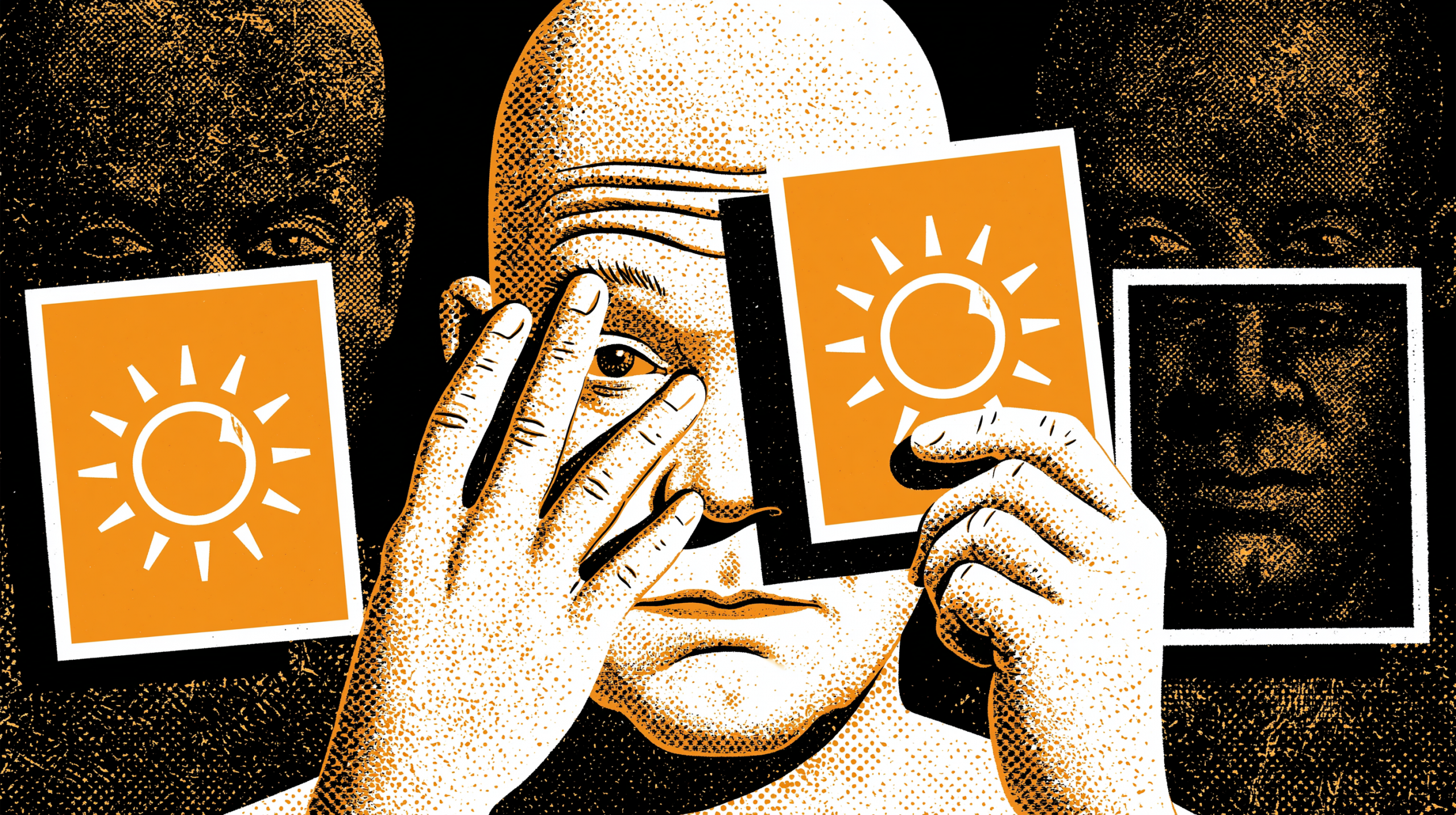
The Negativity Bias: Why Your Brain Remembers Insults but Forgets Compliments.
Your brain processes bad faster, encodes it deeper, and recalls it more readily than good. This biological asymmetry shapes everything from what you click to how you lead, and specific cognitive strategies can measurably counteract it. Here is what the science actually says, and what to do with it.
01Bad Is Stronger Than Good
Your brain files threats as more true than rewards
In 2023, researchers partnered with the digital media platform Upworthy to run what may be the largest randomised controlled trial ever conducted on human attention: 22,743 headline variants tested against 370 million real impressions, measuring not what people said they preferred but what they actually clicked.[1] The finding was blunt. Each additional negative word in a headline increased click-through rate by 2.3 per cent. Positive words had the opposite effect. Human beings, given a free choice between equivalent information framed positively or negatively, reliably choose the negative version, not because they enjoy bad news but because their brains treat it as more urgent and more worth remembering.
That pattern, what psychologists call negativity bias, is not new to science. In 2001, Roy Baumeister and colleagues published a landmark review titled Bad Is Stronger than Good, synthesising evidence from across psychology, economics, sociology, and developmental science.[2] Their conclusion was stark: negative events, bad feedback, and bad information are associated with greater behavioural effects than positive events of equivalent objective magnitude across every domain examined. Bad impressions form faster and resist disconfirmation more stubbornly than good ones. The self works harder to avoid a bad identity than to pursue a good one. A quarter-century and more than ten thousand citations later, the core finding has not been overturned.[3]
What has changed is the precision of the explanation. We now understand negativity bias not merely as a psychological tendency but as a neural architecture: a set of measurable asymmetries in how the brain detects, encodes, consolidates, and retrieves negative versus positive information. And we understand, with increasing specificity, what it costs when that architecture runs unchecked in environments it was never designed for.
The asymmetry shows up before a child can speak. Developmental research demonstrates that infants in the second half of their first year already attend more to negative than positive social-emotional cues, an observation consistent with the evolutionary interpretation that threat detection was under stronger selection pressure than reward detection.[6] Paul Rozin and Edward Royzman's 2001 taxonomy distinguished four manifestations: negative potency (bad events are subjectively stronger), negative gradients (negativity grows faster as events intensify), negativity dominance (mixed combinations tilt negative), and negative differentiation (we have richer cognitive categories for bad than for good).[3]
These distinctions are not interchangeable. A person whose bias manifests as negative potency (bad events hitting harder) faces a different problem from someone whose bias manifests as negative differentiation, where the vocabulary for failure is richer than the vocabulary for success. Soroka, Fournier, and Nir's 17-country physiological study demonstrated that individual-level variation is substantial and not neatly explained by culture.[4]
Negativity bias is a species-wide architecture, not a deterministic programme. It expresses differently across people and contexts, and the intervention literature now shows it responds to cognitive strategies that target the mechanism itself.
02The Mechanism
The Neural Architecture of Why Bad Hits Harder
The story begins in the oldest part of the brain's alarm system. When sensory input reaches the thalamus, it has a choice of routes. The fast route, the thalamo-amygdaloid pathway identified by Joseph LeDoux, bypasses the cortex entirely, delivering a rough-and-ready threat assessment to the amygdala in approximately 12 milliseconds.[7] This is the circuit that makes you flinch before you know why. The slow route takes the scenic path through sensory cortex, builds a detailed representation, and arrives at the amygdala roughly 150 to 300 milliseconds later, by which time the fast route has already triggered a defensive cascade.
Catherine Norris's integration of event-related potential (ERP) and functional magnetic resonance imaging (fMRI) evidence confirmed what that architecture implies: negative stimuli produce larger P1 component responses than positive stimuli matched for arousal, a pattern consistent with pre-conscious attentional capture.[8] The amygdala activates for negative inputs even when stimuli are presented subliminally, below conscious awareness.[13] The brain does not wait for your opinion before deciding that bad deserves more processing power.
That matters because the asymmetry is not just about detection speed. It cascades downstream into every system the amygdala talks to, and the amygdala talks to nearly everything.
The negativity-bias cascade: the thalamo-amygdaloid fast track fires a threat alarm in ~12 ms; the amygdala triggers cortisol and norepinephrine release; those neurochemicals bias hippocampal consolidation toward threat memories; and the same cortisol surge blunts the prefrontal brake, leaving the alarm as the final verdict.
Diagram · HPC
Once the amygdala flags a stimulus as negative, the hypothalamic-pituitary-adrenal axis (HPA axis) activates, releasing cortisol and norepinephrine.[9] In an fMRI study of emotional images and sounds, activity patterns in the hippocampus and amygdala were linked to later memory for negative events.[11] A theoretical synthesis identified the core circuit: the amygdala, hippocampus, and ventromedial prefrontal cortex (vmPFC) form a triangular loop of emotional tagging, memory consolidation, and top-down regulation.[9] When regulation fails under elevated cortisol, the result is a memory system biased toward threat.
The persistence is striking. Klug, Enneking, and colleagues' two-year fMRI follow-up of 57 patients with major depressive disorder found that amygdala hyperactivity to subliminal negative stimuli persisted regardless of whether patients had relapsed or remitted.[10] A translational study in a mouse model of depression found that disrupted basolateral amygdala circuits support negative valence bias in depressive states. [12]
03Evidence
The 5 Strongest Studies on Negativity Bias Science
01The claim
The single load-bearing finding
The hero study finds 10,000+ citations.
Not all evidence is equal. The five studies below were scored against a 100-point rubric measuring design quality, sample scope, rigour, causal inference, replication, and field influence. The ranking asks which findings you can trust most, and why. The philosophical critique should be noted: Jennifer Corns has argued that the negativity bias construct rests on definitional ambiguities about what counts as "negative."[15] That challenge has sharpened how researchers operationalise the construct.
Pooled estimate
10,000+ citations
02How we measured
Grading the asymmetry evidence
Studies scored on design, sample, rigour, causality, replication, citations.
Because the negativity bias spans subjective reports, physiological measures, click behaviour, and neural activation, the decisive rubric question is whether an objective, hard-to-fake measure was used, which separates genuine asymmetry from self-report artefact.
Rubric weights
03The spread
Heterogeneity across 5 studies
Methodological quality across the ranked studies.
The hierarchy reveals a pattern. The highest-scoring studies are the broadest in scope (Baumeister's synthesis, Soroka's 17-country experiment), while the most causally precise (Robertson's RCT) scores lower on replication because its data comes from a single publisher.[1] The intervention study (Doré) scores lowest on sample size but highest on practical relevance: it is the only study that tells you what to do. This is a maturing field. The foundational observations are established. The mechanistic pathway is increasingly mapped. The intervention evidence is youngest and thinnest.
Rubric spread
86
→ 68 /100
Highest to lowest rubric score across the ranked studies.
04What does not hold
Negative knowledge
What the evidence base does not support.
One finding deserves mention outside the hierarchy. Vos, Everaert, and Koster's 2025 meta-analysis of 81 longitudinal studies (N = 17,709) found that interpretation bias and memory bias reliably predict later anxiety and depression (β = 0.04, p < .001).[16] The effect is small but robust: not strong predictors, but consistent ones, a distinction that matters for modifiable risk.[22]
5 trials. One pooled answer.
Below: the anchor study in full; then the forest plot at scale; then the supporting trials in ranked order.
01Anchor
Bad Is Stronger than Good
The negative-to-positive asymmetry is not domain-specific. It is a general organising principle of human psychology, operating from first impressions through long-term memory.
No single study matches its scope. While individual experiments may have cleaner causal designs, none synthesises evidence across as many psychological domains with as much subsequent empirical confirmation.
Rubric breakdown
The strongest studies, ranked by methodological weight.
Each scored 0–100 against a six-criterion rubric, tagged by design and year; the anchor leads. No study in this set reaches the rubric-90 tier.
02
Cross-national evidence of a negativity bias in psychophysiological reactions to news
Across 17 countries and six continents, participants showed greater skin conductance response to negative than positive BBC news content on average. The effect reached individual statistical significance in 9 of 17 countries; two countries showed directionally opposite effects.[4]
82/100
03
The Negativity Bias, Revisited: Evidence from Neuroscience Measures and an Individual Differences Approach
Electrophysiological measures show larger P1 components for negative stimuli than for positive stimuli matched for arousal, consistent with early attentional capture; fMRI data confirm heightened amygdala recruitment for negative inputs.[8]
74/100
04
Negativity drives online news consumption
Each additional negative word in a headline increased click-through rate by 2.3%; positive words decreased consumption. The effect held across news categories within the dataset.[1]
79/100
05
Reappraisal but not Suppression Determines Negativity Bias After Stress Exposure
Habitual cognitive reappraisers showed significantly less negativity increase under acute stress (Study 1, N = 43, lab) and real-world pandemic stress (Study 2, N = 97). Suppression showed no protective effect in either study.[14]
68/100
04Stakes
The Four Costs of Uncalibrated Negativity
Negativity bias becomes pathological not when it detects threats but when it treats everything as a threat, distorting mental health, performance, decisions, and the information environment itself.
The Rumination Cascade
Negative interpretation and memory biases prospectively predict worsening anxiety and depression across 81 longitudinal studies.[16] The bias does not cause mental illness by itself, but it reliably feeds the cycle. Wisco and Harp demonstrated that rumination mediates the link between interpretation bias and depression symptoms. The bias creates the raw material that rumination converts into sustained distress.[21]
replaying what went wrong, catastrophising ambiguous events, waiting for the next bad thing
The Feedback Distortion
Bianchi and colleagues found that both burnout and depression are associated with over-recall of negative items and under-recall of positive items (N = 1,015 educational staff).[17] One piece of critical feedback can occupy more cognitive real estate than months of praise. Blanco-Encomienda's meta-analysis confirmed that work-related rumination significantly impairs employee well-being across studies. The bias does not stay at the office.[18]
remembering the one criticism from last quarter, forgetting the praise, chronic professional self-doubt
The Loss Aversion Trap
Molins, Martínez-Tomás, and Serrano demonstrated that implicit negativity bias predicts greater loss aversion in risky decisions, an effect specific to implicit (automatic) processing rather than explicit (deliberate) evaluation.[19] The bias silently overweights past losses when you assess present opportunities. The practical consequence is not irrationality but systematic conservatism: avoiding beneficial risks because the memory of past failures is encoded more vividly than the memory of past successes.
knowing an opportunity is good but fixating on what went wrong last time, avoiding calculated risks
The Algorithmic Multiplier
The modern information environment does not merely reflect negativity bias. It exploits it. Robertson's data shows publishers are rewarded for negative framing.[1] A panel study found that news orientations were linked to higher egotropic anxiety about violent crime and climate change: worry about being personally affected or harmed. [20] Watson's social sharing data closes the loop: users amplify the negative content that algorithms then serve to others.[5] The digital environment converts a personal cognitive bias into a collective information distortion.
knowing the world isn't ending but being unable to stop doomscrolling, anxiety after reading news
05Protocol
A 4-Strategy Negativity Bias Recalibration Protocol
These are not happiness hacks. They are evidence-informed strategies that target specific nodes in the negativity bias circuit: the appraisal system, the attentional filter, the emotional valence, and the environment that triggers the cascade.
The protocol, as a sequence.
Daily → Structured → Daily → Architectural
Cognitive Reappraisal
Write a brief reappraisal narrative after negative events: same facts, different meaning frame. Target the interpretation, not the emotion.
Doré's two-study evidence shows that habitual cognitive reappraisal significantly attenuates negativity increase under stress; suppression does not.[14] A study protocol proposes that reappraisal training may reduce negative cognitive bias by altering prefrontal-amygdala connectivity. [23] The mechanism works by strengthening the prefrontal brake, not suppressing the alarm.
Using suppression ("don't think about it") instead of reappraisal. Doré's data is unambiguous: suppression has zero protective effect against stress-amplified negativity.[14]
Mindfulness Training
Complete a structured MBSR or equivalent mindfulness programme, minimum 8 weeks.
Hanley and Garland found that MBSR produces a lasting shift toward positive appraisals of ambiguous stimuli, sustained at 8-week follow-up.[24] Wei's randomised controlled fMRI study confirmed that mindfulness-based intervention reduces interference from negative stimuli in working memory.[27] The mechanism is nonreactivity: learning to observe the negative signal without amplifying it.
Expecting immediate results. The shift is a training effect that consolidates over weeks, not a session-level outcome.[24]
Gratitude Logging
Write three specific, recent, sensory-grounded gratitude entries daily for at least 14 days.
A meta-analysis of 64 randomised controlled trials reported meaningful reductions in anxiety and depressive symptom scores relative to control conditions.[25] The mechanism appears to operate through deliberate attentional redirection, forcing the encoding system to process positive events with the same specificity it naturally reserves for negative ones.
Vague generalities ("I'm grateful for my family"). The evidence points toward specific, recent, concrete entries as the active ingredient: not the sentiment but the specificity.[30]
Digital Environment Design
Set specific time windows for news consumption, unfollow algorithmically recommended negative content, and restructure notification defaults.
06Verdict
The verdict.
"Cognitive reappraisal attenuates the negativity spiral. Suppression does not. The difference is not willpower. It is mechanism.", Adapted from Doré, Silvers, & Ochsner (2021), *Affective Science*
Bottom line
Your brain was built to remember insults and forget compliments. That is the architecture. What you build on top of it is the only part that is actually up to you.
The argument
Negativity bias is among the most replicated findings in human psychology: a conserved neural architecture that processes threats faster, encodes them deeper, and retrieves them more readily than equivalent positive experiences. It is not a flaw. It is a survival system running at full intensity in an environment that no longer requires it. The strongest evidence, from Baumeister's foundational synthesis through Soroka's 17-country demonstration through Robertson's 370-million-impression experiment, establishes that the asymmetry is real, cross-cultural, and behaviourally consequential. The intervention evidence points consistently in one direction: cognitive reappraisal, not suppression, engages the prefrontal brake and recalibrates the system. You cannot remove the bias. You can change how much authority you grant it.
The practical question is not whether your brain treats bad as stronger than good. It does. The practical question is whether you continue to treat the bias's output as an accurate report on reality or whether you recognise it as a signal with a known and measurable distortion, like a gauge that consistently reads high.
For the high-performance reader, this matters beyond emotional comfort. Negativity bias affects how you evaluate feedback, assess risk, and build or erode your own sense of competence.[31][32] It is an engineering problem with a known architecture, documented failure modes, and increasingly evidence-based countermeasures.
The science is not finished. The largest behavioural study draws from a single publisher's data.[1] The reappraisal findings await large-scale confirmation.[14] The gratitude literature is extensive but effect sizes are modest.[25] None of this changes the central argument. The bias is real. The mechanism is mapped. The first-generation countermeasures are identified.
No comparison figure runs here. The prose above does not resolve to one clean effect size to set against another, and this magazine does not manufacture a number to fill the space. The verdict stands on the evidence as written.
Bad really is stronger
Negative events are processed more thoroughly, encoded more deeply, and recalled more readily than positive events of equal magnitude, across every psychological domain examined. This is not a mood or a personality type. It is a conserved neural architecture. The evidence base spans decades, continents, and methodologies.
Unchecked bias distorts everything
When the architecture runs without recalibration, it distorts mental health (feeding rumination and predictive anxiety), professional judgement (amplifying criticism and suppressing recognition), decision-making (systematic over-weighting of losses), and the information environment itself (rewarding negative content with more engagement). The cost is not just emotional. It is operational.
Target the mechanism, not the symptom
Cognitive reappraisal engages the prefrontal brake that cortisol weakens. Mindfulness training reduces attentional reactivity to negative stimuli. Gratitude logging forces the encoding system to process positive events with equivalent specificity. Environmental design removes the triggers that activate the cascade. The bias is built in, but the volume knob is accessible.
Put it to work
Where this science goes next on HPC
07Bibliography
The bibliography.
-
01
Journal
doi: 10.1038/s41562-023-01538-4
Rubric 79/100
Negativity drives online news consumption
-
02
Review
doi: 10.1037/1089-2680.5.4.323
Rubric 86/100
Bad is stronger than good
-
03
Review
doi: 10.1207/S15327957PSPR0504_2
Negativity bias, negativity dominance, and contagion
-
04
Journal
doi: 10.1073/pnas.1908369116
Rubric 82/100
Cross-national evidence of a negativity bias in psychophysiological reactions to news
-
05
Journal
doi: 10.1038/s41598-024-71263-z
Negative online news articles are shared more to social media
-
06
Journal
doi: 10.1037/0033-2909.134.3.383
Not all emotions are created equal: The negativity bias in social-emotional development
-
07
Journal
doi: 10.1023/a:1025048802629
The emotional brain, fear, and the amygdala
-
08
Journal
doi: 10.1080/17470919.2019.1696225
Rubric 74/100
The negativity bias, "revisited": Evidence from neuroscience measures and an individual differences approach
-
09
Journal
doi: 10.3389/fpsyt.2024.1348474
A theory of the neural mechanisms underlying negative cognitive bias in major depression
-
10
Journal
doi: 10.1038/s41380-024-02429-4
Persistence of amygdala hyperactivity to subliminal negative emotion processing in the long-term course of depression
-
11
Journal
doi: 10.1016/j.cortex.2022.02.014
Representing the good and bad: fMRI signatures during the encoding of multisensory positive, negative, and neutral events
-
12
Journal
doi: 10.1038/s41398-024-03085-6
Disrupted basolateral amygdala circuits supports negative valence bias in depressive states
-
13
Journal
doi: 10.1038/s41598-017-00502-3
Neural basis of negativity bias in the perception of ambiguous facial expression
-
14
Journal
doi: 10.1007/s42761-021-00059-5
Rubric 68/100
Reappraisal, but not suppression, tendencies determine negativity bias after laboratory and real-world stress exposure
-
15
Review
doi: 10.1007/s13164-018-0382-7
Rethinking the negativity bias
-
16
Meta
doi: 10.1016/j.cpr.2025.102552
Do cognitive biases prospectively predict anxiety and depression? A multi-level meta-analysis of longitudinal studies
-
17
Journal
doi: 10.1177/1359105318765621
Memory bias toward emotional information in burnout and depression
-
18
Meta
doi: 10.1007/s11205-020-02356-1
Association between work-related rumination, work environment and employee well-being: A meta-analytic study of main and moderator effects
-
19
Journal
doi: 10.3390/ijerph192417037
Implicit negativity bias leads to greater loss aversion and learning during decision-making
-
20
Journal
doi: 10.1080/15205436.2023.2297829
The scary world syndrome: News orientations, negativity bias, and the cultivation of anxiety
-
21
Cohort
doi: 10.1177/20438087211015233
Rumination as a mechanism of the association between interpretation bias and depression symptoms: A longitudinal investigation
-
22
Journal
doi: 10.1177/1754073919892069
Mapping dynamic interactions among cognitive biases in depression
-
23
Journal
doi: 10.3389/fnhum.2022.919002
The antidepressant effect of cognitive reappraisal training on individuals cognitively vulnerable to depression: Could cognitive bias be modified through the prefrontal-amygdala circuits?
-
24
Journal
doi: 10.1007/s12671-021-01810-8
Mindfulness-based stress reduction triggers a long-term shift toward more positive appraisals of emotional ambiguity
-
25
Meta
doi: 10.31744/einstein_journal/2023RW0371
The effects of gratitude interventions: A systematic review and meta-analysis
-
26
Journal
no doi
The negativity bias predicts response rate to behavioral activation for depression
-
27
RCT
doi: 10.1016/j.ijchp.2024.100432
Mindfulness-based intervention reduces interference of negative stimuli to working memory in individuals with subclinical depression: A randomized controlled fMRI study
-
28
Meta
doi: 10.1093/cercor/bht154
Cognitive reappraisal of emotion: A meta-analysis of human neuroimaging studies
-
29
Journal
doi: 10.1080/1047840x.2014.940781
Emotion regulation: Current status and future prospects
-
30
Journal
doi: 10.1037/0003-066X.60.5.410
Positive psychology progress: Empirical validation of interventions
-
31
Journal
no doi
Self-efficacy: The exercise of control
-
32
Journal
doi: 10.1037//0003-066x.55.1.68
Self-determination theory and the facilitation of intrinsic motivation, social development, and well-being
-
33
Journal
doi: 10.1080/21670811.2021.2019074
I knew it, the world is falling apart! Combatting a confirmatory negativity bias in audiences' news selection through news media literacy interventions
No entries match the current filter and search.
The protocol card
The Negativity Bias: Why Your Brain Remembers Insults but Forgets Compliments
One sheet. The four moves, in the order the day runs them.
-
01
Daily · within 2 hours of trigger
Cognitive Reappraisal
Write a brief reappraisal narrative after negative events: same facts, different meaning frame. Target the interpretation, not the emotion.
AvoidUsing suppression ("don't think about it") instead of reappraisal. Doré's data is unambiguous: suppression has zero protective effect against stress-amplified negativity.
-
02
Structured · 8-week programme
Mindfulness Training
Complete a structured MBSR or equivalent mindfulness programme, minimum 8 weeks.
AvoidExpecting immediate results. The shift is a training effect that consolidates over weeks, not a session-level outcome.
-
03
Daily · evening, 5 minutes
Gratitude Logging
Write three specific, recent, sensory-grounded gratitude entries daily for at least 14 days.
AvoidVague generalities ("I'm grateful for my family"). The evidence points toward specific, recent, concrete entries as the active ingredient: not the sentiment but the specificity.
-
04
Architectural · one-time setup + weekly review
Digital Environment Design
Set specific time windows for news consumption, unfollow algorithmically recommended negative content, and restructure notification defaults.
AvoidTrying to resist algorithmic negativity through willpower alone. The architecture of the digital environment was designed to exploit the bias. Redesign the architecture; do not try to out-think it.
hiperformanceculture.com · 33 sources · 6 April 2026




How this was made
The desk, the instrument, and when this page is next examined.
- Desk
- HPC Editorial
- Instrument
- 6 weighted criteria, 100 points see every score
- Register
- 33 sources, 31 with a resolving DOI read them
- Reading time
- 22 min read
Revision log
- First published.
- Last revised. Sources re-checked against the register above.
- Next review Due by , or earlier if a new controlled trial or systematic review lands.
THE HAND-OFF. Performance Scan: find your limiting factor. Three minutes, 24 questions, six systems. Your answers never leave your device.