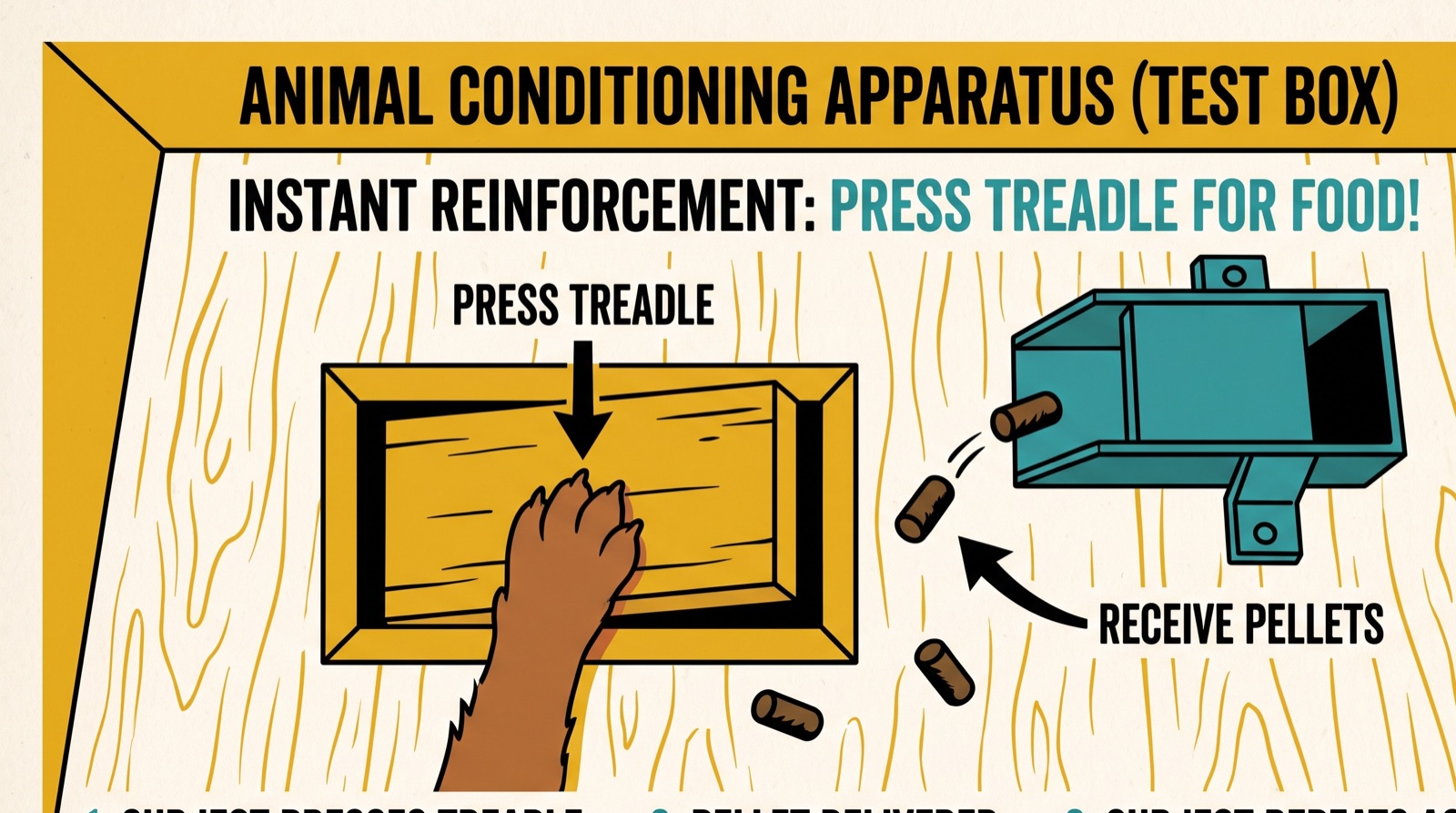
Operant Conditioning n.
Negative reinforcement is not punishment: it involves removing an aversive stimulus to increase a behaviour, whereas punishment introduces an aversive stimulus to suppress one.
/ˈɒp.ər.ənt kənˌdɪʃ.ən.ɪŋ/ · also known as Instrumental conditioning
The definition
Operant conditioning is a form of associative learning in which voluntary behaviour is shaped by its consequences: reinforcement increases the probability of a response recurring, while punishment suppresses it. First systematised by B.F. Skinner, the framework explains how actions become habitual through contingent reward schedules, and why those habits resist extinction even when rewards cease.
The mechanism
Operant conditioning operates through consequence contingency: a voluntary response is followed by an outcome (reinforcer or punisher) that alters the probability of that response under similar future conditions.12 This distinguishes operant from classical conditioning, which pairs stimuli to elicit involuntary reflexes. The critical variable is not temporal proximity between behaviour and outcome, but contingency: the outcome must depend on the response.
Four schedules of reinforcement systematically control response rate and resistance to extinction: fixed-ratio (reinforced after a set number of responses), variable-ratio (after an unpredictable number), fixed-interval (after a set time), and variable-interval (after an unpredictable time).2 Variable-ratio schedules produce the highest and most persistent response rates because unpredictable reward delivery prevents adaptation. The neural substrate for this learning centres on the dorsal striatum, where the direct (go) pathway facilitates reinforced actions and the indirect (no-go) pathway suppresses punished ones, enabling the basal ganglia to function as a biological reinforcement-learning system.4
Extinction of an operant response is not unlearning but the formation of new inhibitory learning that competes with the original response-reinforcer association.3 The original memory remains intact. Spontaneous recovery, renewal (caused by context change), and reinstatement (caused by unsignalled reinforcer exposure) can all restore the extinguished behaviour, which is why stopping a habit does not erase it and why context engineering is more reliable than willpower alone.
Learning by Consequence — Operant conditioning — consequences reinforce or weaken a behaviour, shaping whether it repeats.
In practice
The clearest everyday illustration of variable-ratio scheduling is the design of slot machines, which use unpredictable payouts to maximise the persistence of play well beyond what predictable rewards could produce.
Worked example
A player receives a payout on the 7th pull, then the 23rd, then the 3rd. No pattern is detectable. Because the next win could always be one more pull away, extinction is suppressed and play continues despite net loss. The same mechanism governs compulsive notification-checking: remove the reward schedule and the behaviour extinguishes slowly, but reinstate even occasional positive returns and the full response rate recovers rapidly.
Variable-ratio reinforcement exploits the brain's dopamine prediction machinery so effectively that top-down inhibitory control is rarely sufficient to override it without environmental restructuring.
Why it matters
Because extinction produces interference rather than erasure, relapse after habit-cessation attempts is the expected outcome rather than the exception.3 Context change alone is sufficient to restore an extinguished response, which explains recidivism rates across behaviour-change programmes: a routine successfully suppressed in one environment frequently reinstates on return to the original context. Compulsive behaviours maintained by variable-ratio reinforcement (compulsive smartphone use, gambling, substance use) are particularly resistant because the dorsal striatal circuits encoding them become progressively less sensitive to outcome devaluation, making willpower an insufficient sole mechanism.4
Operant principles underpin some of the most empirically validated interventions in clinical and educational psychology: token economies, programmed instruction, and contingency-management therapies.12 Habit-reversal protocols apply the same logic by pairing extinction of an unwanted behaviour with positive reinforcement of an incompatible competing response, thereby targeting the action-outcome circuitry directly.43
Questions of record
What is the difference between classical and operant conditioning?
Classical conditioning pairs a neutral stimulus with one that naturally elicits a reflex (Pavlov's bell with food), producing involuntary responses. Operant conditioning works on voluntary behaviour: an action generates a consequence that either increases or decreases its frequency. The key distinction is reflexive response versus chosen action.
What are the four reinforcement schedules and how do they affect behaviour?
Fixed-ratio schedules reinforce after a set number of responses; variable-ratio after an unpredictable number; fixed-interval after a set time; variable-interval after an unpredictable time. Variable-ratio produces the highest and most persistent response rates, making it the schedule most exploited in gambling systems and engagement-maximising applications.
Why do habits persist even after I decide to stop them?
Stopping a habit removes the reinforcer but does not erase the learned response-outcome association. Extinction creates competing inhibitory learning over the original, which remains intact. Context change, stress, or re-exposure to the original reinforcer can recover the habit fully, which is why environment design matters more than willpower in behaviour change.
How is operant conditioning used in therapy and behaviour change?
Clinically validated applications include contingency-management therapy (rewarding abstinence in addiction treatment), token economies in educational settings, and habit-reversal training for compulsive behaviours. All three pair extinction of the unwanted behaviour with positive reinforcement of an incompatible alternative, targeting the striatal circuitry that encoded the original pattern.