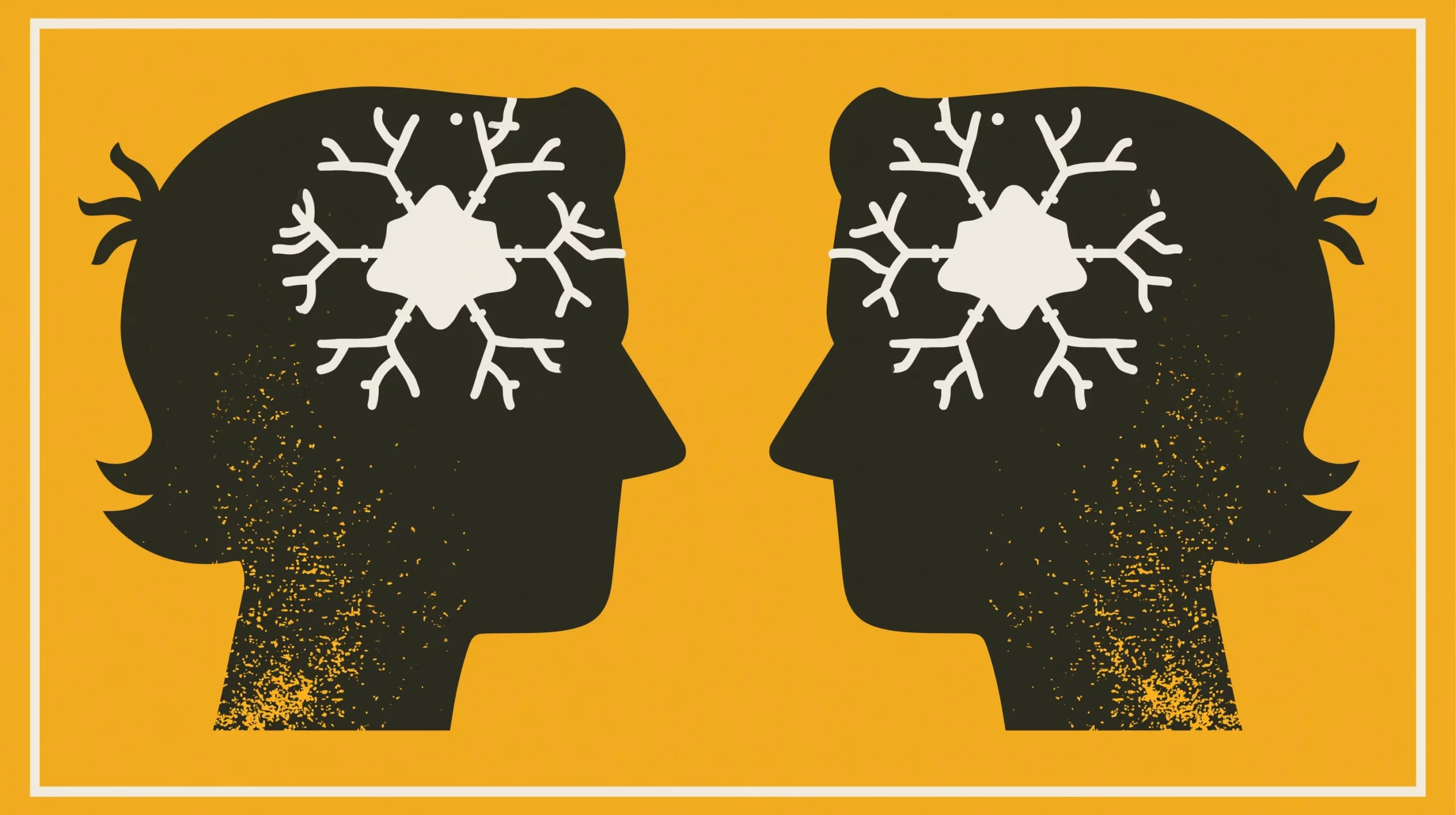

The Mirror Neuron Science Behind Reading Other People.
The mirror neuron system does not help you guess what others feel, it generates a partial simulation of their experience inside your own neural architecture, and that distinction changes how empathy, persuasion, and leadership actually work. Here is what the science actually says, and what to do with it.
01Parma, 1996
A Peanut, a Monkey, and a Neuron That Fired for Both
In 1996, a macaque reached for a peanut in a laboratory in Parma, Italy, and something fired in its premotor cortex. That was expected. What was not expected was that the same neuron had fired moments earlier, when the monkey was sitting still, watching a researcher reach for a peanut instead.[1] Vittorio Gallese and his colleagues had stumbled onto a class of cells that blurred the line between doing and seeing: 92 neurons out of 532 recorded in area F5 that responded to both executed and observed actions.[1] They called them mirror neurons, and the name would become one of the most famous, and most over-promised, terms in modern neuroscience.
The discovery landed at the intersection of questions that had troubled philosophy for centuries. How does one mind read another? How do you know what someone intends before they tell you? The standard cognitive science answer was inference: your brain builds a model of the other person's mental state, runs it forward, and produces a guess. The mirror neuron finding suggested something more direct, your brain does not guess. It runs a partial replay of the other person's action in your own motor system.[2][5] The distinction matters because inference is slow, effortful, and error-prone. Simulation is fast, automatic, and embodied.
That framing captured enormous attention. Within a decade, mirror neurons had been invoked to explain language, culture, autism, morality, and the origin of civilisation itself. V. S. Ramachandran called them "the driving force behind the great leap forward in human evolution."[30] Publications peaked in 2013.[31] Then the backlash arrived.
The honest picture of mirror neurons science today is this: your brain contains cells, and broader circuits, that activate both when you perform an action and when you watch someone else perform it.[4] This mirror mechanism extends beyond motor cortex into emotional and sensory systems.[7][10] When you see someone wince in pain, your anterior insula activates in a pattern that partially overlaps with your own pain circuitry.[11] When you watch someone express disgust, the same insular sites fire as when you smell something repulsive yourself.[10] These shared circuits create what Gallese termed embodied simulation -- an automatic, pre-reflective mapping of others' states onto your own body.[5]
That mapping is not empathy. Empathy requires additional processing, regulation, perspective-taking, contextual appraisal, handled by regions like the temporo-parietal junction and medial prefrontal cortex.[13][14] The mirror mechanism provides the raw signal. The empathy circuit interprets it. Conflating the signal with the interpretation is where the field got into trouble, and where the leadership literature inherited distorted claims.
That matters because leaders are not just reading emotions. They are reading intentions, predicting responses, and calibrating their behaviour in real time. The mirror neuron system contributes to all of these, but as one node in a distributed network, not as a master key.[21]
02The Mechanism
The Mirror Circuit That Simulates Other Minds
The circuit begins with observation. When you watch someone reach for a cup, visual information flows from the superior temporal sulcus -- an area that codes biological motion, into two core mirror regions: the inferior frontal gyrus (IFG, including Broca's area) and the inferior parietal lobule (IPL).[2][6] These regions contain neurons that fire for both executed and observed actions: the defining property of the mirror system. In macaques, the circuit was first mapped in area F5 (premotor cortex), where Gallese and colleagues recorded the original 92 mirror neurons.[1] In humans, Iacoboni's group showed that IFG pars opercularis, the human homologue of F5, activates during both action execution and observation, establishing the first fMRI evidence for a human mirror system.[3]
The system does not simply replay what it sees. It codes the goal structure of actions, not just their kinematics. Iacoboni and colleagues demonstrated this by showing participants videos of someone grasping a cup in three conditions: the action alone, the context alone (a set table vs. a messy table), and the action embedded in context.[12] IFG activation was significantly higher when the action appeared in context, the mirror system was coding the intention (drinking vs. cleaning up), not merely the hand shape.[12] This finding, while influential, has a caveat: the context-embedded condition was visually more complex, and some of the increased activation may reflect that complexity rather than intention-reading per se.[23]
The mirror circuit as simulation engine: biological motion detected by the superior temporal sulcus drives mirror firing in the inferior frontal gyrus and inferior parietal lobule, encoding goals not just kinematics; the insula then relays that motor simulation to the anterior cingulate cortex, producing the shared affective state that underlies empathic accuracy.
Diagram · HPC
The motor mirror circuit is only the first layer. Carr and colleagues showed that imitating emotional facial expressions activates not just premotor areas but also the insula and amygdala, with greater activation during imitation than passive observation.[9] The insula, they proposed, relays motor-simulation output to limbic structures that generate emotional states.[9] The Science Audit notes this relay model is consistent with fMRI co-activation data but not causally established, the insula's role should be understood as a proposed pathway, not a proven mechanism.[9]
Wicker and colleagues strengthened the case for emotional mirroring by showing that the same anterior insula sites activate whether participants smell disgusting odours themselves or watch video of someone else expressing disgust.[10] Singer's landmark study extended this to pain: when romantic partners watched each other receive a painful stimulus, the observer's bilateral anterior insula and rostral anterior cingulate cortex activated, the affective component of pain processing, while the sensory components (posterior insula, primary somatosensory cortex) did not.[11] The observer shared the suffering but not the sensation. Critically, insular and ACC activation correlated with participants' self-reported empathy scores on the Interpersonal Reactivity Index.[11] One important limitation: all fMRI scanning was of female participants; males only delivered the pain signal, so the generalisability across sexes remains untested.[11]
03Evidence
The 5 Strongest Studies in Mirror Neurons Science
01The claim
The single load-bearing finding
The hero study finds 21 patients.
Pooled estimate
21 patients
02How we measured
Grading the mirror neuron studies
Studies scored on design, sample, rigour, causality, replication, citations.
Because the ratio of speculative extrapolation to solid evidence has been unusually poor in this field, design quality and independent replication are what separate the robust cellular finding from the social-cognition claims built on top of it.
Rubric weights
03The spread
Heterogeneity across 5 studies
Methodological quality across the ranked studies.
Rubric spread
87
→ 69 /100
Highest to lowest rubric score across the ranked studies.
04What does not hold
Negative knowledge
What the evidence base does not support.
Saxe and Kanwisher demonstrated that the temporo-parietal junction selectively activates during theory of mind tasks, reasoning about others' false beliefs, and is functionally distinct from mirror areas.[13] This means the brain uses at least two systems for social cognition: a simulation system (mirror mechanism) and a mentalizing system (TPJ/mPFC). Decety and Jackson proposed that full empathy requires both, plus self-awareness and emotion regulation.[14]
5 trials. One pooled answer.
Below: the anchor study in full; then the forest plot at scale; then the supporting trials in ranked order.
01Anchor
Single-neuron responses in humans during execution and observation of actions
Mirror neurons exist in the human brain, not just in macaques and not only in premotor cortex.
It is the only direct cellular evidence. Every other human study uses population-level imaging (fMRI, TMS, EEG), which cannot confirm single-neuron mirror properties.
Rubric breakdown
The strongest studies, ranked by methodological weight.
Each scored 0–100 against a six-criterion rubric, tagged by design and year; the anchor leads. No study in this set reaches the rubric-90 tier.
02
Empathy for pain involves the affective but not sensory components of pain
Bilateral anterior insula and rostral ACC activated for both personal and observed pain; activation correlated with self-reported empathy scores. Posterior insula and primary somatosensory cortex activated only for personal pain, the shared circuit is affective, not sensory.
82/100
03
Is the putative mirror neuron system associated with empathy? A systematic review and meta-analysis
Found only weak evidence for an association between MNS activity (IFG) and emotional empathy; no evidence for IPL involvement in either emotional or cognitive empathy; no significant relationships for motor empathy. The paper's own conclusion: "preliminary evidence" and "modest."
76/100
04
Grasping the intentions of others with one's own mirror neuron system
Posterior IFG/ventral premotor cortex showed significantly greater activation when actions appeared in goal-relevant context versus context alone or action alone, suggesting the mirror system codes intentions, not just movements.
72/100
05
Speaker-listener neural coupling underlies successful communication
Brain activity of speaker and listener became temporally coupled during successful communication. Anticipatory coupling, the listener's brain leading the speaker's, was most predictive of comprehension. Coupling disappeared when the story was told in a language the listener did not understand.
69/100
04Stakes
The cost of impaired social simulation is not abstract, it shows up in teams, relationships, and neural pain circuits
When mirror-mediated social cognition degrades, through impoverished environments, chronic stress, or neurological disruption, the consequences are measurable across four systems.
Clinical Disruption
Early research proposed that mirror neuron system dysfunction explained core deficits in autism spectrum conditions. Dapretto and colleagues found no MNS activation in the IFG during emotion observation in children with ASD, with activity inversely correlated with symptom severity.[19] The "broken mirror" hypothesis, however, has not replicated reliably -- systematic reviews found mixed results, and the theory is now considered premature.[20][21] The mechanism of social disruption in ASD is more complex than a single circuit failure.
difficulty reading facial expressions, social timing mismatches, effortful rather than automatic social processing
Organisational Cost
Goleman's research across 200+ global organisations found that emotional intelligence, self-awareness, empathy, social skill, was more predictive of leader effectiveness than IQ or technical competence.[27] Bass and Riggio's framework identified individualised consideration, attending to each follower's developmental needs, as a core component of transformational leadership, requiring the empathic capacity that the mirror mechanism supports.[28] Leaders who cannot simulate their team's experience make decisions in a social vacuum.
misread reactions in meetings, tone-deaf feedback, teams that comply but do not commit
Population-Level Decline
Konrath's meta-analysis of 72 studies (N = 13,737) documented a 48% decline in empathic concern among US college students between 1979 and 2009, with the steepest drop after 2000.[17] The same research group's 2025 update found that empathic concern and perspective taking have been rising since 2009, the decline was a trough, not a terminus.[17] Heyes and Catmur's framework suggests that mirror mechanisms are learnable and environmentally shaped -- impoverished social environments can degrade them, and enriched ones can rebuild them.[21]
declining prosocial behaviour, social disconnection, reduced emotional vocabulary in public discourse
Neural Pain of Exclusion
Eisenberger, Lieberman, and Williams showed that social exclusion, being left out of a simple ball-tossing game, activates the anterior cingulate cortex in the same pattern as physical pain distress.[18] ACC activity during exclusion correlated with self-reported distress.[18] Social rejection is not metaphorically painful, it is processed through overlapping pain circuitry. For leaders, this means that exclusionary decisions impose a measurable neural cost on the people affected.
the sharp sting of being overlooked, the lingering ache of not belonging, physiological stress response to social isolation
05Protocol
A 4-Practice Mirror Mechanism Protocol
These are not mindfulness exercises. They are evidence-informed practices that engage the specific neural systems described in this article, motor simulation, affective resonance, compassion circuitry, and team psychological safety.
The protocol, as a sequence.
Daily practice → Conversations → Weekly training → Team level
Structured Observation
Spend 5 minutes per interaction attending to non-verbal behaviour before responding.
Empathic accuracy depends on channel access, verbal plus visual channels produce the highest accuracy for inferring others' states.[29] Iacoboni's review confirmed that automatic imitation is pervasive and facilitates empathy when attention is directed toward it.[8]
Multitasking during conversations, splitting attention between a screen and a person reduces the visual channel input that drives mirror activation.
Strategic Mimicry
Allow natural postural and gestural alignment to occur without suppressing it.
Chartrand and Bargh demonstrated that nonconscious mimicry (the chameleon effect) increases liking and interaction smoothness automatically.[15] Van Baaren and colleagues found that being mimicked increased prosocial behaviour, though a 2024 replication found the effect may be less pronounced than originally measured.[16]
Deliberate, exaggerated mimicry, which is perceived as mockery and produces the opposite effect. The mechanism works when it is automatic and subtle.
Compassion over Empathy
Train compassion responses, not just empathic resonance, to avoid empathy fatigue.
Klimecki and colleagues showed in a longitudinal controlled training study that empathy training alone increased negative affect and insula/ACC activation, while subsequent compassion training reversed the negative affect, activating ventral striatum and pregenual ACC, a distinct, positive-affect circuit.[24]
Treating empathy training as sufficient, without the compassion component, increased empathic resonance can lead to burnout rather than prosocial action.
Psychological Safety Architecture
Build explicit team norms that signal safety for interpersonal risk-taking.
Edmondson's study of 51 work teams found that psychological safety predicts learning behaviour, which mediates team performance.[26] Riess's neuroscience-informed empathy curriculum, three 60-minute modules, produced a 2.2-point improvement on the 50-point CARE scale (P = 0.04) in a randomised controlled trial with 99 resident physicians.[25]
Assuming empathic culture happens organically, without structural support, mirror-mediated attunement erodes under performance pressure.
06Verdict
The verdict.
We share the suffering, not the sensation. The brain draws that line at the circuit level, and that distinction is empathy's neural signature. -- Tania Singer, Max Planck Institute
Bottom line
The mirror mechanism does not make you feel what others feel. It gives your brain a running draft -- and the quality of your leadership depends on what you do with it.
The argument
Mirror neurons exist in the human brain. Shared circuits for action, pain, and emotion are confirmed across dozens of studies. The automatic simulation they produce is a foundational layer of social cognition, the fast, pre-reflective signal that tells your brain what another person is doing, feeling, and about to need. But the mirror mechanism is not empathy. It is not a mind-reading device. It is not the explanation for language, culture, or autism. The extrapolations collapsed under scrutiny, and what survived is more modest and more useful: a trainable, measurable, environmentally shaped neural system that gives leaders a biological lever for the social skills their roles demand. The science of mirror neurons does not prove you can feel what others feel. It proves your brain is wired to try, and that the quality of the attempt depends on conditions you can influence.
The field of mirror neuron science has completed a full arc: discovery, hype, backlash, and resolution. The 2010s were dominated by sceptics who argued that mirror neurons had been over-interpreted, and they were right.[21][23] The core finding survived, shared circuits exist, and they contribute to social cognition, but the grand narrative of mirror neurons as the master key to human sociality did not.[31] What replaced it is a more distributed picture: the mirror mechanism as one computational principle among several, operating across motor, emotional, and sensory systems, shaped by experience rather than hardwired from birth.[22][21]
For leaders, this is the finding that matters. If the mirror mechanism were innate and fixed, there would be nothing to do about it, some people would be natural empaths and others would not, and that would be the end of the conversation. The evidence says otherwise. Mirror circuits are formed through visual-motor learning and social practice.[21] They respond to training.[24][25] They degrade in impoverished environments and recover in enriched ones.[17] The leader's job is not to have empathy as a trait. It is to build the conditions, in themselves and in their teams, that allow the mirror mechanism to operate.
The honest mirror neurons science offers no shortcuts and no mythology. It offers something better: a mechanism that explains why social attunement varies, why it matters, and what you can do about it. That is enough.
No comparison figure runs here. The prose above does not resolve to one clean effect size to set against another, and this magazine does not manufacture a number to fill the space. The verdict stands on the evidence as written.
Shared circuits are confirmed
Mirror neurons exist in humans, shared affective circuits for pain are replicated across 32 studies, and the MNS correlates weakly but reliably with emotional empathy. The core mechanism is established. The extrapolations to intention-reading, language, and culture require separate, and currently insufficient, evidence.
Impaired simulation has measurable costs
When mirror-mediated social cognition degrades, the effects cascade: leaders misread teams, social exclusion triggers pain-circuit activation, and population-level empathic concern fluctuates with environmental conditions. The cost is neural, organisational, and cultural.
The mechanism is trainable
Mirror circuits are formed through learning, not hardwired at birth. Structured observation, natural mimicry, compassion training, and psychological safety practices engage the specific systems the science describes. Environment and practice shape the signal.
Put it to work
Where this science goes next on HPC
07Bibliography
The bibliography.
-
01
Journal
doi: 10.1093/brain/119.2.593
Action recognition in the premotor cortex
-
02
Review
doi: 10.1146/annurev.neuro.27.070203.144230
The mirror-neuron system
-
03
Journal
doi: 10.1126/science.286.5449.2526
Cortical mechanisms of human imitation
-
04
Journal
doi: 10.1016/j.cub.2010.02.045
Rubric 87/100
Single-neuron responses in humans during execution and observation of actions
-
05
Journal
doi: 10.1098/rstb.2006.2002
Before and below 'theory of mind': Embodied simulation and the neural correlates of social cognition
-
06
Review
doi: 10.1038/35090060
Neurophysiological mechanisms underlying the understanding and imitation of action
-
07
Review
doi: 10.1038/nrn2833
Somatosensation in social perception
-
08
Review
doi: 10.1146/annurev.psych.60.110707.163604
Imitation, empathy, and mirror neurons
-
09
Journal
doi: 10.1073/pnas.0935845100
Neural mechanisms of empathy in humans: A relay from neural systems for imitation to limbic areas
-
10
Journal
doi: 10.1016/S0896-6273(03)00679-2
Both of us disgusted in my insula: The common neural basis of seeing and feeling disgust
-
11
Journal
doi: 10.1126/science.1093535
Empathy for pain involves the affective but not sensory components of pain
-
12
Journal
doi: 10.1371/journal.pbio.0030079
Grasping the intentions of others with one's own mirror neuron system
-
13
Journal
doi: 10.1016/S1053-8119(03)00230-1
People thinking about thinking people: The role of the temporo-parietal junction in "theory of mind." NeuroImage, 19(4), 1835–1842
-
14
Review
doi: 10.1177/1534582304267187
The functional architecture of human empathy
-
15
Journal
doi: 10.1037/0022-3514.76.6.893
The chameleon effect: The perception-behavior link and social interaction
-
16
Journal
doi: 10.1111/j.0963-7214.2004.01501012.x
Mimicry and prosocial behavior
-
17
Meta
doi: 10.1177/1088868310377395
Changes in dispositional empathy in American college students over time: A meta-analysis
-
18
Journal
doi: 10.1126/science.1089134
Does rejection hurt? An fMRI study of social exclusion
-
19
Journal
doi: 10.1038/nn1611
Understanding emotions in others: Mirror neuron dysfunction in children with autism spectrum disorders
-
20
Review
doi: 10.1038/nrn2024
The mirror neuron system and the consequences of its dysfunction
-
21
Journal
doi: 10.1177/1745691621990638
What happened to mirror neurons? Perspectives on Psychological Science, 17(1), 153–168
-
22
Journal
doi: 10.1016/j.tics.2022.06.003
Mirror neurons 30 years later: Implications and applications
-
23
Journal
doi: 10.1162/jocn.2009.21189
Eight problems for the mirror neuron theory of action understanding in monkeys and humans
-
24
Journal
doi: 10.1093/scan/nst060
Differential pattern of functional brain plasticity after compassion and empathy training
-
25
RCT
doi: 10.1007/s11606-012-2063-z
Empathy training for resident physicians: A randomized controlled trial of a neuroscience-informed curriculum
-
26
Journal
doi: 10.2307/2666999
Psychological safety and learning behavior in work teams
-
27
Review
no doi
What makes a leader? Harvard Business Review, 76(6), 93–102
-
28
Book
no doi
Transformational Leadership
-
29
Book
no doi
Empathic Accuracy
-
30
Journal
no doi
-
31
Journal
doi: 10.1002/brb3.70486
What else is happening to mirror neurons? A bibliometric analysis of mirror neuron research trends and future directions (1996–2024)
No entries match the current filter and search.
The protocol card
The Mirror Neuron Science Behind Reading Other People
One sheet. The four moves, in the order the day runs them.
-
01
Daily practice
Structured Observation
Spend 5 minutes per interaction attending to non-verbal behaviour before responding.
AvoidMultitasking during conversations, splitting attention between a screen and a person reduces the visual channel input that drives mirror activation.
-
02
Conversations
Strategic Mimicry
Allow natural postural and gestural alignment to occur without suppressing it.
AvoidDeliberate, exaggerated mimicry, which is perceived as mockery and produces the opposite effect. The mechanism works when it is automatic and subtle.
-
03
Weekly training
Compassion over Empathy
Train compassion responses, not just empathic resonance, to avoid empathy fatigue.
AvoidTreating empathy training as sufficient, without the compassion component, increased empathic resonance can lead to burnout rather than prosocial action.
-
04
Team level
Psychological Safety Architecture
Build explicit team norms that signal safety for interpersonal risk-taking.
AvoidAssuming empathic culture happens organically, without structural support, mirror-mediated attunement erodes under performance pressure.
hiperformanceculture.com · 31 sources · 4 April 2026

How this was made
The desk, the instrument, and when this page is next examined.
- Desk
- HPC Editorial
- Instrument
- 6 weighted criteria, 100 points see every score
- Register
- 31 sources, 27 with a resolving DOI read them
- Reading time
- 22 min read
Revision log
- First published.
- Last revised. Sources re-checked against the register above.
- Next review Due by , or earlier if a new controlled trial or systematic review lands.
THE HAND-OFF. Performance Scan: find your limiting factor. Three minutes, 24 questions, six systems. Your answers never leave your device.