Flow State & Deep Work:
The complete guide to reliable peak performance
Build a system that makes deep work and “in-the-zone” execution your default setting – not a rare good day. Based on flow science, cognitive psychology, and real-world protocols.
Not hacks. A repeatable system for deep focus, meaningful output, and recovery that holds up on messy, real-world weeks.
Flow State & Deep Work: The Core Concepts
Most people talk about “getting into the zone” like it’s a mood. It isn’t. It’s a trainable state.
If you’re reading this, you probably don’t have a motivation problem. You have a bandwidth and fragmentation problem. Here’s something wild: research shows the average person spends about 47% of their waking hours thinking about something other than what they’re actually doing. That’s nearly half your life spent mentally checked out, distracted, unfocused. Your brain is split between Slack, email, tabs, kids, clients, markets, and a running list of “shoulds” you never quite get to.
This guide is about building a system where deep work happens by default, not on heroic days when everything magically lines up. We’ll combine what we know from flow science, cognitive psychology, and skill acquisition into something you can actually run in a normal, messy week.
Here’s the basic idea:
- Flow is the brain state where you do your best work with less effort.
- Deep work is the container that makes that state more likely.
- Your calendar, environment, and habits either support that state or quietly destroy it.
Across this article, you’ll build a 5-pillar system:
- How to trigger flow on purpose
- How to protect real deep work blocks
- How to engineer a laser-focus environment
- How to use simple pre-work routines to get started
- How to adapt this to your specific domain (coding, sport, business, study, creative work)
By the end, you won’t just “know more about flow.” You’ll have a 30-day plan and a set of constraints that make high-quality output more likely than distraction and drift.
Part 1 · Foundations
Understanding Flow State and Deep Work Core concepts · Science
What flow actually is, what deep work actually is, what’s going on in your brain, and why these states matter for real-world performance.
What is Flow State? (Quick Answer)
Flow state is a mental state of complete absorption in an activity where time seems to disappear, performance peaks, and the work feels effortless despite being challenging. It’s characterised by intense focus, loss of self-consciousness, and intrinsic satisfaction. First scientifically defined by psychologist Mihály Csíkszentmihályi in the 1970s, flow represents the optimal experience where your skills match the challenge at hand.
What is Flow State? (Deep Dive)
Imagine you’re playing your favourite video game. You look up and three hours have passed, but it felt like 30 minutes. You were completely absorbed, reacting instantly, and everything just clicked. That’s flow — a state of peak performance and concentration.
The concept was scientifically defined by psychologist Mihály Csíkszentmihályi in the 1970s after he studied artists, athletes, and chess players. He noticed they all described the same experience: complete absorption in what they were doing, where nothing else seemed to matter.
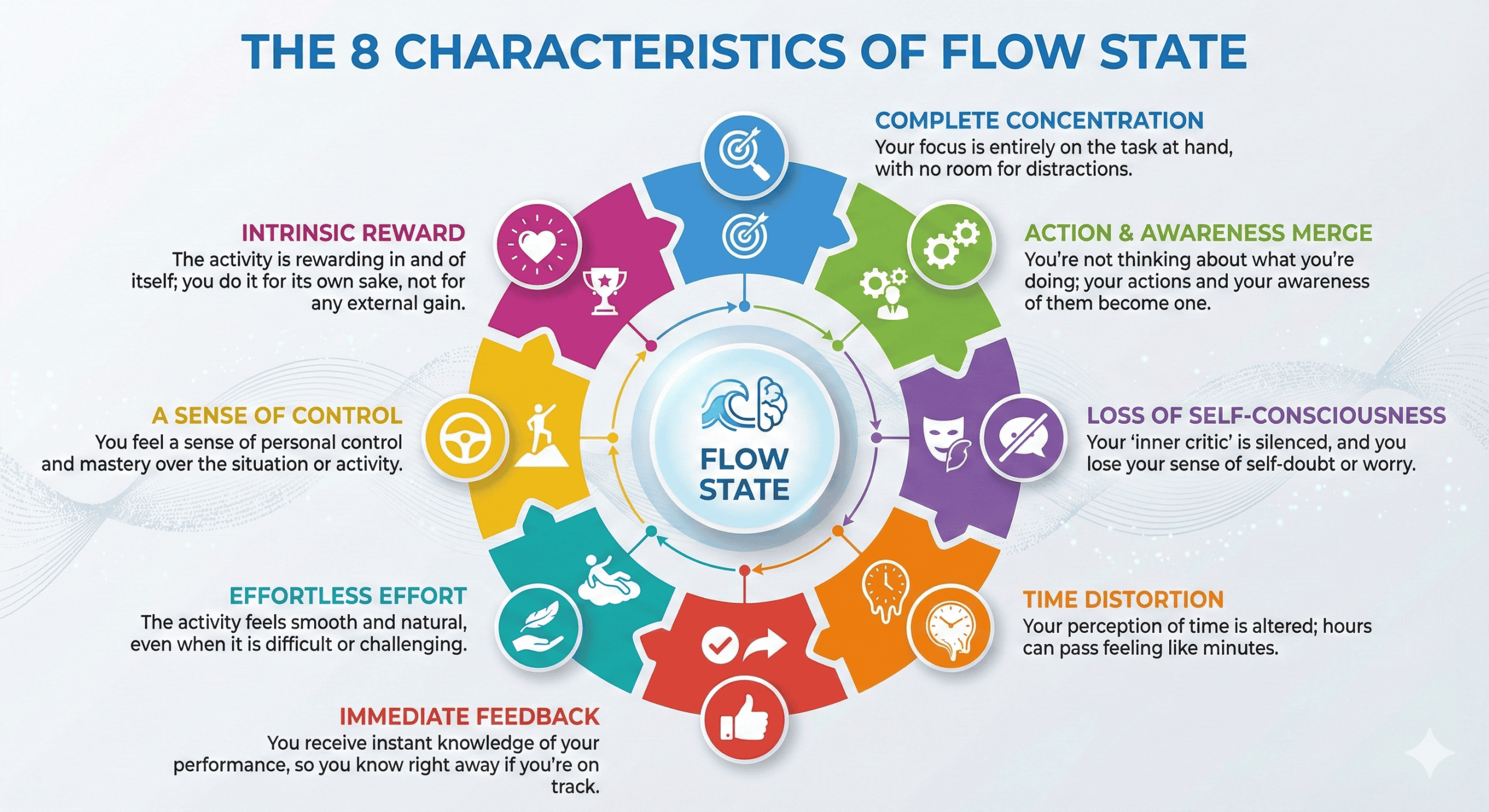
The key characteristics of flow include:
- Complete concentration on the task at hand
- Action and awareness merge — you’re not thinking about doing it, you’re just doing it
- Loss of self-consciousness — your inner critic shuts up
- Time distortion — hours feel like minutes
- Immediate feedback — you know instantly if you’re on track
- Effortless effort — the work feels smooth even when it’s hard
- A sense of control over what you’re doing
- Intrinsic reward — you’d do it even without external rewards
What Happens in Your Brain
When you’re in flow, your brain doesn’t work harder — it works smarter.
Brain imaging studies show that parts of your prefrontal cortex (the brain’s “executive control centre”) temporarily decrease in activity — a phenomenon called transient hypofrontality. That sounds bad, but for performance it’s ideal.
Your prefrontal cortex controls:
- Self-criticism and doubt
- Over-analysing past decisions
- Worrying about the future
- Your sense of time
When this area quiets down, you stop overthinking. The voice saying “you’re not good enough” or “this is too hard” goes quiet. You stop worrying about how you look or whether you’ll succeed. You just do.
The Neurochemical Cocktail:
- Norepinephrine & Dopamine Increase focus, motivation, and pattern recognition.
- Endorphins Reduce pain and create a sense of well-being.
- Anandamide Boosts lateral thinking and creativity.
- Serotonin Underpins satisfaction and post-flow calm.
What is Deep Work?
Flow describes a mental state. Deep work describes a practice. They’re different concepts, but they fit together perfectly.
Computer science professor Cal Newport defines deep work as “professional activities performed in a state of distraction-free concentration that push your cognitive capabilities to their limit.”
It’s the opposite of what he calls shallow work — the administrative and logistical tasks that don’t require intense focus: emails, routine meetings, basic reporting, inbox shuffling.
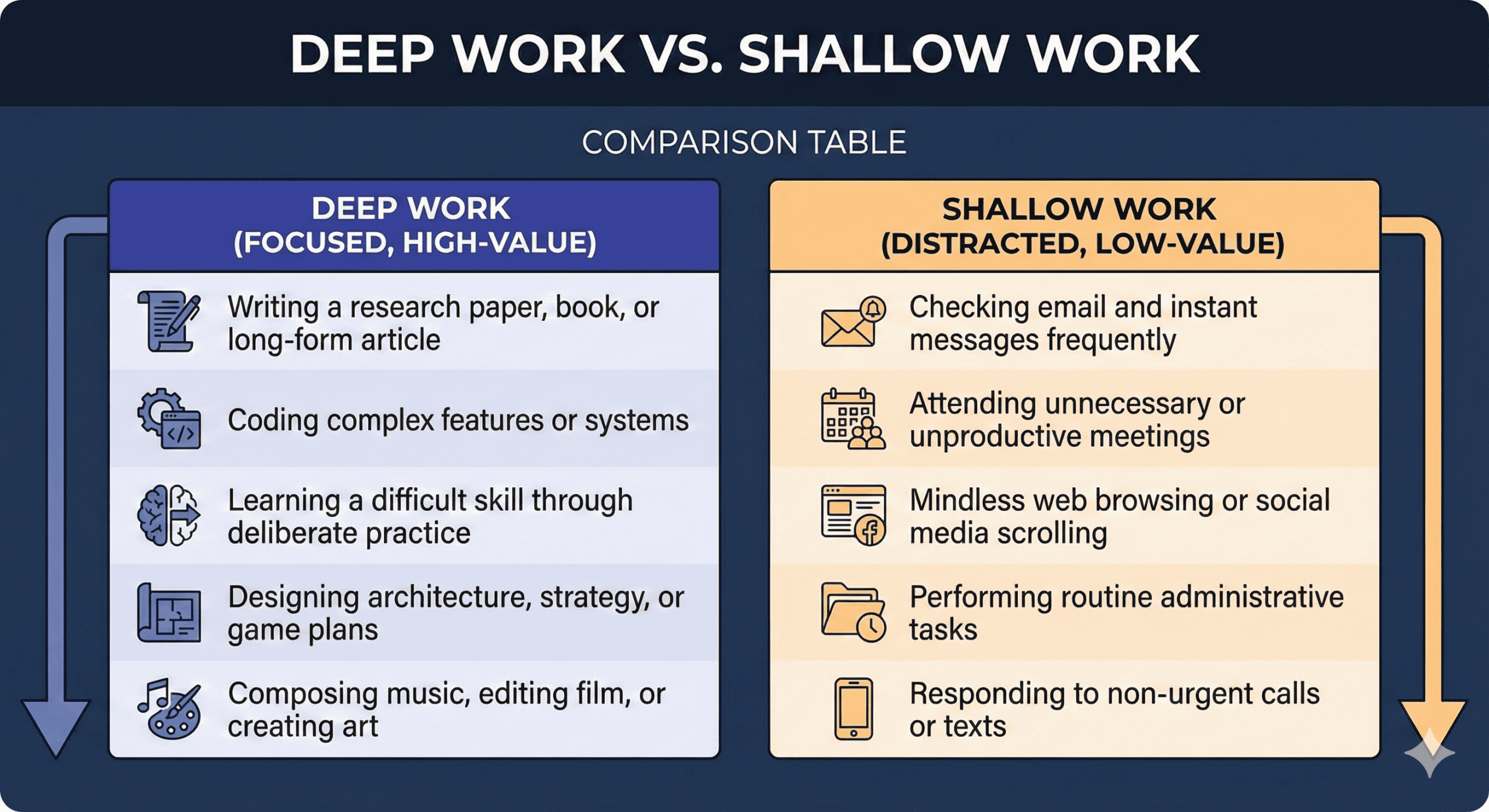
Examples of Deep Work:
- Writing a research paper, book, or long-form article
- Coding complex features or systems
- Learning a difficult skill through deliberate practice
- Designing architecture, strategy, or game plans
- Composing music, editing film, or creating art
The Cost of Distraction
The average knowledge worker checks email or chat dozens of times per day. Every time you switch, you leave behind what researchers call attention residue. It can take 20–25 minutes to fully refocus after a distraction.
- Software Engineers: A “quick Slack check” mid-coding can cost 20–40 mins of lost context.
- Creatives: Switching between creating and evaluating kills flow. Your morning creative session should have zero client communication, zero email, zero administrative tasks. Creation and critique are different cognitive modes” never mix them.
- Students: Every Instagram check during a study session destroys your ability to encode information into long-term memory. One focused 45-minute study block produces more learning than three hours of “studying” with your phone nearby.
How Flow and Deep Work Intersect
The simplest way to think about it: flow is the destination, deep work is the vehicle. You can’t force flow directly. But you can create the conditions:
- Uninterrupted time
- The right level of challenge
- Clear goals and immediate feedback
- A clean, low-friction environment
Deep work gives you that container — a protected block of time where your brain can actually enter flow.
When you combine them:
- Deep work creates the conditions — distraction-free, time-boxed, clearly defined blocks.
- Flow amplifies the output — creativity, learning speed, and quality of work all spike.
- The results reinforce the habit — the satisfaction of flow makes you more likely to protect future deep work blocks.
The Science-Backed Benefits
Flow and deep work aren’t nice-to-have. For anyone who trades in cognition — engineers, founders, athletes, students, creatives — they’re core performance multipliers.
Productivity & Performance
- Executives in sustained flow report being up to 500% more productive.
- Flow can increase performance by 200–400% in terms of output quality and speed.
- Pattern recognition has been measured to improve by ~530% in experiments.
Learning & Skill Acquisition
- Flow states can accelerate learning by 2–5× compared to distracted practice.
- Time to mastery drops dramatically when practice happens inside deep blocks.
Psychological Well-Being
- Regular flow experiences correlate with higher life satisfaction.
- Flow reduces anxiety by giving your brain windows of full engagement (no room for rumination).
- High performers report lower burnout when they consistently access flow.
Research in Practice
- Sarah Chen, a software architect at Google, increased her productive coding time from 14 hours to 31 hours per week by implementing just two flow triggers: clear 90-minute goals written before each session, and a 5-minute breathwork routine. “The breathwork seemed silly at first,” she says, “but it became the psychological switch that told my brain: now we focus.”
- Olympic swimmer Michael Phelps trained by progressively increasing race simulation difficulty by exactly 5% each week, perfectly matching the challenge-skills balance research for optimal flow. His coach deliberately made practices slightly harder than competitions, ensuring flow states during actual races when stakes were highest.
- A 2023 analysis of knowledge workers who implemented flow blocks found that 73% were still maintaining the practice after 6 months but only if they started with ONE 45-minute block rather than trying to restructure their entire day immediately. The lesson: small, consistent changes compound into transformative results.
- The bottom line: flow isn’t just about getting more done. It’s about feeling better while you do it. When flow and deep work are built into your week, your work stops feeling like random effort and starts feeling like an expression of your identity and direction.
Part 2 · The System
The 5 Pillars of Flow Mastery System · Protocol
Now that you understand what flow is, let’s get practical. This is the complete system for consistently entering and sustaining flow states.
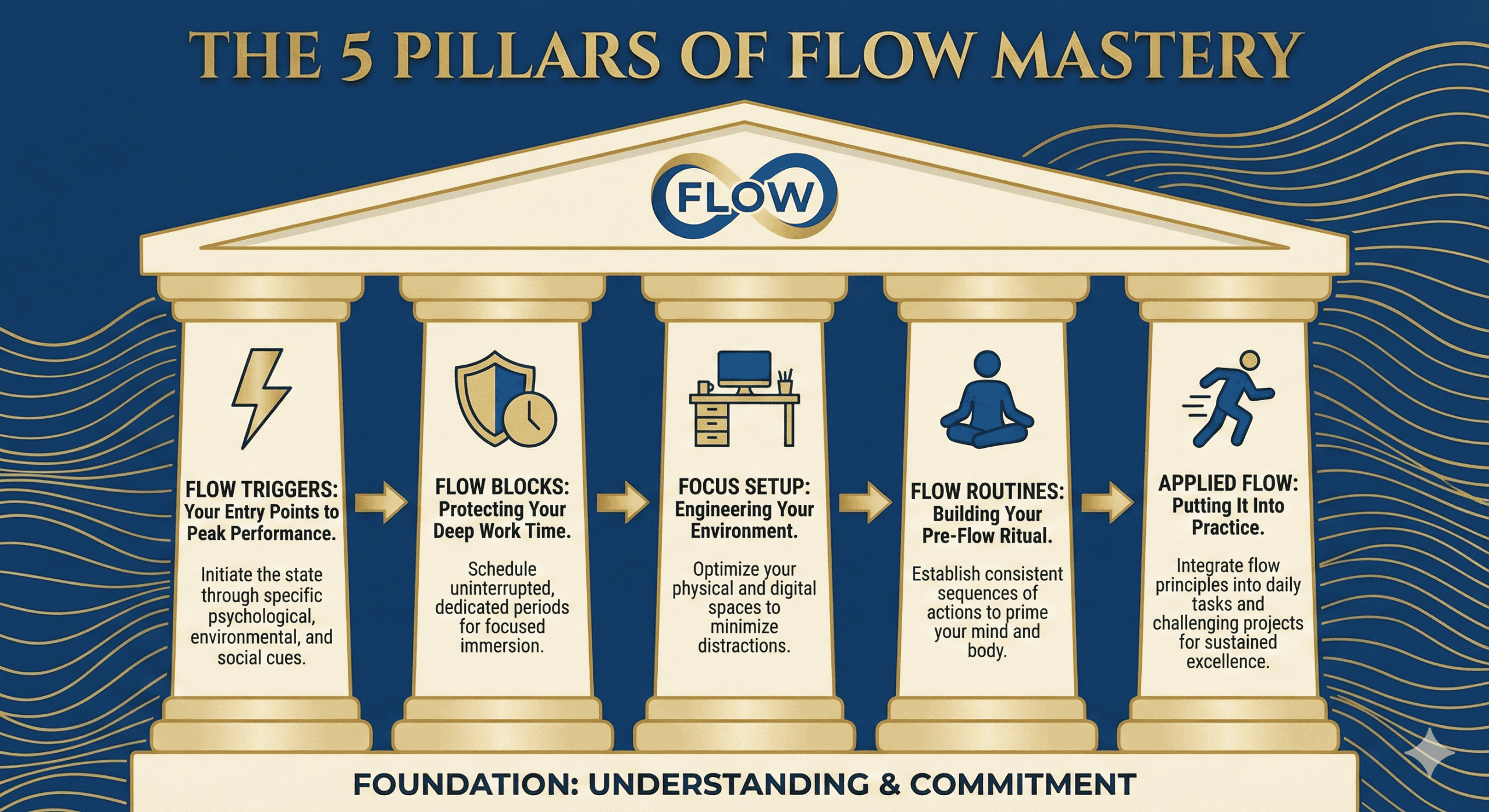
Now that you understand what flow is and why it matters, let’s get practical. The following five pillars represent the complete system for consistently entering and sustaining flow states.
Each pillar builds on the others, creating a framework that works whether you’re studying for exams, building a business, or mastering a craft.
Pillar 1: Flow Triggers – Your Entry Points to Peak Performance
Flow doesn’t happen by accident. Your brain needs specific conditions—called “triggers”—to make the shift into this high-performance state. Understanding and deliberately activating these triggers is the first step to controlling your flow.
Research has identified 17 distinct flow triggers across three categories. Here are the most powerful ones you can activate for peak performance:
Psychological Triggers
- 1. Intense Concentration
The foundational trigger. You must focus solely on the task at hand with undivided attention. No multitasking, no background processing. Complete absorption is the price of entry. - 2. Clear Goals
Your brain needs to know exactly what you’re trying to accomplish. Vague goals like “work on my project” don’t cut it. Specific goals like “write 500 words on the introduction” or “solve problems 15-20 in the textbook” give your brain clear direction. -
For Engineers: Instead of “work on the feature,” try “implement user authentication flow with JWT tokens and write 3 unit tests.” Specificity triggers flow.
For Creatives: Instead of “work on the painting,” try “complete the background layer and establish the color palette for the foreground.” Clarity beats ambiguity.
- 3. Immediate Feedback
You need to know instantly whether you’re on track. This is why video games are so good at inducing flow—you always know your score, your progress, your status. For your work, create feedback loops: Can you test your code immediately? Does each paragraph flow from the last? Are you solving the problem correctly? - 4. Challenge-Skills Balance
This is the golden rule of flow. The task needs to be about 4% more difficult than your current skill level—hard enough to stretch you, but not so hard that you become anxious. Too easy and you’re bored. Too hard and you’re stressed. Right in the middle? That’s where flow lives. -
- 5. High Consequences
When there’s something meaningful at stake, your focus sharpens dramatically. This doesn’t mean you need life-or-death situations—it can be as simple as a deadline, a presentation, or a commitment to someone else. The key is that failure has to matter to you. - 6. Rich Environment
Novelty, unpredictability, and complexity all drive attention and engagement. This is why new challenges or learning new skills often produce flow more easily than routine tasks. Your brain loves novelty—it releases dopamine just from encountering something new and stimulating. - 7. Deep Embodiment
Physical awareness and movement enhance flow states. This is why dancers, athletes, and surgeons often report profound flow experiences. But even if you’re doing mental work, incorporating physical elements (standing while thinking, walking while brainstorming, or even hand movements while coding) can enhance the experience. - 8. Serious concentration from everyone involved
- 9. Shared clear goals that everyone understands
- 10. Good communication with active listening
- 11. Equal participation where everyone contributes
- 12. Element of risk that requires trust and vulnerability
- 13. Familiarity with teammates and their working styles
- 14. Close listening We foster innovation by responding authentically in real-time, rather than hindering conversation with assumptions or planned remarks.
- 15. Sense of Control It combines the freedom to choose your challenges with the competence to master them.
- 16. Always Say YesInteractions should be additive rather than argumentative, amplifying ideas to generate momentum and innovation
- 17. Creativity Creativity drives flow through two channels: the insight to synthesize new ideas and the guts to bring them into the world
- Clear goals (fix this specific bug)
- Immediate feedback (code compiles or doesn’t)
- Challenge-skills balance (difficult but solvable)
- High consequences (it’s blocking other team members)
- Rich environment (novel problem, requires creative thinking)

The Csíkszentmihályi Flow Channel Research shows this sweet spot activates maximum dopamine and norepinephrine release in the brain, optimizing both focus and learning.
Research in Practice: Elite violin students practice pieces that are exactly 4-8% harder than their current mastery level. Too easy (perfect execution) = no growth. Too hard (constant mistakes) = frustration. The edge of ability = flow + rapid skill acquisition.
Environmental Triggers
Key Takeaway You don’t need to activate all 17 triggers every time. But consciously activating 3-4 triggers before starting work dramatically increases your chances of entering flow. Identify which triggers work best for you and design your work to include them.Social Triggers (For Group Flow)
When you’re working with others, additional triggers activate group flow states:
How Triggers Stack and Compound
Here’s where it gets powerful: triggers don’t work in isolation. The more triggers you activate simultaneously, the faster and deeper you enter flow.
Example: A programmer working on a challenging bug fix might activate:
That’s five triggers stacked. The result? Deep, sustained flow.
Explore the complete guide to Flow Triggers → - 5. High Consequences
Pillar 2: Flow Blocks – Protecting Your Deep Work Time
You can have all the right triggers, but without dedicated, uninterrupted time, flow will always elude you. This is where flow blocks come in—scheduled chunks of time specifically designed to enable deep work and flow states.
Why 90-120 Minute Blocks Are Optimal
Your body operates on 90-120 minute cycles called “ultradian rhythms” throughout the day. These are similar to the 90-minute sleep cycles you experience at night—understanding this connection to sleep optimization and circadian rhythms is crucial for peak performance.
Business Architecture Week
Founder Schedule // Content & StrategyDuring each ultradian cycle, your alertness and energy naturally rise to a peak, plateau, then gradually decline. Working with these natural rhythms—rather than against them—makes flow significantly easier to achieve.
Research on elite performers across multiple domains shows they typically work in focused sessions of 90-120 minutes, followed by breaks. Push beyond this, and your performance drops sharply. Work within it, and you optimize for both quality and recovery.
Real-World Example: Stanford professor BJ Fogg structures his writing days around three 90-minute blocks: 6:00-7:30am (highest creativity), 9:00-10:30am (analytical editing), and 2:00-3:30pm (outline/planning). He produces more published research than colleagues working “all day” on papers.
The Different Types of Flow Blocks
Not all work is created equal. Different types of cognitive work happen more naturally at different times of day, aligned with your circadian rhythms and chronotype.
(First 2-4h)
For Creatives: Never schedule client calls or admin work before 10am. Your morning creative block is sacred.
(Mid-day)
For Engineers: Save debugging and code review for 10am-2pm when your logical brain is sharpest.
(Post-lunch)
(Optional)
Calendar Architecture for Consistent Flow
Here’s how to structure your schedule to maximize flow:
The Ideal Week Structure:
- 1-3 deep work blocks per day (90-120 minutes each)
- 20-30 minutes breaks between blocks
- 1-2 shallow work periods for email, meetings, admin tasks
- Morning blocks for your most important work (when willpower is highest)
Practical Implementation:
- Block your calendar two weeks in advance
- Treat flow blocks like unmovable appointments (would you cancel on your CEO? Don’t cancel on yourself)
- Communicate boundaries to colleagues and family
- Use different calendar colors for deep vs. shallow work (makes it visual)
- Review and adjust weekly based on results
Studies show that knowledge workers who implement time blocking report completing their work in 40% less time while producing higher quality output.
- “I have too many meetings!” → Batch meetings on specific days or afternoons (2-5pm). Protect mornings.
- “My work is too unpredictable!” → Start with just ONE protected block per day.
- “What about emergencies?” → True emergencies are rare. Define “Emergency” with your team vs. urgency.
Pillar 3: Focus Setup – Engineering Your Environment
Here’s a truth that might surprise you: your environment has more influence over your ability to focus than your willpower does.
Research in environmental psychology shows that the physical and digital spaces we work in don’t just affect our mood—they fundamentally change our cognitive performance. A poorly designed environment is like trying to run a marathon in flip-flops. You might finish, but it’s going to be unnecessarily hard.
The good news? Once you understand the principles, optimizing your environment for flow is straightforward.
The Four Layers of Focus Setup
Zero Peripheral Inputs.
Temp: 70°F / 21°C.
STATE
Binaural Beats / Lo-Fi.
Wifi: Whitelist Only.
Layer 1: Physical Workspace Optimization
Your physical environment sends constant signals to your brain about what mode you should be in.
- Ergonomics and comfort: If you’re uncomfortable, part of your attention is dedicated to managing discomfort. Get a proper chair, position your monitor at eye level.
- Visual clarity: A cluttered desk = a cluttered mind. Visual clutter competes for your attention at a neural level.
- Temperature: Cognitive performance peaks at around 70-72°F (21-22°C).
- Dedicated space: Have a specific location that means “work mode.” Your brain creates strong associations between locations and mental states.
For Remote Workers: If you work from home, never work from your bed or couch. Create a dedicated workspace—even just a specific chair.
Layer 2: Digital Environment
This is where most people leak attention. Every notification, every open tab is a potential flow killer.
- Website/App blocking: Use tools like Freedom or Cold Turkey. Even the potential for distraction reduces cognitive capacity.
- Notification annihilation: Turn off ALL notifications (sound, vibration, visual). Put your phone in another room.
- Single-tasking setup: One browser window. One task. Multitasking is rapid task-switching and reduces productivity by 40%.
- Communication boundaries: Set up auto-responders. Use “Do Not Disturb” status.
For Creatives: Install browser extensions that block social media. Your inspiration scroll just cost you 35 minutes of flow.
Layer 3: Sensory Inputs
Your senses are constantly feeding information to your brain. Optimize them.
- Lighting: Natural light is ideal. Use bright/cool light for analysis, warm/dim for creative.
- Sound: Highly personal. Ambient noise (~70dB) enhances creativity. Silence is often best for analysis.
- Scent: Peppermint increases alertness. Lavender promotes calm. Rosemary enhances memory.
Layer 4: Tool Accessibility and Friction Reduction
Every micro-decision depletes willpower. The concept of “activation energy” applies here: reduce the energy required to start your flow work.
- Everything in its place: Have everything within arm’s reach.
- Templates and systems: Use templates for common tasks. Create checklists. Build systems that reduce decisions.
- Technology ready: Laptop charged, apps open. Files organized. You should be working within 60 seconds.
Quick wins: You don’t need perfection. Start with: 1. Block distracting sites, 2. Turn off all notifications, 3. Clear desk.
Pillar 4: Flow Routines – Building Your Pre-Flow Ritual
Elite athletes don’t just show up and perform. They have pre-game rituals that signal to their brain: “It’s time.” Basketball players bounce the ball exactly three times before a free throw. Tennis players adjust their strings in a specific pattern before serving.
These aren’t superstitions—they’re psychological priming mechanisms. And you need one too. Learn more about athlete psychology and mental preparation.
Why Routines Act as Psychological Switches
Your brain loves patterns. It creates associations between specific actions and specific mental states. When you repeatedly perform the same sequence of actions before entering flow, your brain learns: “This sequence = focus mode.”
Over time, the routine itself becomes a trigger. Just starting your routine begins shifting your brain into the right state, even before you start the actual work.
Research in habit formation shows that consistent routines can reduce the cognitive load of getting started by up to 75%. Translation: It becomes automatic to begin. No willpower required. This is why habit stacking and behavior design is so powerful for productivity.
Real-World Example: Novelist Haruki Murakami wakes at 4am, writes for 5-6 hours, runs 10km, reads, and listens to music—same sequence every single day. “The repetition itself becomes the important thing,” he says. “It’s a form of mesmerism. I mesmerize myself to reach a deeper state of mind.”
The Science of Cue-Behavior-Reward
Every habit operates on a three-part loop:
- Cue: A trigger that initiates the behavior
- Behavior: The routine itself
- Reward: The positive outcome that reinforces the loop
For a flow routine:
- Cue: Your scheduled flow block begins
- Behavior: Your specific pre-flow sequence
- Reward: Entering flow state (the neurochemical cocktail we discussed earlier)
The more consistently you perform this loop, the stronger the association becomes. Eventually, starting your routine almost automatically induces a flow state.
Components of an Effective Flow Routine
The best flow routines include three types of preparation:
500ml Water + 2 mins Box Breathing. Shift the nervous system.
Phone to another room. Door closed. ANC Headphones ON.
Define the *single* outcome for this block. Write it down.
Start timer. Begin first action immediately.
Examples from Different Professions
Writer’s Pre-Flow Routine (12 minutes):
- Make tea (ritual, gives hands something to do)
- 5-minute walk around the block (physical activation)
- 2 minutes of box breathing (nervous system regulation)
- Review yesterday’s last paragraph (creates continuity)
- Write down today’s specific goal (intention setting)
- Close all browser tabs except document (environmental prep)
- Start writing
Explore more about creative performance and overcoming creative blocks.
Programmer’s Pre-Flow Routine (8 minutes):
- Stand and stretch for 2 minutes (physical)
- Review project goals and today’s specific task (mental clarity)
- Set up: website blockers on, phone away, headphones on
- Play focus playlist (auditory cue)
- Write today’s specific goal as a comment in code
- Begin coding
Student’s Study Routine (10 minutes):
- Organize study materials (only what’s needed)
- 5-minute walk or quick exercise (physical activation)
- Hydrate
- Write down: “In this session I will: [specific goal]”
- Set timer for 50 minutes (creates time boundary and slight pressure)
- Phone in backpack across the room
- Three deep breaths
- Begin
Learn more about coachability and optimizing your learning process.
For Students: The timer creates mild pressure (a consequence trigger), and physically removing your phone removes temptation. These two small changes can double your study effectiveness.
How to Design Your Personalized Routine
- Start simple: Choose 3-5 elements that resonate with you. Don’t overcomplicate.
- Include all three types: Physical, mental, and environmental preparation.
- Make it consistent: Same sequence, same order, every time. Consistency creates the association.
- Time it appropriately: 5-15 minutes total. Longer than 15 minutes creates too much friction. Shorter than 5 minutes doesn’t give your brain enough time to shift gears.
- Iterate based on results: Track what works. If certain elements consistently help, keep them. If something feels forced or doesn’t help, replace it.
- Test for 2 weeks: Give any new routine at least 10 repetitions before judging effectiveness. The neural pathways need time to form—see our guide on neuroplasticity and rewiring your brain.
Pillar 5: Applied Flow – Putting It Into Practice
Understanding flow is one thing. Actually using it to transform your work is another. This pillar bridges theory and practice—it’s about implementing everything you’ve learned in the real world.
Moving from Theory to Implementation
Knowledge without implementation is just entertainment. You need a structured approach to turn these concepts into consistent practice.
The key is progressive mastery: start simple, build competence, then add complexity. Don’t try to implement everything at once. That’s a recipe for overwhelm and abandonment.
The Progressive Flow Training Approach
Goal: Establish ONE daily flow block. Duration: Start with 45 minutes (even this seems long at first). Focus: Eliminate distractions (that’s it—just practice working without interruptions). Track: Record each day you complete your flow block.
Goal: Increase to 90-minute flow blocks. Add: Basic pre-flow routine (5 minutes). Focus: Notice when you enter flow vs. when you’re just focused. Track: Rate flow quality 1-10 after each session.
Goal: Multiple flow blocks per day. Add: Environmental optimization, trigger stacking. Focus: Experiment with different times of day and conditions. Track: What conditions consistently produce flow.
Goal: Flow as your default work mode. Add: Advanced techniques, domain-specific applications. Focus: Fine-tuning for maximum efficiency. Track: Long-term productivity and satisfaction metrics.
Studies on deliberate practice show this progressive approach leads to 3-4x faster skill acquisition than random practice.
Domain Protocols
Quantified Flow
Iterating and Improving Your Practice
Flow mastery is a skill, not a switch. Like any skill, it improves with deliberate practice and iteration.
Monthly optimization cycle:
- Review your data: What’s working? What isn’t?
- Identify one bottleneck: Don’t try to fix everything. What’s the biggest obstacle?
- Experiment with a solution: Change one variable. Test for 2 weeks.
- Evaluate results: Did it help? Keep, modify, or abandon.
- Repeat: Continuous improvement.
This process ensures you’re constantly evolving your practice based on real results, not assumptions—see our guide on self-coaching systems and performance reviews.
Master the complete Applied Flow system with implementation playbooks →The 30-Day Sprint
From scattered attention to consistent flow. Follow this daily progression to build the neural pathways required for deep work.
Part 4 · Troubleshooting
Common Obstacles and Solutions
No system is perfect. Here are the friction points that derail most people—and exactly how to overcome them.
- Wake earlier: The 90 minutes before the world wakes is golden. Shift sleep schedule 15 mins/week.
- Boundaries: Tell colleagues: “I’m unreachable 9-10:30am.” Learn more about communication psychology.
- Batch obligations: Stack meetings. Protect other blocks.
- Start smaller: One 45-minute block creates momentum.
- Environmental: Use blockers (Freedom, Cold Turkey). Phone in another room. See digital hygiene protocols.
- Capacity: Train focus like a muscle. Start with 45m, build to 90m.
- Notice the urge: Write down the distraction, then return to work.
- Headphones Rule: Make it explicit. Headphones on = Do Not Disturb.
- Meeting Rooms: Book them for solo work.
- Visual Barriers: Plants, monitors, partitions reduce visual noise.
- Separate modes: Deep work blocks vs. Shallow work batches. Never mix.
- Batch Comms: Check Slack/Email 3x/day, not continuously.
- Granular Blocking: Even 2-3 blocks per week = 6-9 hours of deep work.
- Automate: Schedule blocks 2 weeks out. See building discipline.
- Reduce Friction: Simplify the pre-flow routine.
- Identity Shift: “I am someone who does deep work.” See identity-based habits.
- Never Miss Twice: If you miss a day, return immediately.
Five System Hazards That Kill Flow
Avoid these common failure modes to stay ahead of 90% of people.
Hazard #1: Implementing All 5 Pillars at Once
Why it fails: Cognitive overload. Trying to change too many variables leads to abandonment when results aren’t instant.
The Fix: Pick ONE pillar (Flow Blocks). Master it for 2 weeks. Then add the next.
Hazard #2: Skipping the Routine When Rushed
Why it fails: The routine IS the physiological trigger. Skipping it means relying on willpower.
The Fix: If you don’t have 5 mins for the routine, you don’t have time for high-quality flow work.
Hazard #3: Comparing Metrics to Others
Why it fails: Flow capacity is highly individual. Social comparison is demotivating.
The Fix: Track YOUR trends over time against YOUR baseline.
Hazard #4: Ignoring Energy Rhythms
Why it fails: Fighting biology. Forcing high-intensity cognitive work during natural energy troughs.
The Fix: Track energy for one week. Schedule blocks during your specific peak hours.
Hazard #5: Not Defining “Emergency”
Why it fails: If everything is Urgent, nothing is Important. Others will interrupt if boundaries are vague.
The Fix: Explicitly define true emergencies (e.g., “System Down”) vs. normal urgency.
Advanced Flow State Techniques
Once you’ve mastered the basics (3-6 months of practice), use these protocols to increase depth and duration.
Flow Cycling & Recovery
Elite performers prioritize the complete stress-recovery cycle. High stress + High recovery = Adaptation.
- 90/15 Rule: 90m deep work followed by 15m active recovery (walk, stretch, disconnect).
- Daily Recovery: Specific evening routines to downregulate the nervous system.
- Weekly Recovery: One full day completely off from intense cognitive load.
Novak Djokovic takes “stillness breaks” even when energized to prevent future fatigue accumulation.
Group Flow Coordination
Applying flow principles to collaborative environments.
- Shared Goals: Absolute clarity on the collective objective.
- Equal Participation: No single voice dominates; turn-taking protocols.
- Psychological Safety: Risk-taking is rewarded, not punished. See high-trust teams.
- “Yes, And”: Building on ideas rather than blocking them during ideation.
Accelerated Learning States
Flow occurs at the edge of ability, making it the optimal zone for rapid skill acquisition (200-500% faster).
- The 4% Rule: Target material that is roughly 4-10% harder than your current skill level.
- Interleaving: Mix related topics after initial understanding to deepen neural pathways.
- The Feynman Technique: immediately teach what you learn to identify gaps.
Part 5 · Integration
The Flow-Driven Life
Flow isn’t just a work technique—it’s a way of being. When you master it, it transforms not just what you accomplish, but how you experience life.
Making Flow Your Default Mode
After 6-12 months of consistent practice, something shifts. Flow stops being something you “do” and becomes something you “are.” The research backs this up: with sustained practice, neural pathways become more efficient.
- You protect focus time without conscious effort.
- Your environment stays optimized (it’s your new normal).
- Pre-flow routines happen automatically, like brushing teeth.
- Work feels fundamentally different—more engaging, more satisfying.
Lifestyle Design for Sustained Flow
To sustain flow long-term, align your broader life choices with flow principles.
Non-negotiable. Flow requires cognitive resources. Aim for 7-9 hours. Protect it like a flow block.
20-30 minutes of movement enhances cognitive function and mood. It primes the brain for focus.
Stable blood sugar is key. Your brain uses 20% of your energy. Fuel it properly.
True rest (hobbies, nature) isn’t wasted time. It’s necessary for high performance.
Career Architecture
The ultimate goal is to design your career around work that naturally induces flow. Ask yourself: What challenges are hard but engaging? What makes time disappear?
Research shows that people who experience regular flow report higher job satisfaction and career success, even controlling for income.
Command Center
Your journey continues here. Select a specific pillar to master next.
Your future self—the one who creates remarkable work while staying energized—is waiting.
Start today.
Part 6 · FAQ
Frequently Asked Questions
Getting Started
Timing
How long does it take to learn to enter flow consistently?
Most people can reliably enter flow states within 4-8 weeks of consistent practice using the Flow Blocks and Flow Triggers systems. However, deep mastery—where flow becomes your default mode—takes 6-12 months of daily practice. The key is starting simple: protect one 45-60 minute block daily.
Schedule
What if I can only find 30-45 minutes for deep work?
Start there! While 90-120 minute blocks are optimal (aligned with ultradian rhythms), even 30-45 minutes of protected focus time compounds dramatically. One 45-minute session daily equals 22.5 hours per month—more than most accomplish in a quarter.
Setup
Do I need complete silence to enter flow?
Not at all. Research shows moderate ambient noise (~70dB) can enhance creativity. Silence works best for analytical tasks. The key is consistency: find your optimal sound (white noise, lo-fi beats) and make it part of your pre-flow routine.
Work Type
Can I experience flow doing tasks I don’t enjoy?
Yes, but it’s harder. Flow requires engagement, not necessarily passion. You can find flow if the task has clear goals, feedback, and challenge. However, regular flow in meaningful work produces the deepest satisfaction and intrinsic motivation.
Technical & Advanced
Signs
How do I know if I’m in flow or just focused?
True flow has distinctive markers beyond focus:
- Time distortion: Hours feel like minutes.
- Effortless concentration: No struggle to maintain attention.
- Loss of self-consciousness: Your inner critic goes quiet.
If you’re constantly battling distraction, you’re focused but not in flow. Learn more about psychological flexibility.
Biology
Can medication or supplements help?
Flow is fundamentally about psychological conditions, not chemical enhancement. While caffeine helps alertness, high doses increase anxiety, killing flow. The brain’s natural neurochemical cocktail is far more powerful. Focus on Focus Setup instead.
Common Challenges
Environment
What if I work in an open office?
Strategic adaptations work: headphones as a “Do Not Disturb” sign, booking meeting rooms for solo work, or arriving early. The key is treating deep work as sacred and communicating boundaries.
Consistency
I can’t maintain the habit. What now?
Rely on systems, not motivation. 1) Schedule blocks 2 weeks out. 2) Simplify your routine. 3) Shift identity (“I am someone who does deep work”). See identity-based habits.
Role Type
My work is too fragmented. Can I use this?
Yes. Separate work types: deep work in blocks, shallow work in batches. Check email 3x daily, not continuously. Even 6-9 hours of deep work per week is transformative. See decision fatigue strategies.