Flow Routines: The Protocol for Peak Performance on Command
Most professionals wait to feel motivated. Elite performers engineer the network switch — DMN to TPN — in under five minutes.
Three trigger layers — environment, physiology, cognition — chain into a routine your brain fires automatically, mapped in the trigger stack alongside, diagrammed in the trigger stack below. This guide builds yours.
Stack all three layers to bypass willpower. Each layer compounds the next — environment primes physiology, physiology primes cognition.
A flow routine is a repeatable sequence of environmental, physiological, and cognitive cues your brain learns to associate with deep focus. Once installed, it bypasses the willpower bottleneck — shifting you from Default Mode Network to Task Positive Network in minutes rather than the prolonged drift most professionals endure before reaching depth. Three mechanisms compound: context-dependent memory encodes the environment, arousal regulation primes the body, and implementation intentions direct the mind.
Network Shifting
Your brain’s Default Mode Network fights focus by design. Learn the neuroscience of switching to Task Positive — and why willpower is the wrong tool.
If-Then Architecture
The most replicated behaviour-change tool in psychology. Build specific if-then plans that fire automatically when your cue conditions are met.
The Trigger Stack
Assemble your 3-component ritual: environment anchors context, physiology shifts arousal, cognition primes the task. Chain all three.
Context Engineering
Match your workspace to your task type. Context-dependent memory means your environment encodes your mental state — and the association strengthens with every session.
The 66-Day Installation
Move your routine from conscious effort to unconscious execution. The phased protocol that locks your trigger stack into deep automaticity.
TLDR: 10 Pre-Flow Rituals. 10 Routine Myths Busted.
Everything below distilled into 20 cards. Deploy the tactics, debunk the myths. The full science follows after.
Why Starting Is the Hardest Part
You’ve experienced this paradox countless times. You know exactly what you need to do. The project is clear. The deadline is real. Yet somehow, you spend 45 minutes “preparing” to work—checking email, organizing your desk, or scrolling through just a few more articles.
By the time you finally start, you’ve burned through your peak cognitive hours. The mental energy you needed for deep work has been frittered away on procrastination theater—the appearance of preparation without actual preparation.
Here’s what’s really happening: your brain doesn’t have a clear signal for when “preparation mode” ends and “work mode” begins.
Without a defined transition, your brain remains in a vigilant, scanning state. This is the default mode network at work—the brain’s “screensaver”—and it is incompatible with the focused, absorbed quality of flow states.
Elite performers solved this problem long ago. They don’t just show up; they execute precise behavioral scripts:
- Basketball players bounce the ball exactly three times before free throws.
- Tennis players adjust their strings in precise patterns.
- Surgeons follow identical scrub-in sequences before every operation.
- Olympic swimmers perform the same stretching routine, in the same order.
These aren’t superstitions. They’re psychological priming mechanisms that signal to the brain: “The preparation phase is over. Performance mode begins now.”
Research confirms that athletes who use consistent routines show improved performance, reduced anxiety, and greater confidence. But here’s the insight most people miss: this same mechanism works for cognitive performance.
Your brain can learn to associate a specific sequence of actions with a specific mental state. Perform the same routine consistently before focused work, and eventually, the routine itself triggers the focus state. The conscious effort of “getting into focus mode” transforms into an automatic neurological shift.
This guide teaches you exactly how to build that routine—based on research in habit formation, implementation intentions, and the neuroscience of state change.
The Anatomy of Effective Flow Routines Structure
Effective flow routines aren’t random collections of activities. They are structured sequences that address three distinct dimensions of readiness: physical, mental, and environmental. Research confirms that comprehensive preparation produces better outcomes than any single dimension alone.
Component 1: Physical Preparation
Your body and mind aren’t separate systems. Physical state directly influences mental state through blood flow, neurochemicals, and arousal regulation.
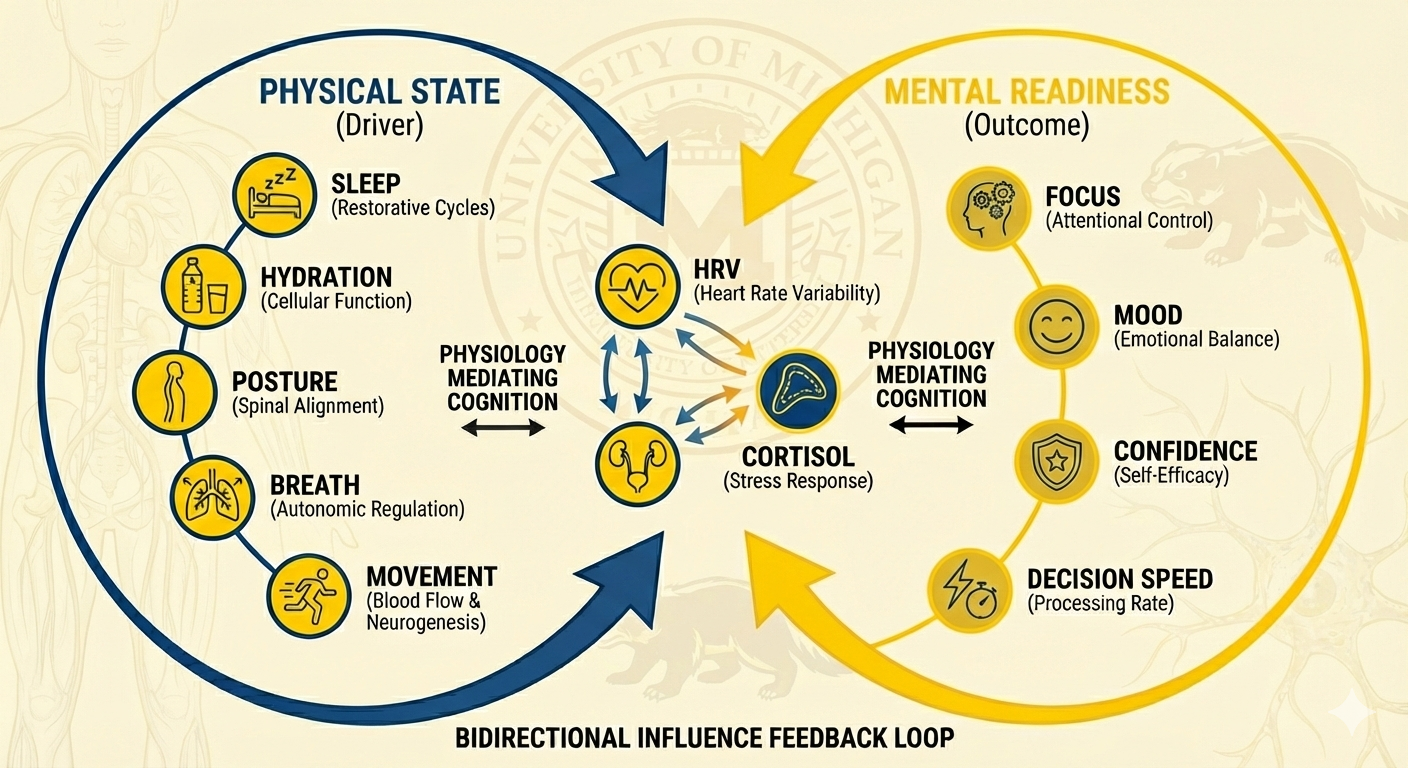
Light Movement (3-7 minutes)
Brief activity shifts the body from sedentary sluggishness to energized readiness. Research on acute exercise shows that even short bouts improve executive function within minutes.
Breathwork (2-5 minutes)
Breathing patterns directly regulate the autonomic nervous system. This is the fastest lever you have to shift your physiological state.
Component 2: Mental Preparation
Physical activation sets the stage; mental preparation directs attention. This component involves clearing cognitive clutter and priming the psychological state.
Brain Dump (2-3 minutes)
The Zeigarnik Effect describes how unfinished tasks occupy working memory. A brief brain dump externalizes these “open loops,” freeing up cognitive capacity.
Intention Setting (1-2 minutes)
Vague goals produce vague results. Before each session, write down specifically what you’ll accomplish.
- Bad: “Work on the presentation.”
- Good: “Complete slides 1-5 with speaker notes.”
Visualization (1-3 minutes)
Research on motor imagery demonstrates that imagined movements activate the same brain regions as actual movements. Briefly visualize yourself working in deep flow or completing the output.
Component 3: Environmental Preparation
Environmental preparation ensures your space supports rather than sabotages your focus session.
Physical Clearing
Clear your primary work surface. Research demonstrates that visual clutter competes for processing resources in the visual cortex.
Digital Shutdown
- Phone: In another room (not just silenced).
- Notifications: Global “Do Not Disturb” active.
- Tabs: Close everything not required for this specific task.
Timing and Duration
Research suggests the optimal duration is 7-12 minutes. Shorter than 5 minutes may not provide sufficient transition time; longer than 15 minutes creates procrastination risk.
Effective flow routines address three dimensions: Physical (activation), Mental (direction), and Environmental (protection). The combination of all three produces more powerful state change than any single dimension alone.
The Five Routine Archetypes Templates
While every flow routine should be personalized, research and practice have identified archetypal patterns that work across individuals. These templates provide a starting point you can customize.
01. Morning Activation
10-15 MIN- Movement (5m): Light stretching or walk (seek natural light).
- Hydration: Full glass of water to rehydrate brain.
- Brain Dump (2m): Capture overnight thoughts.
- Intention (1m): Define specific outcome for first block.
- Setup (2m): Clear desk, phone away.
- Breathwork (3m): Box breathing to center attention.
02. The Transition
5-8 MIN- Closure (1m): Explicitly close tabs/materials from previous task.
- Physical Reset (2m): Stand, walk, break the physical pattern.
- Clearing (1m): Quick capture of lingering thoughts.
- Intention (1m): Define next outcome.
- Environment (1m): Phone away, notifications off.
- Breath (2m): 5-6 deep centering breaths.
03. Deep Work Entry
12-15 MIN- Sanctuary (3m): Door closed, sign posted, zero distractions.
- Activation (3m): Vigorous dynamic stretching.
- Breathwork (3m): Extended box breathing sequence.
- Dump & Intention (4m): Comprehensive clearing + visualization.
- Ritual (1m): Specific trigger action (e.g., lighting a candle, specific song).
04. Creative Flow
8-12 MIN- Sensory (3m): Look at inspiring images or listen to evocative music.
- Movement (3m): Walk while letting mind wander (no focus).
- Clearing (2m): Dump analytical thoughts to clear space.
- Intention (1m): Non-judgmental (“I will explore” vs “I will produce”).
- Mood (1m): Adjust lighting/sound for ambience.
- Opening (2m): Free-writing or sketching to lower barrier.
05. Recovery-to-Focus
5-7 MIN- Assess (30s): Note energy level (1-10).
- Activate (2m): High energy movement if low; calm if high.
- Fuel: Hydrate + light snack if physiological need exists.
- Context Reload (1m): Review where you left off.
- Intention (1m): Restate goal.
- Transition (1m): 5-6 breaths.
These archetypes are starting templates, not rigid rules. Use them as a foundation, then customize based on your personal responses, work type, and constraints. The best routine is the one you will actually perform consistently.
Building Your Personalized Flow Routine System
Generic routines help you start. Personalized routines deliver results. This section guides you through designing a routine optimized for your psychology and life circumstances.
Step 1: Self-Assessment
Before building your routine, assess your transition style. Rate each statement 1-5:
- I find it easy to shift gears between activities.
- My energy is consistent throughout the day.
- I can ignore distractions without much effort.
- I’m naturally a morning person.
- Physical movement helps me think.
- I benefit from quiet time before focused work.
- I feel most creative when I’m slightly relaxed.
- I prefer structured approaches over spontaneous ones.
- Music or sounds help me focus.
- I need closure on previous tasks before starting new ones.
Step 2: Component Selection
Based on your assessment, select components from each category to build your stack.
Step 3: Sequencing Your Routine
Order matters. Follow this general flow for optimal state change:
- Start with Physical: Increases blood flow and creates action momentum.
- Follow with Mental: Direct that energy. Clear clutter, establish direction.
- Finish with Environmental: Most proximate to work. These actions should be identical every time.
Step 4: Testing and Iteration
Your first routine is a hypothesis. Test it systematically.
Perform routine before every block. Rate focus (1-10). Note any friction.
Adjust selection. Modify duration. Experiment with sequencing.
Periodically add/remove components. Adapt to seasonal changes.
⚠️ Pitfall: Don’t iterate too quickly. Give each version 7-10 repetitions to allow the habit loop to strengthen.
Step 5: Environment Anchoring
Strengthen your routine by anchoring it to consistent environmental cues.
- Location: Perform routine in the same spot.
- Time: Align with circadian rhythms (e.g., 9:00 AM daily).
- Object: Use specific tools (a certain pen, a specific cup) only during prep.
The best routine is one that fits your psychology and feels natural enough to perform consistently. Start with an archetype, customize based on self-assessment, and refine through testing.
Domain-Specific Routines
Different types of work require different preparation. Here are detailed routines designed for specific professional domains.
Knowledge Workers
- Closure (1m): Close tabs/materials.
- Transition (2m): Stand, stretch, water.
- Shutdown (1m): Close Slack/Email.
- Dump (1.5m): Capture competing tasks.
- Intention (30s): Define outcome.
- Breath (1m): 3 cycles (4-4-4-4).
Creative Pros
- Inspiration (2m): Look at art/music.
- Opening (2m): Gentle movement.
- Release (1m): “Permission to be imperfect.”
- Intention (1m): “Explore with curiosity.”
- Mood (1m): Adjust lighting/sound.
- Free Practice (1.5m): Sketch/write freely.
Software Engineers
- Context (1m): Review last commit/notes.
- Freeze (1m): Close notifications/status.
- Activate (1.5m): Stretch neck/wrists.
- Spec (1m): Ultra-specific task goal.
- Model (1.5m): Mental walkthrough.
- Env (30s): Files open, docs ready.
Students
- Relocation (1m): Phone in another room.
- Setup (1m): Only needed materials.
- Reset (2m): Walk/stretch to break inertia.
- Spec (1m): “Complete probs 15-25”.
- Timer (30s): Pomodoro set (Accountability).
- Breath (1.5m): 5 deep breaths (Anxiety).
Executives
- Boundary (1m): Door closed, EA notified.
- Delegate (1m): Quick check: delegate this?
- Shift (2m): Break meeting posture.
- Elevate (2m): “Highest leverage use?”
- Dump (1.5m): Clear ops concerns.
- Viz (1.5m): Visualize strategic goal.
Athletes
- Warm-up (7m): Sport-specific dynamic.
- Check (30s): Rate arousal 1-10.
- Regulate (2m): Breath to calm or energize.
- Mental (2m): Review tactical cues.
- Viz (3m): Rehearse successful execution.
- Trigger: Sport-specific gesture.
Domain-specific routines address unique challenges. Use these as starting templates, but remember the underlying principle is universal: Physical, Mental, and Environmental preparation.
Advanced Routine Techniques Mastery
Once you’ve established a foundational routine and maintained it for 4-8 weeks, these advanced techniques can enhance effectiveness and adaptability.
Technique 1: Routine Stacking
Routine stacking involves layering multiple routines throughout the day. Each routine builds on the state created by the previous one, creating a compounding effect.
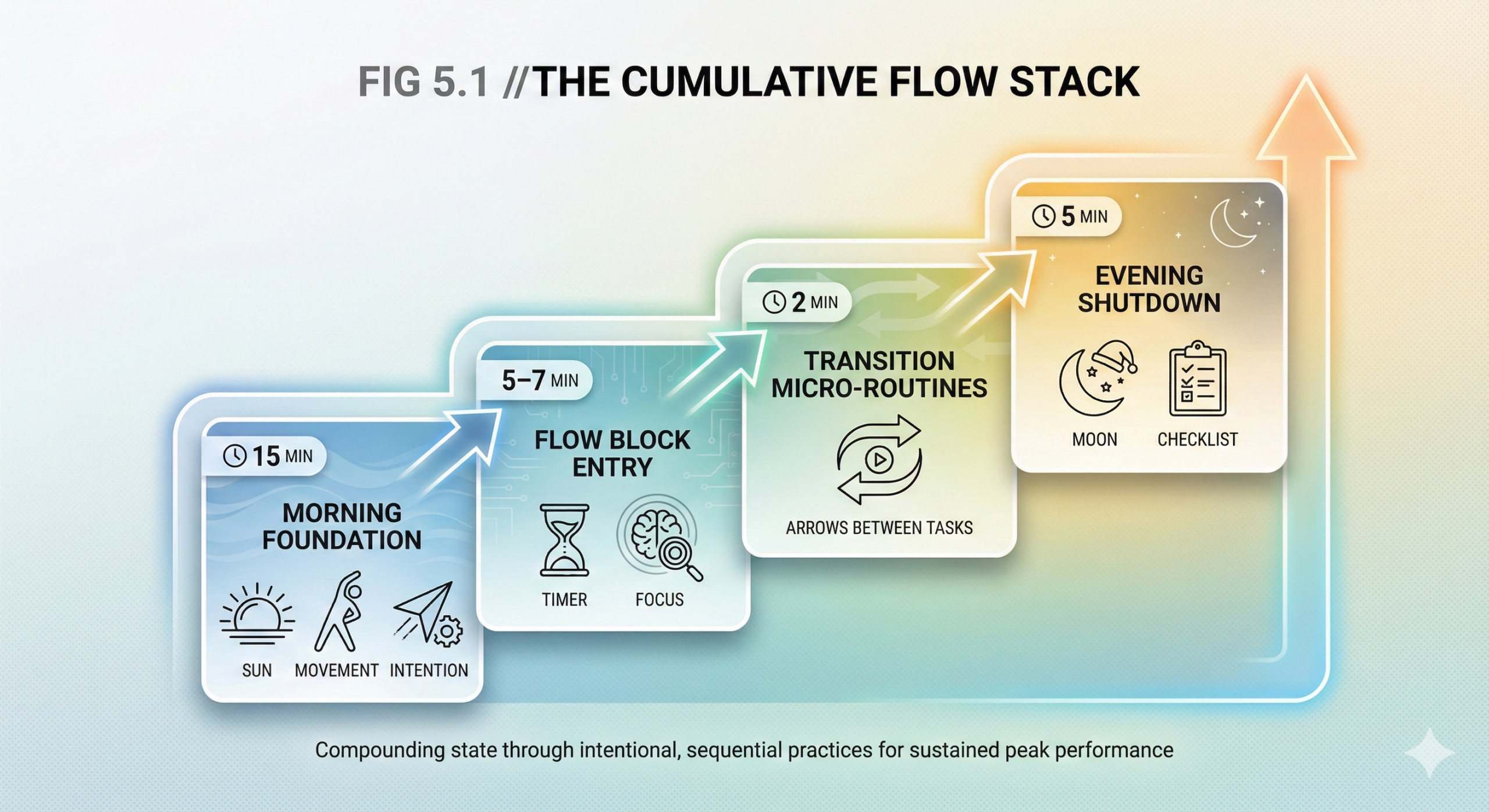
The Stacking Framework:
-
Morning Foundation 15 min
Sets the tone. Physical activation and daily intention. -
Flow Block Entry 5-7 min
Abbreviated routines before each specific block. -
Transition Micro-Routines 2 min
Maintains state continuity between tasks. -
Evening Shutdown 5 min
Closes loops and creates separation for recovery.
Technique 2: Environmental Anchoring
This leverages classical conditioning. By consistently pairing specific sensory cues with your flow state, the cue itself eventually triggers the state.
A specific instrumental playlist or track used only during deep work.
A specific scent (candle/oil) lit only when the timer starts.
A specific physical gesture (e.g., touching thumb to forefinger) at start.
A totem or object placed on the desk only during focus blocks.
Technique 3: State Priming
Research on embodied cognition shows that physical posture influences psychological state. Use the body to lead the mind.
- Stand tall with open, expansive posture (Power Posing).
- Relax facial muscles and adopt a slight smile (Facial Feedback).
- Deep breathing while maintaining this stance.
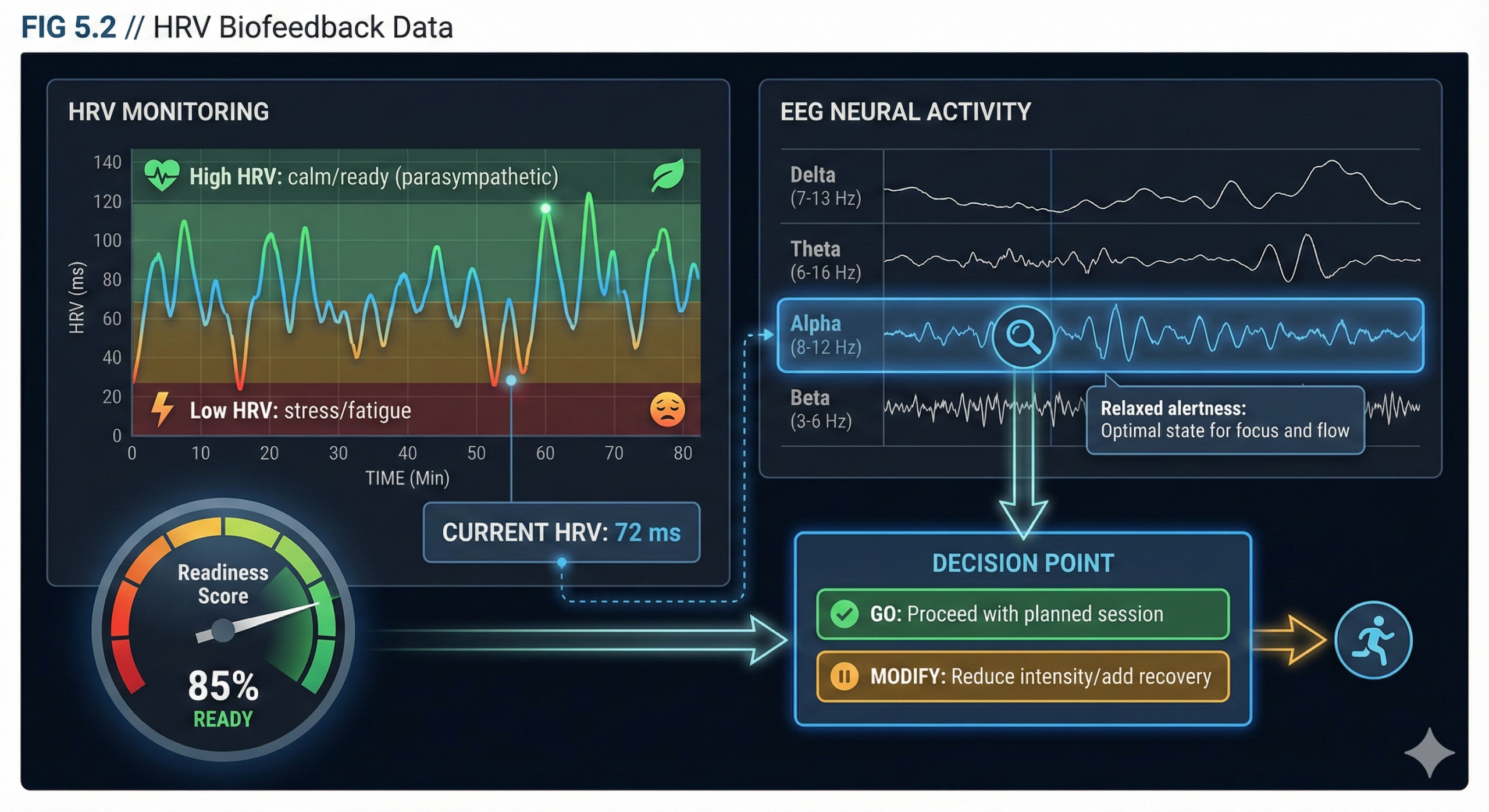
Technique 4: Biofeedback Integration
Advanced practitioners use data to objectively verify readiness.
- Heart Rate Variability (HRV): High HRV indicates parasympathetic dominance (calm/ready). Low HRV suggests stress/fatigue.
- EEG Monitoring: Measuring Alpha waves associated with relaxed alertness.
Technique 5: Routine Flexibility
Maintain consistency without rigidity using the Core-Flex Framework.
🔒 Core Elements (Fixed)
- Phone in other room
- Intention written down
- 3 Centering breaths
- Ritual Marker
↔️ Flex Elements (Adaptive)
- Activation: Extended if low energy.
- Brain Dump: Extended if mind is cluttered.
- Visualization: Added for high-stakes work.
Advanced techniques should be layered on top of a solid foundational practice. Master the basics first (4-8 weeks of consistency), then selectively add anchoring, stacking, or biofeedback to optimize.
The Flow Routine Mastery Protocol
A 90-day systematic programme to design, install, and permanently integrate pre-performance flow routines — from foundational habit formation through advanced optimisation to elite-level automaticity.
Based on Gollwitzer, Fogg, Csikszentmihalyi, Lally, and 50+ years of habit science and flow research
Day Complete
Great work on your flow routine practice.
Risks, Limitations
& The Dark Side
Where pre-flow rituals fail — and the dangers of confusing preparation with performance
Rituals are seductive because they offer certainty in an uncertain process. ‘Do these five things and flow will follow.’ But routines have failure modes that mirror the very biases they’re designed to overcome. When your pre-flow ritual becomes a superstitious chain rather than a genuine cognitive primer, you’ve traded one form of irrationality for another — and this version feels productive, which makes it harder to detect.
Understanding where flow routines fail prevents you from building elaborate preparation systems that substitute for the work itself. What follows is an honest assessment of the costs, the limits, and the contexts where ritualised preparation does more harm than simply beginning.
5 Failure Modes
These failure modes affect anyone who builds pre-work rituals. But for some, routines are actively counterproductive.
When to Skip This Approach
If any of these apply, modify the approach or consult a professional before proceeding.
Personal routine mastery has limits. The deepest barriers to consistent preparation aren’t about your ritual — they’re about the systems that surround it. This is Part 5 of the Flow Routines guide.
Overconfidence Warning
Active Warning
The Preparation-Performance Confusion
The deepest trap in flow routine practice is mistaking preparation for performance. Your routine feels productive. You’re doing something related to your work. But until you start the actual work, you’ve produced nothing. The danger is that routines provide the psychological satisfaction of productivity without its substance — and over time, the preparation itself becomes the reward.
Honest self-check — select any that apply:
- Your routine has grown longer in the past 6 months without deliberate, tested additions
- You feel unable to start work if any element of your routine is missing or disrupted
- You spend more energy perfecting your routine than you spend on the deep work it precedes
- You’ve never tested whether your routine actually improves flow entry compared to just starting
You’re showing signs of the preparation-performance confusion. Your routine has become the work. Test it, trim it, or replace it with the simplest possible entry: open the document and begin.
Protection Protocols
Evidence-Based Safeguards
- Hard cap: 5 minutes maximum for any pre-flow routine, no exceptions
- Quarterly audit: remove any element you can’t prove contributes to flow entry
- Skip days: deliberately start work without your routine once per week
- Track the transition: measure time from ‘routine start’ to ‘first productive output’
System-Level Limitations
Even the best personal routine can’t overcome environmental and organisational barriers to consistent flow practice.
When individual optimisation hits organisational walls:
What Organisations Can Do Instead
- Team-level transition rituals that signal collective focus periods — normalising preparation rather than treating it as individual eccentricity
- Organisational respect for transition time between meetings and deep work — building 15-minute buffers into scheduling software
- Portable routine design training — teaching employees to build location-independent focus triggers
- Interruption protocols that protect the first 10 minutes of scheduled focus time — when routines are most vulnerable
- Async documentation of routine practices across teams — sharing what works without prescribing one-size-fits-all approaches
The goal was never the perfect ritual. It was reducing the friction between intention and action — then getting out of your own way.
The risks of flow routines are real: ritual inflation, sequence rigidity, emotional bypassing, social performance, and false causation. Keep your routine ruthlessly simple, empirically tested, and subordinate to the work itself.
Explore Applied FlowYour Questions Answered
16 research-backed answers covering routine science, pre-work rituals, shutdown sequences, and recovery protocols — from why routines beat motivation to building your complete flow preparation system.
No questions match your search
Try different keywords or
01Why do routines matter more than motivation for entering flow?
Motivation is volatile — it fluctuates with sleep, mood, and circumstance. Routines bypass motivation entirely by creating automatic behavioural sequences that trigger flow-state neurochemistry regardless of how you feel when you sit down.
Research on expert performers reveals a counterintuitive pattern: the most consistently productive people don't rely on feeling motivated. They rely on routine. A pre-work ritual acts as a conditioned stimulus — after enough repetitions, the routine itself triggers the neurochemical cascade (norepinephrine, dopamine, endorphins, anandamide) associated with focused attention. This is classical conditioning applied to cognitive performance. The routine becomes a reliable on-ramp to flow because your brain learns to associate the sequence of behaviours with the state that follows. Motivation gets you started once. Routine gets you started every day.1Flow: The Psychology of Optimal ExperienceHarper & Row2Psychology of HabitAnnual Review of Psychology, 67, 289-314
Maya Angelou rented a hotel room every morning, arriving at 6:30am with a Bible, a deck of cards, a bottle of sherry, and a yellow legal pad. She never spent the night. The ritual — same room, same objects, same time — was the trigger. She didn't wait to feel inspired; the routine manufactured the conditions for inspiration to arrive reliably.
Stop waiting to feel ready. Build a routine that makes you ready. After 15–20 repetitions, the routine itself becomes the trigger.
02What is the neuroscience behind pre-performance routines?
Pre-performance routines work through three neural mechanisms: contextual cueing (environmental signals prime task-relevant neural networks), procedural memory automation (reducing prefrontal load), and anticipatory neurochemistry (the brain releases focus chemicals before the task begins).
When you perform the same sequence before deep work repeatedly, your basal ganglia encodes the routine as a chunked motor programme — a single neural 'unit' that fires automatically. This frees the prefrontal cortex (your executive control centre) from managing the transition and lets it focus entirely on the upcoming task. Additionally, the brain learns to release norepinephrine and dopamine during the routine itself, not after the task begins — meaning you arrive at your desk already neurochemically primed for focus. This anticipatory release is why athletes report 'getting in the zone' during warm-up rather than during competition.1Habits, Rituals, and the Evaluative BrainAnnual Review of Neuroscience, 31, 359-387
A concert pianist's pre-performance routine (specific stretches, visualisation of the opening bars, three deep breaths, adjustment of the bench) takes exactly 90 seconds. Brain imaging shows her prefrontal activity decreasing during this routine — not increasing. The routine is offloading preparation to automatic systems, freeing conscious resources for the performance itself.
Your routine literally changes your brain chemistry before you start working. The more consistent the routine, the stronger the anticipatory neurochemical response.
03How long should a pre-work routine be?
Research on transition rituals suggests 5–15 minutes is the sweet spot — long enough to trigger the neurochemical transition but short enough that the routine doesn't become a procrastination vehicle.
Under 5 minutes and the routine doesn't create sufficient state change — your brain hasn't fully transitioned from default mode network (mind-wandering) to task-positive network (focused attention). Over 15 minutes and diminishing returns set in — the additional preparation doesn't improve focus quality and can become elaborate avoidance. The optimal length depends on your baseline state. If you're transitioning from a calm, low-stimulation environment (home office, early morning), 5–7 minutes may suffice. If you're transitioning from a high-stimulation context (commute, meetings, social media), you may need 10–15 minutes to fully disengage the previous state.1Recovery from Job StressCurrent Directions in Psychological Science, 24(3), 166-171
A software architect tested three routine lengths over six weeks, tracking time-to-first-commit as a proxy for flow entry. The 3-minute routine averaged 23 minutes to first productive output. The 8-minute routine averaged 11 minutes. The 20-minute routine averaged 14 minutes — the extra time didn't help and sometimes became its own distraction. He standardised on 8 minutes.
Start with 8 minutes. Adjust by 2-minute increments based on how quickly you enter focused work. Track time-to-first-output as your metric.
04What's the difference between routines and rituals?
Routines are functional sequences that reduce cognitive load. Rituals are routines imbued with meaning and intentionality — and research shows rituals produce stronger psychological effects because the sense of significance amplifies the neurochemical response.
A routine is brushing your teeth before bed. A ritual is a Japanese tea ceremony. The behavioural components may overlap, but the psychological framing is entirely different. Research by Francesca Gino and Michael Norton demonstrates that rituals — even arbitrary ones — reduce anxiety, increase confidence, and improve performance. The mechanism is the sense of control and meaning that rituals create. For flow entry, converting your routine into a ritual means adding intentionality: not just 'I close my tabs and put on music' but 'I'm transitioning into my highest-value work — this sequence marks the boundary between distraction and depth.'1Don't Stop Believing: Rituals Improve Performance by Decreasing AnxietyOrganizational Behavior and Human Decision Processes, 137, 71-85
A writer's routine: close email, open Scrivener, put on headphones. The same writer's ritual: close email while saying 'the world can wait,' open Scrivener and re-read the last paragraph written (reconnecting with the work), put on the same playlist (always the same one), and take three breaths while looking at a photo of a reader's thank-you note pinned above the monitor. Same actions, dramatically different psychological framing — and measurably faster flow entry.
Transform your routine into a ritual by adding intentionality and meaning. The psychological framing matters as much as the behaviours themselves.
05Can routines become stale or counterproductive?
Yes — routines can calcify into empty habit if they lose connection to the state they're meant to trigger. The fix isn't abandoning routines but periodically refreshing specific elements while preserving the core structure.
Habituation is a real risk: after months of the same sequence, your brain may stop producing the anticipatory neurochemical response because the routine no longer carries novelty or significance. The solution is the 80/20 refresh: keep 80% of your routine stable (this maintains the conditioned association) and rotate 20% every 4–6 weeks (this introduces enough novelty to prevent habituation). The core structure — timing, location, duration — should remain consistent. The variable elements — specific music, breathing technique, warm-up task — can rotate.1Psychology of HabitAnnual Review of Psychology, 67, 289-314
A designer kept her core routine stable for two years (same time, same desk setup, same duration) but rotated three elements quarterly: the background music genre, the opening creative exercise (sketching, word association, or image browsing), and the specific tea she drank. Each rotation produced a noticeable 'freshness' spike in the first week, while the stable core ensured reliable flow entry throughout.
Audit your routine every 6 weeks. Keep the skeleton. Refresh the details. If flow entry has degraded, the routine probably needs a 20% refresh, not a complete overhaul.
06What are the essential components of a pre-work flow ritual?
An effective pre-work ritual has five components: environmental priming (setting up the physical space), digital clearing (eliminating notification sources), cognitive warm-up (engaging the relevant neural networks), intentional framing (defining the session's purpose), and state transition (bridging from default mode to task mode).
Environmental priming: desk clear, tools ready, lighting optimised, temperature comfortable. This signals to the brain that the environment is 'work mode.' Digital clearing: phone silent and face-down or in another room, unnecessary tabs closed, notifications disabled, communication apps closed. This removes the largest source of attention fragmentation. Cognitive warm-up: 2–3 minutes reviewing yesterday's work, scanning today's task, or doing a brief related exercise. This activates task-relevant neural networks before the main work begins. Intentional framing: a single sentence defining what you'll accomplish ('I'm writing the methodology section'). This narrows attentional focus. State transition: 3–5 deep breaths, brief body scan, or 60 seconds of stillness. This physiologically downregulates the sympathetic nervous system and engages parasympathetic readiness.1Deep Work: Rules for Focused Success in a Distracted WorldGrand Central Publishing
A data scientist's 8-minute ritual: (1) desk wipe and notebook placement (environment, 1 min), (2) phone in drawer, Slack set to DND, close email (digital clearing, 1 min), (3) re-read yesterday's last code commit and review today's Jira ticket (cognitive warm-up, 3 min), (4) write one sentence on a sticky note: today's specific output goal (framing, 30 sec), (5) box breathing 4-4-4-4 for six cycles (state transition, 2.5 min). Total: 8 minutes. Flow entry within 5 minutes of starting work.
Include all five components in your ritual. Missing any one creates a gap that delays flow entry — digital clearing and state transition are the most commonly skipped and the most impactful.
07How important is the physical environment in a pre-work routine?
The physical environment acts as a contextual cue that primes your brain for the associated cognitive state — research shows that environmental consistency is one of the strongest predictors of routine effectiveness and flow entry speed.
Context-dependent memory research demonstrates that cognitive states are partially encoded with environmental features. Working in the same space, at the same desk, with the same sensory inputs creates a multi-modal cue that triggers the associated mental state faster with each repetition. This is why dedicated workspaces outperform variable locations for deep work. The minimum environmental signals: consistent location (even a specific chair), consistent lighting, consistent ambient sound (or consistent silence), and a clean, prepared workspace. Each signal reinforces the conditioned association between environment and focus state.1Context-Dependent Memory in Two Natural EnvironmentsBritish Journal of Psychology, 66(3), 325-331
A freelance consultant who worked from different coffee shops struggled with inconsistent flow entry (averaging 25+ minutes). He couldn't control location, so he created portable environmental consistency: the same noise-cancelling headphones, the same playlist, a specific notebook placed at the same angle, and the same pen. These portable cues reduced flow entry to 12 minutes regardless of location — the consistent objects became the contextual trigger in place of a consistent room.
If you can control your workspace, make it consistent. If you can't, create portable consistency through objects, sounds, and sensory cues you carry with you.
08What role does music play in a flow routine?
Music serves as both a state-transition trigger and an attention anchor during deep work — but only specific types of music enhance focus, and using the same tracks during your routine strengthens the conditioned flow response over time.
Research on music and cognition reveals a nuanced picture. Music with lyrics competes for language-processing resources and impairs writing and analytical work. Music with high variability (jazz improvisation, complex classical) demands attention and can distract. The optimal flow music has: no lyrics (or lyrics in a language you don't understand), moderate tempo (60–80 BPM for analytical work, 80–120 BPM for creative work), low variability (ambient, lo-fi, minimalist), and personal association with focus. The critical insight for routines: using the same music during your pre-work ritual creates a Pavlovian association. After 10–15 sessions, pressing play on that specific playlist triggers the focus state before the music itself affects cognition.1
A venture capitalist used the same Brian Eno album ('Music for Airports') exclusively during deep analysis sessions for three years. He reported that simply hearing the opening track triggered a measurable shift in his attention — colleagues learned that when the album came on, he'd entered 'analysis mode' and shouldn't be disturbed. The music became the most reliable element of his flow trigger stack.
Choose one album or playlist for deep work. Use it only during deep work. After 2–3 weeks, the music itself becomes a flow trigger through conditioned association.
09How do I design a morning routine that sets up the entire day for flow?
The optimal morning routine front-loads biological and psychological preparation — light exposure, movement, and cognitive priming — so that when your first flow block begins, you're operating at peak neurochemical readiness rather than fighting residual sleep inertia.
The research-backed morning flow preparation sequence: first 10 minutes after waking — bright light exposure (outdoor sunlight or 10,000 lux lamp) to suppress melatonin and trigger cortisol awakening response. Minutes 10–30 — movement (even a 10-minute walk) to elevate BDNF, increase cerebral blood flow, and shift from parasympathetic to sympathetic activation. Minutes 30–45 — hydration and strategic nutrition (protein-forward breakfast stabilises blood glucose for sustained cognition). Minutes 45–60 — cognitive priming (review today's priorities, visualise the first work session, set a single intention). This sequence means your first flow block starts with optimised neurochemistry rather than fighting grogginess.1Optimizing Workspace for Productivity, Focus, and CreativityHuberman Lab Podcast
A hedge fund analyst restructured his morning: 6:00am wake → immediate 15-minute outdoor walk (light + movement), 6:15 → cold shower (norepinephrine spike, sympathetic activation), 6:30 → protein-heavy breakfast while reviewing overnight market data (nutrition + cognitive priming), 7:00 → 8-minute pre-work ritual → deep analysis block. He reported that the quality of his 7am–10am analysis improved more from the morning routine change than from any analytical tool or data source upgrade.
Your flow block quality is determined by the 60 minutes before it starts. Front-load light, movement, nutrition, and cognitive priming to arrive at your desk already primed.
10What is a shutdown ritual and why is it as important as starting?
A shutdown ritual is a deliberate end-of-work sequence that signals to your brain that work is complete — it closes open cognitive loops, prevents attention residue from bleeding into recovery time, and ensures tomorrow's flow entry starts clean.
Cal Newport's research on attention residue shows that switching from work to personal time without a clear boundary leaves task-related thoughts circulating in working memory — degrading both your evening recovery and next-morning focus. A shutdown ritual provides cognitive closure. The mechanism is the Zeigarnik Effect: incomplete tasks occupy mental bandwidth until they're either completed or captured in a trusted system. By reviewing open tasks, writing tomorrow's plan, and explicitly declaring 'shutdown complete,' you give your brain permission to release work-related processing and enter genuine recovery.1Deep Work: Rules for Focused Success in a Distracted WorldGrand Central Publishing
A product director's shutdown ritual (7 minutes): review today's accomplishments and note them (closure on completed work, 2 min), scan tomorrow's calendar and identify the single most important task (reduces morning decision fatigue, 2 min), capture any lingering thoughts or open loops in a trusted task manager (cognitive offloading, 2 min), say 'shutdown complete' while closing the laptop (explicit verbal cue, 30 sec), change into non-work clothes (environmental state change, 30 sec). Her evenings became genuinely restorative and her morning flow entry time dropped from 20 minutes to 8.
Your evening recovery quality determines your next-day flow quality. A 5–10 minute shutdown ritual is the bridge between productive work and genuine rest.
11How do I prevent work thoughts from invading my evening?
Rumination after work is caused by unclosed cognitive loops — tasks you haven't completed or captured. The solution isn't willpower ('stop thinking about work') but systematic cognitive offloading during your shutdown ritual that gives the brain nothing left to process.
The Zeigarnik Effect shows that incomplete tasks create intrusive thoughts. But research by Masicampo and Baumeister (2011) revealed a critical nuance: simply making a plan to complete the task is sufficient to eliminate the intrusive thoughts — you don't actually need to finish the task, just commit it to a trusted external system with a clear next action. This is why shutdown rituals that include task capture and next-day planning are so effective. Additionally, creating a strong environmental boundary — different room, different clothes, different activities — reinforces the cognitive transition from 'work mode' to 'recovery mode.'1Consider It Done! Plan Making Can Eliminate the Cognitive Effects of Unfulfilled GoalsJournal of Personality and Social Psychology, 101(4), 667-683
A barrister who couldn't stop replaying case arguments in the evening implemented two changes: a shutdown ritual with explicit task capture ('Case X: draft cross-examination questions Tuesday 9am') and a hard environmental boundary (work bag stays in the hallway, never enters the living room). Intrusive work thoughts dropped by approximately 80% within two weeks — not because she cared less about her cases, but because her brain no longer needed to hold them in active memory.
Capture every open loop in a trusted system with a specific next action and time. Your brain will release what it trusts is safely stored elsewhere.
12What should a between-session recovery routine look like?
Between flow blocks, your brain needs 15–20 minutes of genuine recovery — not passive scrolling or email checking but deliberate activities that restore the neurochemical resources depleted during deep focus.
Deep work depletes specific neurochemical resources: dopamine, norepinephrine, and acetylcholine all draw down during sustained focus. Recovery activities that restore these resources share common features: they're mildly physical (walking, stretching), low-cognitive-demand (not social media, not email), and ideally involve nature or novel sensory input. The default mode network — associated with creativity, insight, and memory consolidation — activates during these periods, which is why breakthrough ideas often arrive during breaks rather than during focused analysis. The worst between-session activity is checking email or social media, which depletes the same attentional resources you're trying to restore while providing none of the neurochemical restoration.1The Cognitive Benefits of Interacting with NaturePsychological Science, 19(12), 1207-1212
A software team replaced their between-sprint coffee-and-Slack habit with a structured recovery protocol: 5-minute outdoor walk (light + movement + nature), 5 minutes of casual non-work conversation (social connection, default mode activation), 5 minutes of quiet individual time (journaling, stretching, or simply sitting). Afternoon productivity metrics improved 18% — not from working harder but from recovering properly between work blocks.
Between flow blocks: walk, move, look at nature, talk to a human about something non-work. Avoid screens. The 15 minutes you 'lose' to recovery you gain back 3x in the next session's quality.
13How does a weekly review routine compound flow performance?
A weekly review routine is the meta-routine that optimises all your other routines — it creates a feedback loop where you systematically identify what's working, what's degrading, and what needs adjustment across your entire flow system.
David Allen's weekly review concept, extended to flow performance, creates a compound improvement cycle. Each week, you assess: flow block quality (how many sessions achieved genuine depth?), routine effectiveness (did pre-work rituals reliably trigger focus?), recovery quality (did shutdowns enable genuine rest?), and system friction (what interrupted flow most frequently this week?). The review takes 20–30 minutes and produces 1–2 specific adjustments for the following week. Over 52 weeks, these micro-adjustments compound into a dramatically optimised system — one that's custom-fitted to your specific neurology, schedule, and work context.1Getting Things Done: The Art of Stress-Free ProductivityViking
A management consultant ran weekly reviews for six months (26 iterations). Week 3: discovered that flow blocks after 2pm meetings consistently failed — moved all meetings to a single afternoon. Week 8: noticed music had lost its triggering effect — rotated to a new playlist. Week 14: identified that Sunday evening planning reduced Monday flow entry time by 50%. Week 22: flow block success rate had risen from 40% to 78%. No single change was dramatic — the compound effect of 22 small adjustments was transformative.
Schedule a 20-minute weekly review every Friday or Sunday. One question: 'What one adjustment would improve next week's flow?' Fifty-two of these compound into a system no generic advice could produce.
14What's the simplest pre-work routine I can start with today?
The minimum viable pre-work routine has three steps and takes 5 minutes: clear your workspace, silence your phone, and write one sentence defining your session's output. That's enough to begin building the conditioned association.
Don't over-engineer your first routine. Complexity kills consistency, and consistency is what builds the conditioned neurochemical response. Step 1 (1 min): clear your desk of everything except what you need for this specific task. Step 2 (1 min): put your phone on silent, face-down, or ideally in another room. Close email and messaging apps. Step 3 (3 min): open yesterday's work and re-read the last thing you produced. Then write one sentence on paper or a sticky note: 'This session I will [specific output].' Start working immediately after writing the sentence. That's it. Do this for 10 consecutive workdays before adding any additional elements.1Atomic HabitsRandom House
A junior analyst was overwhelmed by the elaborate morning routines described in productivity books. Her manager suggested the three-step minimum: clear desk, phone away, one-sentence intention. She did it for two weeks straight. By day 8, she noticed she was entering focused work within 5 minutes of completing the routine — faster than she'd ever achieved with motivation-based approaches. She then gradually added a breathing component in week 3 and music in week 4.
Three steps. Five minutes. Ten consecutive days. Build the habit first, optimise later. A simple routine done daily beats an elaborate routine done occasionally.
15How do I build a shutdown routine if I currently have no boundary between work and rest?
Start with a single hard boundary: a specific time after which you do not check work communications. Then build backward with a 3-minute capture ritual at that time — reviewing open tasks, writing tomorrow's top priority, and declaring 'done.'
If you currently have no work-rest boundary, the first priority is establishing any boundary — even an imperfect one. Choose a hard stop time that's realistic for your current situation (it doesn't have to be 5pm — even 8pm is better than no boundary). At that time, perform three actions: (1) open your task manager and capture anything still circulating in your mind (2 min), (2) write tomorrow's single most important task on a sticky note and place it on your keyboard (30 sec), (3) close your laptop and say 'shutdown complete' out loud (30 sec). The verbal declaration sounds silly but research on implementation intentions shows that explicit verbal commitments dramatically increase follow-through.1Deep Work: Rules for Focused Success in a Distracted WorldGrand Central Publishing
A startup founder who regularly worked until midnight with no clear endpoint started with a 9pm hard boundary. At 9pm: brain dump into Notion (every open loop, every lingering thought), write tomorrow's one thing on a Post-it, close the laptop, move to a different room. The first week was uncomfortable — he kept reaching for his phone. By week three, his sleep quality improved, his mornings were sharper, and his total productive output actually increased because the hard boundary forced prioritisation during work hours.
Pick a time. Any time. Build a 3-minute capture ritual at that time. Do it for 14 consecutive days. The boundary between work and rest is the foundation everything else builds on.
16What's the complete 30-day flow routine protocol?
Week 1: install the minimum pre-work and shutdown routines. Week 2: add environmental and sensory consistency. Week 3: add between-session recovery. Week 4: run your first weekly review and personalise the system.
Days 1–7: install the three-step pre-work routine (clear desk, phone away, one-sentence intention) and the three-step shutdown routine (brain dump, tomorrow's priority, verbal shutdown). Do both every workday — consistency matters more than perfection. Days 8–14: add environmental consistency (same workspace setup, same lighting, same ambient sound) and one sensory anchor (a specific playlist, a specific scent, or a specific beverage used only during deep work). Days 15–21: add structured between-session recovery (15-minute non-screen break between flow blocks: walk, stretch, nature). Also add a morning preparation element (10 minutes of light exposure and movement before your first flow block). Days 22–28: run your first weekly review. What's working? What's friction? Adjust one element. Then personalise — extend routines that serve you, trim elements that don't. Day 30: you now have a personalised flow routine system with pre-work entry, between-session recovery, shutdown closure, and a weekly improvement cycle.1Flow: The Psychology of Optimal ExperienceHarper & Row
A UX designer followed this protocol precisely. By day 30 she had: a 7-minute morning ritual (light walk + desk setup + playlist + intention), a 15-minute between-session recovery walk, and a 5-minute shutdown capture. Her flow block success rate (sessions where she achieved genuine depth) went from approximately 3 per week to 8 per week. The routine system was producing more deep work than motivation, caffeine, and deadline pressure ever had.
Thirty days of progressive routine building installs a complete flow system. Start today with the three-step minimum and add one element per week.
You’ve explored all 16 questions
Ready to go deeper? The full Flow Routines article provides comprehensive frameworks, implementation protocols, and advanced optimization systems.
Installing Automatic Focus Rituals
From willpower battles to neurological automation — your complete framework for routines that trigger flow on command.
The struggle to start working isn’t a discipline problem — it’s a missing transition signal. Your brain cannot switch from scanning mode to focused execution without a clear neurological cue.
Your 45 minutes of daily preparation theatre isn’t procrastination. It’s your default mode network running unchecked because no behavioural script tells it to stand down.
The Compounding Effect
If a 7-minute routine saves 45 minutes of daily theatre and accelerates flow entry by 60% across 250 days, that’s 187 recovered hours and dramatically deeper sessions — that’s the equivalent of an extra working month — a transformative output gain.
Knowledge Work
Immediate transition from morning routine to deep cognitive output without drift
Creative Practice
Rituals that bypass blank-page paralysis and activate creative flow automatically
Athletic Performance
Pre-performance routines reducing anxiety and increasing confidence under pressure
Team Leadership
Meeting preparation rituals that shift groups from scattered to focused in minutes
The Practice Requirement
Routines only work through repetition, not understanding. Knowing habit neuroscience without daily practice produces nothing — just as understanding brain chemistry without changing nutrition eliminates zero fog.
Your Next Steps
-
TodayDesign Your Starter RoutineChoose one component from each preparation layer: physical, mental, environmental.
-
Next 30 DaysInstall Through Daily PracticeExecute your routine before every focus session for 30 days. Track session quality to measure impact.
-
Next 60 DaysRefine & ExpandAdd advanced habit stacking, build domain-specific variations, extend to multiple daily sessions.
-
6–12 MonthsAchieve Ritual MasteryFull automaticity where the routine triggers focus without conscious effort. Zero preparation theatre.
- Zero preparation theatre daily
- Flow entry in under 10 minutes
- Automatic network switching
- Confidence before every session
- Rituals that compound over years
“We are what we repeatedly do. Excellence, then, is not an act, but a habit.” — Will Durant
What You Need to Remember
The startup sequences that elite performers use to reliably enter deep focus.
Your routine is a conditioned trigger
A consistent pre-flow sequence trains a Pavlovian association between specific environmental cues and the neurochemical cascade of deep focus. After 3-4 weeks, the routine itself initiates the state.
Explore: Module 1 — Conditioned Response →90 minutes is biologically optimal
Ultradian rhythm research shows cognitive performance peaks in ~90-minute waves. Blocks shorter than 60 minutes never reach full depth. Blocks longer than 120 minutes produce diminishing returns.
Explore: Module 1 — Block Architecture →The first five minutes are the whole game
Cold-starting a deep work session (opening laptop, staring at screen) predicts failure. A ritualized 5-minute transition — review goals, close tabs, set timer — predicts flow entry.
Explore: Module 2 — Startup Sequences →Your last task is still running in the background
Attention residue from email, Slack, or a meeting reduces performance on your deep work task by 20-40% for up to 15 minutes — even when you feel fully transitioned. Build a buffer.
Explore: Module 2 — Residue Effect →How you end determines how you start tomorrow
A 5-minute shutdown ritual — capture loose threads, review tomorrow's plan, declare "shutdown complete" — prevents work rumination during recovery and ensures clean re-entry the next morning.
Explore: Module 3 — Shutdown Protocol →Undefended routines die within weeks
Your carefully designed flow routine will be eaten alive by meetings, "quick questions," and Slack unless it's defended by calendar blocks, environmental barriers, and explicit social agreements.
Explore: Module 3 — Routine Defense →Vary the surface, not the structure
Same time, same startup sequence — but alternate locations, background sound, or challenge type on different days. This prevents habituation while preserving the conditioned trigger that makes flow reliable.
Explore: Module 4 — Rhythmic Variation →Hours worked is a vanity metric
Track: sessions completed, time-to-flow, interruptions per session, and subjective depth rating. These four metrics predict creative output better than total hours at desk.
Explore: Module 4 — Flow Metrics →Design the day around your biology
Administrative tasks at low alertness, deep work at your circadian peak, collaborative work in the social energy window. Stack your day to create rising focus, not scattered attention.
Explore: Module 5 — Day Architecture →The routine that works in month 1 won't work in month 6
Monthly metric review reveals which elements to keep, adjust, or replace. A flow routine is a living system — it evolves with your work, your biology, and your environment.
Explore: Module 5 — Continuous Refinement →Continue Your Journey
References
0 sources cited — journal articles, foundational texts, and landmark studies in habit science, implementation intentions, and pre-performance ritual design
- 1(2000). Habits as knowledge structures: Automaticity in goal-directed behavior. Journal of Personality and Social Psychology, 78(1), 53-63.
- 2(2011). Breaking habits with implementation intentions: A test of underlying processes. Personality and Social Psychology Bulletin, 37(4), 502-513.
- 3(2005). Sudarshan Kriya yogic breathing in the treatment of stress, anxiety, and depression: Part I. Journal of Alternative and Complementary Medicine, 11(1), 189-201.
- 4(2010). Power posing: Brief nonverbal displays affect neuroendocrine levels and risk tolerance. Psychological Science, 21(10), 1363-1368.
- 5(2012). The effects of acute exercise on cognitive performance: A meta-analysis. Brain Research, 1453, 87-101.
- 6(1990). Pre-performance routines in sport: Theoretical support and practical applications. The Sport Psychologist, 4(3), 301-312.
- 7(2002). Exercise: A behavioral intervention to enhance brain health and plasticity. Trends in Neurosciences, 25(6), 295-301.
- 8(2007). Mind-set matters: Exercise and the placebo effect. Psychological Science, 18(2), 165-171.
- 9(1990). Flow: The psychology of optimal experience. Harper & Row. Book
- 10(1994). Does mental practice enhance performance? Journal of Applied Psychology, 79(4), 481-492. .
- 11(2012). The power of habit: Why we do what we do in life and business. Random House. Book
- 12(2019). Tiny habits: The small changes that change everything. Houghton Mifflin Harcourt. Book
- 13(2006). Reverse replay of behavioural sequences in hippocampal place cells during the awake state. Nature, 440(7084), 680-683.
- 14(2015). A review and analysis of the use of 'habit' in understanding, predicting and influencing health-related behaviour. Health Psychology Review, 9(3), 277-295.
- 15(1975). Context-dependent memory in two natural environments: On land and underwater. British Journal of Psychology, 66(3), 325-331.
- 16(1999). Implementation intentions: Strong effects of simple plans. American Psychologist, 54(7), 493-503.
- 17(2006). Implementation intentions and goal achievement: A meta-analysis of effects and processes. Advances in Experimental Social Psychology, 38, 69-119.
- 18(2008). Habits, rituals, and the evaluative brain. Annual Review of Neuroscience, 31, 359-387.
- 19(2008). Be smart, exercise your heart: Exercise effects on brain and cognition. Nature Reviews Neuroscience, 9(1), 58-65.
- 20(2017). Rituals decrease the neural response to performance failure. PeerJ, 5, e3363.
- 21(2001). Neural simulation of action: A unifying mechanism for motor cognition. NeuroImage, 14(1), S103-S109.
- 22(2006). Physiology of long pranayamic breathing: Neural respiratory elements may provide a mechanism. Medical Hypotheses, 67(3), 566-571.
- 23(2010). A wandering mind is an unhappy mind. Science, 330(6006), 932.
- 24(2014). Voluntary activation of the sympathetic nervous system and attenuation of the innate immune response in humans. Proceedings of the National Academy of Sciences, 111(20), 7379-7384.
- 25(2010). How are habits formed: Modelling habit formation in the real world. European Journal of Social Psychology, 40(6), 998-1009.
- 26(2014). Heart rate variability biofeedback: How and why does it work? Frontiers in Psychology, 5, 756. .
- 27(2002). Building a practically useful theory of goal setting and task motivation. American Psychologist, 57(9), 705-717.
- 28(2013). Using mental imagery to deliver self-regulation techniques to improve sleep behaviors. Annals of Behavioral Medicine, 46(3), 260-272.
- 29(2017). The effect of diaphragmatic breathing on attention, negative affect and stress in healthy adults. Frontiers in Psychology, 8, 874.
- 30(1989). Delay of gratification in children. Science, 244(4907), 933-938.
- 31(1996). The psychology of concentration in sport performers: A cognitive analysis. Psychology Press. Book
- 32(2012). How do habits guide behavior? Perceived and actual triggers of habits in daily life. Journal of Experimental Social Psychology, 48(2), 492-498.
- 33(2010). The automatic component of habit in health behavior: Habit as cue-contingent automaticity. Health Psychology, 29(4), 374-383.
- 34(1997). Writing about emotional experiences as a therapeutic process. Psychological Science, 8(3), 162-166.
- 35(2010). Water, hydration, and health. Nutrition Reviews, 68(8), 439-458.
- 36(2001). A default mode of brain function. Proceedings of the National Academy of Sciences, 98(2), 676-682.
- 37(2008). Spark: The revolutionary new science of exercise and the brain. Little, Brown. Book
- 38(2017). The physiological effects of slow breathing in the healthy human. Breathe, 13(4), 298-309.
- 39(1994). The use of imagery by soccer players. Journal of Applied Sport Psychology, 6(1), 116-133.
- 40(2004). Self-regulatory strength. In Handbook of self-regulation: Research, theory, and applications. Chapter
- 41(1999). Implementation intentions and repeated behaviour. European Journal of Social Psychology, 29(2-3), 349-369.
- 42(2002). Pre-performance state, routines, and automaticity. Journal of Sport and Exercise Psychology, 24(4), 359-375.
- 43(2001). Environmental context-dependent memory: A review and meta-analysis. Psychonomic Bulletin & Review, 8(2), 203-220.
- 44(1988). Inhibiting and facilitating conditions of the human smile. Journal of Personality and Social Psychology, 54(5), 768-777.
- 45(2015). The neuroscience of mindfulness meditation. Nature Reviews Neuroscience, 16(4), 213-225.
- 46(1998). Harnessing the imagination: Mental simulation, self-regulation, and coping. American Psychologist, 53(4), 429-439.
- 47(2003). Reflections on past behavior: A self-report index of habit strength. Journal of Applied Social Psychology, 33(6), 1313-1330.
- 48(2018). Foundations of sport and exercise psychology (7th ed.). Human Kinetics. Book
- 49(2007). A new look at habits and the habit-goal interface. Psychological Review, 114(4), 843-863.
- 50(2016). Psychology of habit. Annual Review of Psychology, 67, 289-314.
- 51(1927). Das Behalten erledigter und unerledigter Handlungen. Psychologische Forschung, 9, 1-85.
- 52(2014). The effect of instructional self-talk on performance and learning the backstroke of young swimmers. Journal of Physical Education and Sport, 14(1), 27-35.