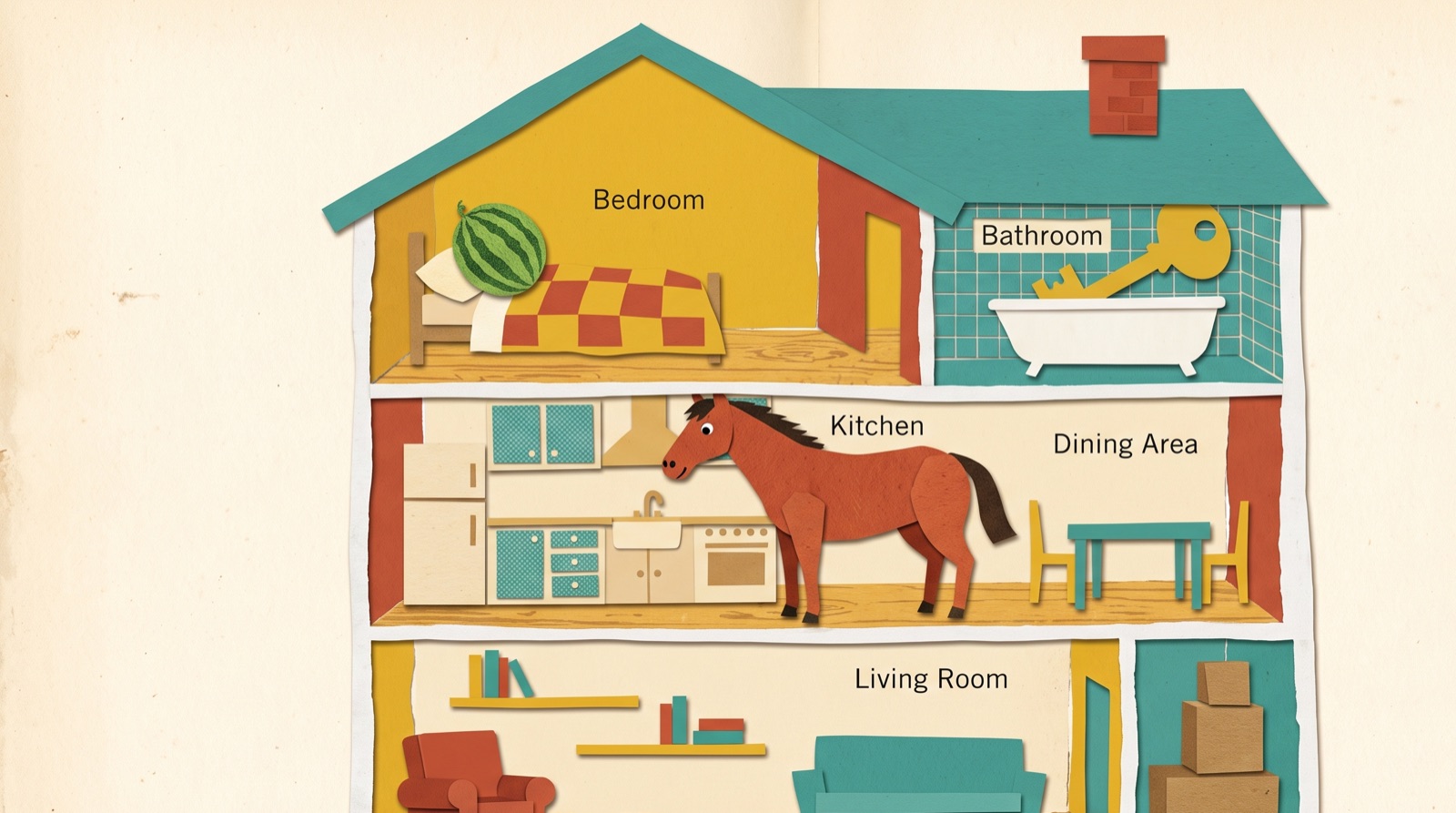
Method of Loci n.
The technique is widely known by the synonym memory palace; the Latin term loci simply means 'places', reflecting its origin in classical rhetorical training.
/ˈmɛθ.əd ɒv ˈloʊ.saɪ/ · also known as memory palace
The definition
Method of Loci is an ancient mnemonic technique in which items to be remembered are mentally placed at distinct locations along a familiar spatial route or building. During recall, the learner imagines traversing that route and retrieves each item from its assigned location. The technique leverages the hippocampus's spatial navigation circuits to achieve recall performance far exceeding passive rehearsal.
g = 0.65
effect size for method of loci vs rehearsal across 13 randomised controlled trials
TWOMEY & KRONEISEN · 20213
The mechanism
The method of loci works by explicitly binding each to-be-remembered item to a distinct spatial location, activating hippocampal and parahippocampal circuits associated with spatial navigation and episodic memory consolidation4. The learner selects a familiar environment (a home, a habitual commute route, a well-known building) and mentally deposits each item at a specific waypoint along the path. During retrieval, mentally retracing the route reinstates spatial context, and the items surface in the correct sequence.
This process recruits dual-coding: vivid visual imagery binds items to locations, while mental route traversal reinstates that spatial context at retrieval, yielding stronger encoding than verbal rehearsal alone4. The more distinctive the image (unusual, exaggerated, even structurally bizarre), the more reliably it surfaces. The hippocampus, a structure demonstrably plastic under sustained spatial demands, provides the neural scaffolding for the entire system1.
Six weeks of method of loci training reshapes functional connectivity between the right dorsolateral prefrontal cortex, medial prefrontal cortex, and medial temporal lobe structures, producing durable brain network reorganisation visible at four-month follow-up2. Naive adults trained with the technique converge on the functional connectivity patterns found in world memory champions, suggesting that the training does not merely sharpen performance temporarily but reorganises memory architecture itself.
In practice
The method of loci transfers readily from competitive memorisation to professional preparation.
Worked example
A senior analyst preparing to present quarterly results to a board memorises nine key data points by building a mental route through a familiar office floor. Each conference room holds a distinct figure: revenue growth at the reception desk, margin compression in the first meeting room, and so on. Walking through the route during the presentation allows smooth, prompt retrieval without notes.
The spatial scaffolding does the work that index cards cannot: it sequences the information and holds it stable under pressure.
Why it matters
A meta-analysis of 13 randomised controlled trials found a medium-to-large effect of the method of loci on serial recall compared with rehearsal (Hedges g = 0.65, 95% CI: 0.45 to 0.85), robust to publication bias correction and sensitivity analyses3. This effect size places the technique among the most reliably effective mnemonic interventions studied under controlled conditions. The improvements are not transient: memory gains from six weeks of training persist at four-month follow-up and correlate with acquired changes in brain connectivity2.
A 2025 systematic review confirmed consistent neuroimaging evidence of hippocampal, parahippocampal, and retrosplenial cortex activation during method of loci encoding, while rating overall evidence quality as low-to-very-low due to high risk of bias in the included trials4. The direction of the effect is not in dispute; the precise magnitude may be inflated by trial design, which means practitioners should treat the technique as a robust tool without expecting performance gains at the upper end of effect estimates.
Questions of record
What is the method of loci and how does the memory palace work?
The method of loci, also called the memory palace, is a mnemonic technique in which each item to be remembered is mentally placed at a distinct location along a familiar route. Retrieval involves mentally retracing the route to find each item in the order it was placed.
Is the memory palace technique scientifically proven to improve recall?
A meta-analysis of 13 randomised controlled trials found a medium-to-large effect on serial recall versus rehearsal (Hedges g = 0.65). A 2025 systematic review corroborated the neuroimaging evidence but rated overall evidence quality as low-to-very-low, noting heterogeneous controls and risk of bias, so the direction of the effect is robust but precise magnitude is less certain.
How long does it take to learn and benefit from the method of loci?
Naive adults can be taught the core technique in a single brief session using a familiar environment. Measurable recall improvements appear quickly, but six weeks of regular training produces durable brain network reorganisation that persists at four-month follow-up, indicating that consistent practice drives the deepest structural benefits.
Does using the method of loci change brain structure or function?
Regular use of the technique reorganises functional connectivity between the prefrontal cortex and medial temporal lobe structures, and these changes persist at four-month follow-up. Separately, sustained spatial navigation experience expands posterior hippocampal volume, demonstrating that the hippocampus is plastic and responds to prolonged spatial memory demands.