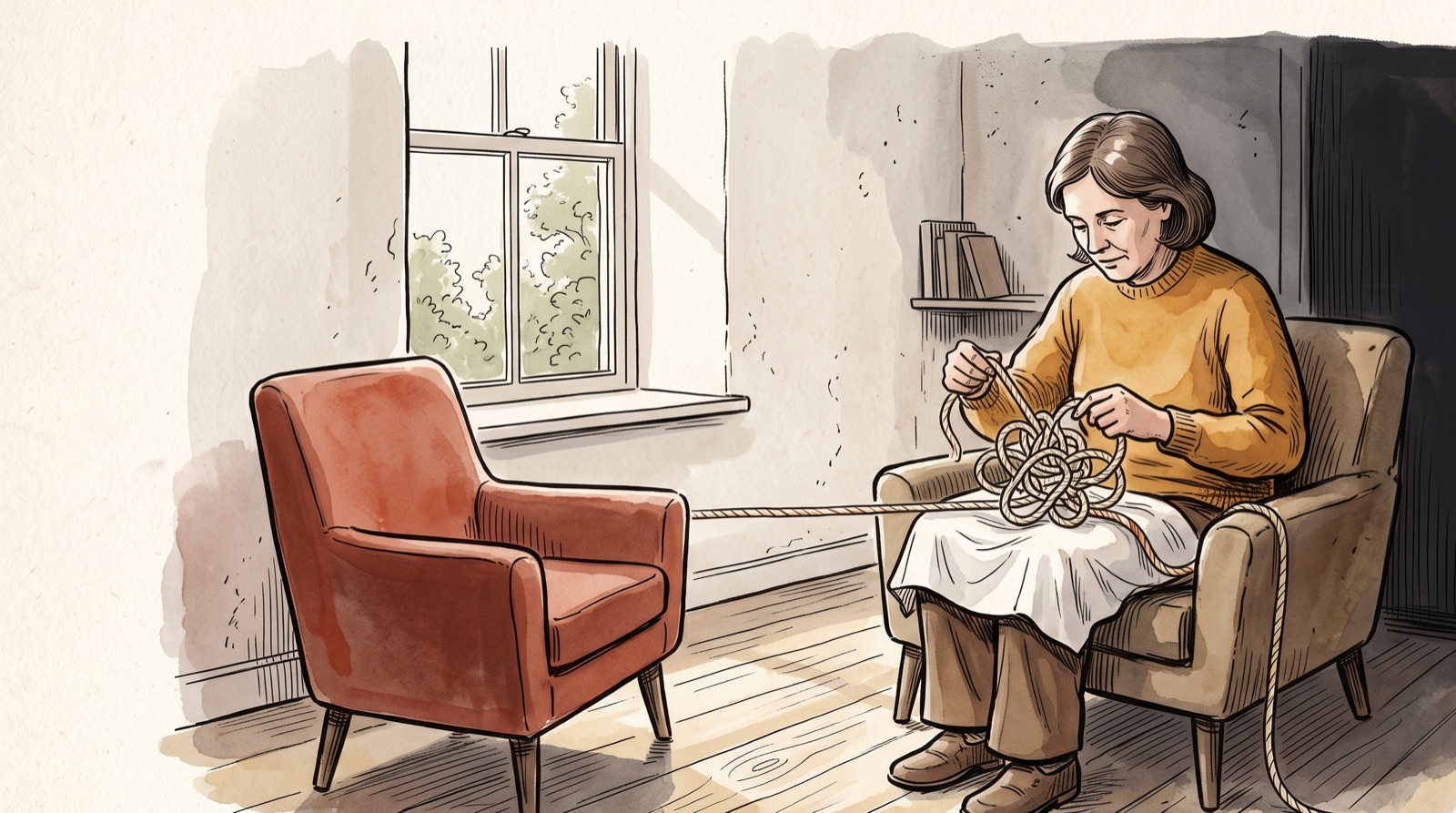
Cognitive Behavioural Therapy n.
CBT is today the umbrella term for a family of therapies including cognitive therapy, behavioural activation, and exposure-based protocols, each sharing the core model but using distinct techniques.
also known as CBT
The definition
Cognitive Behavioural Therapy is a structured, short-term psychotherapy, developed by Aaron Beck in the 1960s, that targets the relationship between automatic thoughts, core beliefs, and behaviour. Patients learn to identify cognitive distortions, examine the evidence for them, and replace unhelpful appraisals with more balanced alternatives, producing durable change in mood and behavioural patterns.
0.79
effect size (Hedges' g) for CBT vs. control in depression across 409 trials
CUIJPERS ET AL. · 20234
The mechanism
CBT rests on Beck's cognitive model: emotional distress arises not from events themselves but from the interpretations a person makes of them.1 These interpretations are shaped by cognitive schemas, deeply held core beliefs about the self, the world, and the future. Schemas generate automatic thoughts, rapid and often unconscious appraisals that arise in response to triggering situations. When those schemas are maladaptive (for example, 'I am fundamentally defective' or 'the world is threatening'), the resulting automatic thoughts maintain distress and produce avoidance behaviour.
The treatment works through two complementary processes. Cognitive restructuring involves the therapist and patient examining evidence for and against distorted automatic thoughts, then generating more balanced alternative appraisals.12 This is conducted through Socratic questioning, with the therapist asking guided questions rather than correcting the patient directly. A second, distinct mechanism is behavioural activation: scheduling rewarding activities to break avoidance cycles and rebuild contact with positive reinforcement.2 These two components address cognition and behaviour through different pathways, which is why protocol selection matters as much as the therapy label.
CBT is typically delivered over 12-20 sessions, with a structured, manual-based format designed from the outset for empirical evaluation.12 Sessions follow a set agenda: reviewing between-session practice, addressing new material, and assigning new tasks. This structure is not incidental; it is the mechanism by which the patient gradually becomes their own therapist, with skills that persist after treatment ends.
In practice
CBT's restructuring technique is most visible when a patient confronts a recurring, self-defeating pattern of thought.
Worked example
A manager regularly avoids presenting at senior meetings, fearing he will appear incompetent. His therapist asks him to log automatic thoughts before each avoided meeting: 'They will see I'm out of my depth.' Together they examine the evidence: positive feedback from previous presentations, and examples of other managers also acknowledging uncertainty. Over several sessions, the thought is tested, challenged, and replaced with a more accurate appraisal, and avoidance decreases.
The mechanism is not motivational persuasion but collaborative empiricism: the patient's own evidence, gathered systematically, does the correcting.
Why it matters
The evidence base for CBT is the largest of any psychotherapy. A 2021 meta-review of 494 systematic reviews found CBT produced a consistent modest-to-moderate benefit across all conditions studied, including anxiety, depression, chronic pain, insomnia, and somatic disorders, with a standardised mean difference of 0.23.3 A meta-analysis of 409 randomised controlled trials found moderate-to-large effects on depression (Hedges' g = 0.79), and CBT outperformed pharmacotherapy at 6-12 months post-treatment, suggesting structural change rather than symptom suppression alone.4
Access remains the binding constraint. CBT requires trained therapists, typically 12-20 sessions, and response rates of roughly 50-60% mean a substantial minority of patients do not achieve remission.23 NICE and APA guidelines recommend CBT as the first-line psychological treatment for depression, generalised anxiety, panic disorder, PTSD, OCD, bulimia nervosa, and insomnia, reflecting its unmatched breadth of evidence across diagnostic categories.23
Questions of record
What actually happens in a CBT session?
Each CBT session follows a structured agenda: therapist and patient review homework from the previous week, identify a specific automatic thought or problem to address, apply techniques such as Socratic questioning or behavioural experiments, and agree on new between-session practice. The patient takes an active role throughout, making sessions collaborative rather than directive.12
Is CBT more effective than medication for depression?
Short-term, CBT and antidepressants show comparable efficacy. At 6-12 months post-treatment, CBT has a measurable advantage (Hedges' g = 0.34 over pharmacotherapy), which researchers attribute to its focus on building transferable cognitive skills rather than managing symptoms, meaning gains persist after treatment ends.4
What conditions is CBT used to treat?
CBT is the first-line recommended psychological treatment for major depressive disorder, generalised anxiety disorder, panic disorder, PTSD, OCD, bulimia nervosa, and insomnia under NICE and APA guidelines. Adaptations exist for chronic pain, psychosis, and personality disorders, though evidence strength varies across these extensions.23
How many sessions does CBT take?
Most CBT programmes run 12-20 sessions, with measurable symptom reduction often visible within the first 6-8 sessions for anxiety and depression. Shorter formats exist for specific phobias and some anxiety presentations. Gains generally persist at follow-up, with the therapy's skill-building structure accounting for its durability.12