Tiny Habits n.
The method's core formula, 'After I [ANCHOR], I will [TINY BEHAVIOUR]', encodes each new habit as a recipe tied to an established daily trigger.
The definition
Tiny Habits is a behaviour-design method developed by BJ Fogg in which new behaviours are anchored to existing routines, kept small enough to require minimal motivation, and reinforced with immediate positive emotion. Grounded in Fogg's B=MAP model, it holds that shrinking a behaviour to its smallest executable form bypasses the motivation barrier that defeats conventional goal-setting.
The mechanism
The Fogg Behavior Model holds that a behaviour occurs only when Motivation, Ability, and a Prompt converge simultaneously; if any element is absent, the behaviour fails to trigger1. Tiny Habits targets the Ability dimension directly. By reducing a target behaviour to a starter step (the smallest possible executable form), the method ensures the action sits above the action line even when motivation is low51.
Each new behaviour is structured as a habit recipe: After I [ANCHOR], I will [TINY BEHAVIOUR]. The anchor is an existing, reliable routine that serves as a prompt, eliminating reliance on memory or willpower5. Immediately after completing the tiny behaviour, Fogg prescribes a Shine moment: a brief, genuine celebration designed to generate positive emotion. This immediate emotional reward is proposed as the mechanism that encodes and strengthens the habit wire, accelerating the transition to automaticity52.
Fogg's own programme data, drawn from more than 40,000 participants, indicate that those who selected starter steps they genuinely wanted to perform, rather than felt obliged to, reported higher long-term retention5. Motivation wave refers to the natural fluctuation in drive across any given day; the Tiny Habits framework sidesteps this variable entirely by requiring no sustained elevation of motivation.
In practice
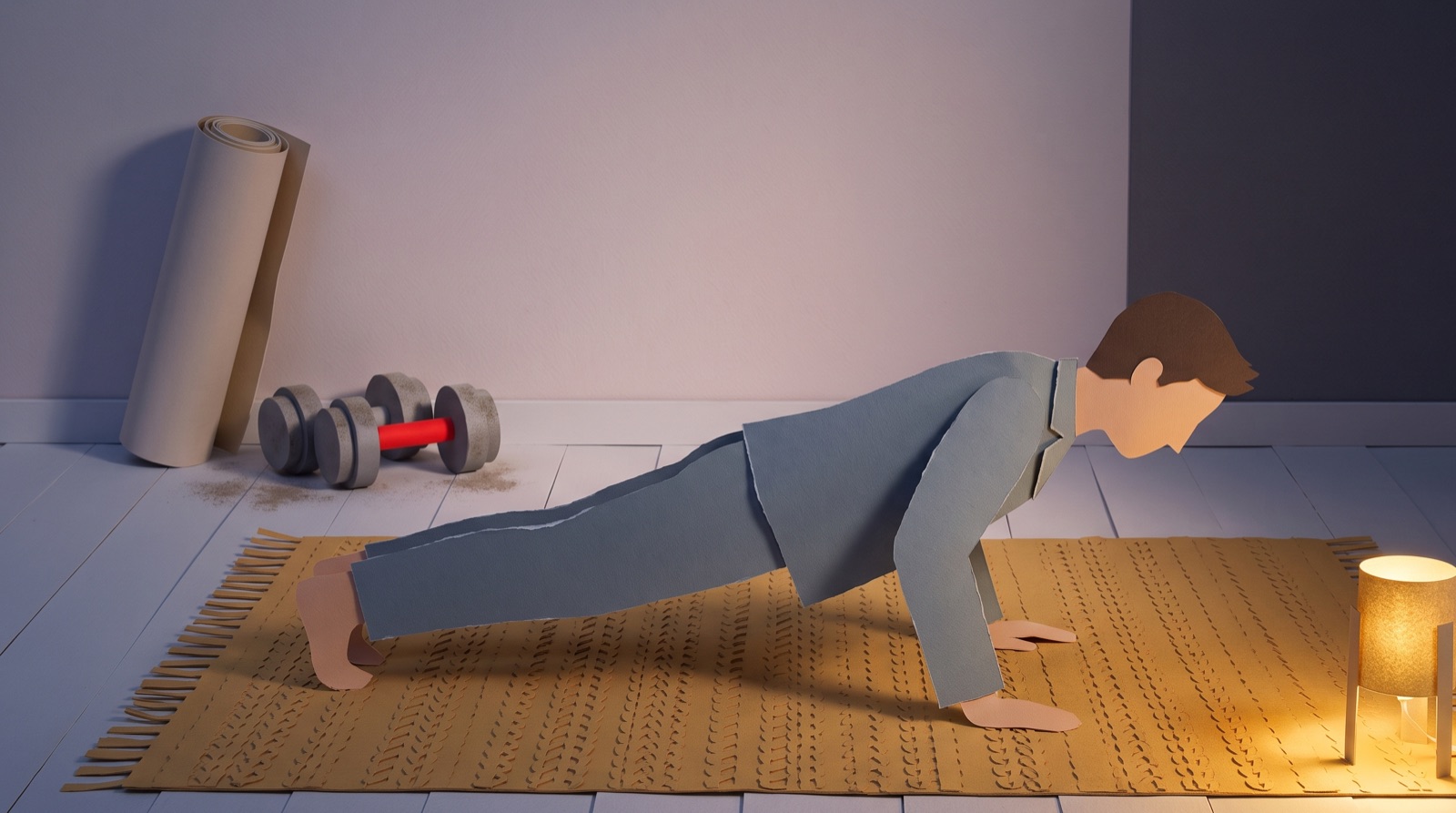
The method's structure is best understood through a routine that feels impossible to start but trivial to sustain once anchored.
Worked example
A professional who has failed repeatedly to establish a daily mobility practice decides to implement a single movement sequence: after pouring the morning coffee, complete two shoulder rolls. The action takes under thirty seconds and requires no equipment, clothing change, or preparation. Over weeks, the sequence lengthens naturally as the anchor-and-action pairing becomes automatic, with each completion reinforced by a brief moment of genuine satisfaction.
The starter step's trivial cost removes the decision barrier; the anchor absorbs the Prompt dimension, leaving Ability as the only variable to manage.
Why it matters
The stakes of behaviour-design methodology become clear when compared with conventional goal-setting. Setting ambitious targets without modifying the ability to execute reliably produces a predictable pattern: initial motivation drives early action, motivation wanes, and the behaviour extinguishes. In a structured 5-Day Programme, healthcare students demonstrated durable increases in gratitude behaviour that persisted for up to one month3, illustrating the method's potential to produce lasting change quickly. The Fogg Behavior Model's framework, applied across public health interventions more broadly, has generated significant improvements in health-related behavioural outcomes across diverse populations4.
There are real limits to the approach. The model identifies that motivation must be sufficient but does not specify which motivational drives are operative for a given person, a limitation critics note reduces its predictive precision4. The evidence base, while promising, is still limited: the Fogg Behavior Model has been tested in only a small number of published health intervention studies to date. For individuals with low baseline desire for a behaviour, engineering ability and anchors may not be sufficient to produce durable change.
Questions of record
What is a Tiny Habits Recipe and how do you write one?
A Tiny Habits Recipe takes the form: After I [ANCHOR], I will [TINY BEHAVIOUR]. The anchor is a reliable existing routine, such as brewing coffee or brushing teeth, that serves as a prompt. The new behaviour is made as small as possible to ensure it can be performed regardless of motivation level.
How long does it take for a tiny habit to become automatic?
Lally et al. found that automaticity takes between 18 and 254 days to reach its plateau, with a median around 66 days, and substantial individual variation. Missing a single repetition did not materially slow the process. The wide range reflects differences in behaviour complexity and individual factors rather than a single universal timeline.
Is the Tiny Habits method scientifically supported?
The evidence is promising but limited. A controlled application study found that healthcare students completing Fogg's 5-Day Programme showed sustained increases in gratitude behaviour. A scoping review applying the Fogg Behavior Model across public health contexts reported significant improvements in health-related outcomes, though the reviewers noted the model is descriptive rather than causal.
How does Tiny Habits differ from other habit-formation approaches such as Duhigg's habit loop?
Duhigg's habit loop framework (cue, routine, reward) describes how habits operate; Tiny Habits is a prescriptive design method. Where the habit loop is primarily analytical, Tiny Habits specifies exactly how to engineer an anchor, what size to make the behaviour, and why to use immediate celebration to wire it in.