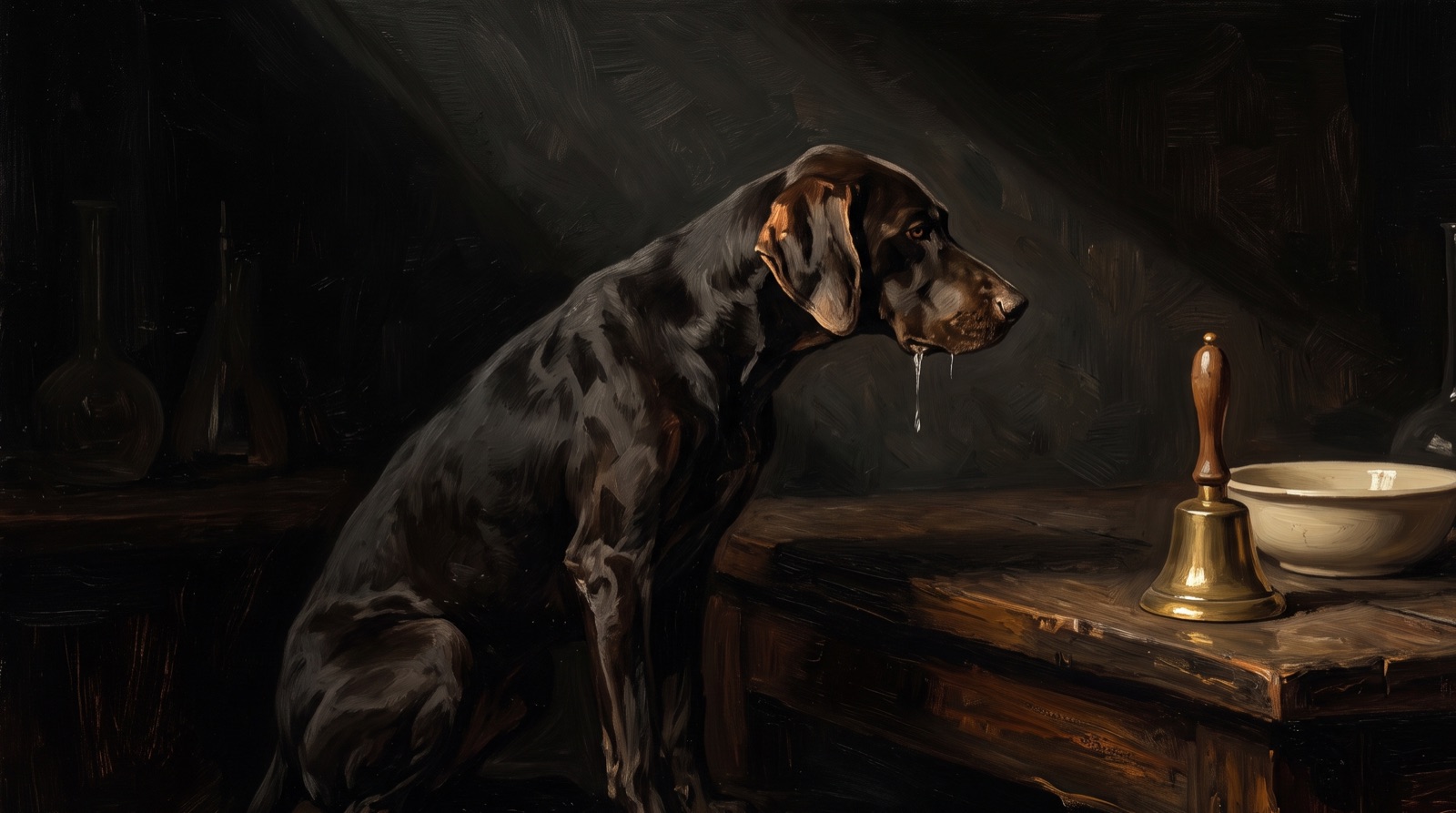
Classical conditioning n.
Also known as Pavlovian conditioning, after Ivan Pavlov, whose early-twentieth-century salivation experiments in dogs established the foundational paradigm.
also known as Pavlovian conditioning
The definition
Classical conditioning is a form of associative learning in which a neutral stimulus acquires the capacity to elicit a response through repeated pairing with a biologically significant unconditioned stimulus. Discovered by Ivan Pavlov through experiments with dogs, it underpins habit formation, fear acquisition, and clinical interventions from exposure therapy to addiction treatment.
The mechanism
The core learning event in classical conditioning involves three roles: the unconditioned stimulus (US), which reliably elicits a biological response without prior learning; the unconditioned response (UR), the automatic reaction to the US; and the conditioned stimulus (CS), a previously neutral event that acquires predictive value through temporal pairing with the US. After repeated CS-US pairings, the CS alone suffices to produce the conditioned response (CR).1 A critical corrective to early stimulus-response accounts: conditioning depends on contingency, not mere contiguity. A CS that occurs alongside the US but provides no new predictive information fails to produce conditioning, even after many exposures.2
The neural architecture of conditioning centres on prediction error. Dopamine neurons in the midbrain initially fire in response to an unexpected unconditioned stimulus; as conditioning proceeds, those same neurons shift their firing forward in time, responding to the onset of the conditioned stimulus rather than to US delivery.3 This trial-by-trial update process encodes the associative weight between cue and outcome, providing a mechanistic account of how the brain learns to anticipate events before they occur.
Conditioning extends beyond direct contact with the original reinforcer through higher-order conditioning: an established conditioned stimulus can itself function as an unconditioned stimulus to condition a further neutral cue.4 This chain property explains how the architecture of everyday habit cues grows elaborate and distal from the original reinforcing event. The smell of a gym, the sight of running shoes by the door, or the sound of a morning alarm can each function as a conditioned stimulus that activates preparatory states without direct access to the underlying biological reward.
Learning by Association — Classical conditioning — a neutral cue paired with a stimulus eventually triggers the response alone.
In practice
Classical conditioning shapes performance routines wherever consistent environmental cues precede a physiologically or cognitively demanding task.
Worked example
A competitive swimmer follows the same locker-room preparation before every training session for months: the scent of chlorine, a specific warm-up track, and a fixed sequence of mobility drills. Over time, these cues alone produce a focused, low-arousal readiness state. On competition day, absent the familiar training pool, the same preparation ritual activates the same internal state.
The pre-competition cues have become conditioned stimuli that reliably activate a prepared internal state, making deliberate routine design a direct application of Pavlovian learning.
Why it matters
Classical conditioning's significance extends well beyond laboratory curiosity. A single intense pairing of a neutral cue with a traumatic event can produce a durable conditioned fear response that persists for years, generalising to related stimuli and explaining the tenacity of phobias and post-traumatic reactivity.12 Environmental cues previously paired with drug use trigger conditioned craving and physiological changes that increase relapse risk even after extended abstinence, because the conditioned stimulus retains predictive strength independently of the substance itself.2
Understanding that extinction overlays rather than erases the original CS-US association has direct clinical implications.24 Exposure-based therapies work by building a new inhibitory memory trace; relapse risk is highest when treatment occurs in a context different from where the cue will next be encountered. For anyone deliberately designing performance routines, the same principle applies: cues portable across environments produce more robust conditioned readiness than triggers tightly bound to a single training setting.
Questions of record
What is the difference between classical and operant conditioning?
Classical conditioning involves learning that a neutral stimulus predicts a biologically significant event, so the organism's response is elicited automatically by the cue. Operant conditioning involves learning that a behaviour produces a consequence, so the organism acts voluntarily to obtain rewards or avoid punishments. The two systems operate in parallel and frequently interact.
How does classical conditioning explain habit formation and cue-triggered behaviour?
Environmental cues repeatedly paired with a habitual behaviour or its rewards acquire the status of conditioned stimuli. The smell of coffee, a gym bag by the door, or a notification chime can each trigger the associated routine automatically, without conscious deliberation. The reliability of cue-to-outcome prediction determines how strongly the conditioned response becomes established.
Can conditioned responses be permanently erased?
Extinction training reduces conditioned responding by building a new inhibitory memory trace, but the original CS-US association is not erased. Under stress or in a new context, the extinguished response can spontaneously recover or return at full strength. This is why relapse after treatment often occurs in environments different from where extinction learning took place.
What role does dopamine play in classical conditioning?
Dopamine neurons in the midbrain encode prediction error: they fire strongly when a reward is unexpected, reduce their firing when a reward is predicted, and are suppressed when an expected reward fails to arrive. As conditioning proceeds, firing shifts from the unconditioned stimulus to the conditioned stimulus, updating the brain's model of which cues predict significant outcomes.