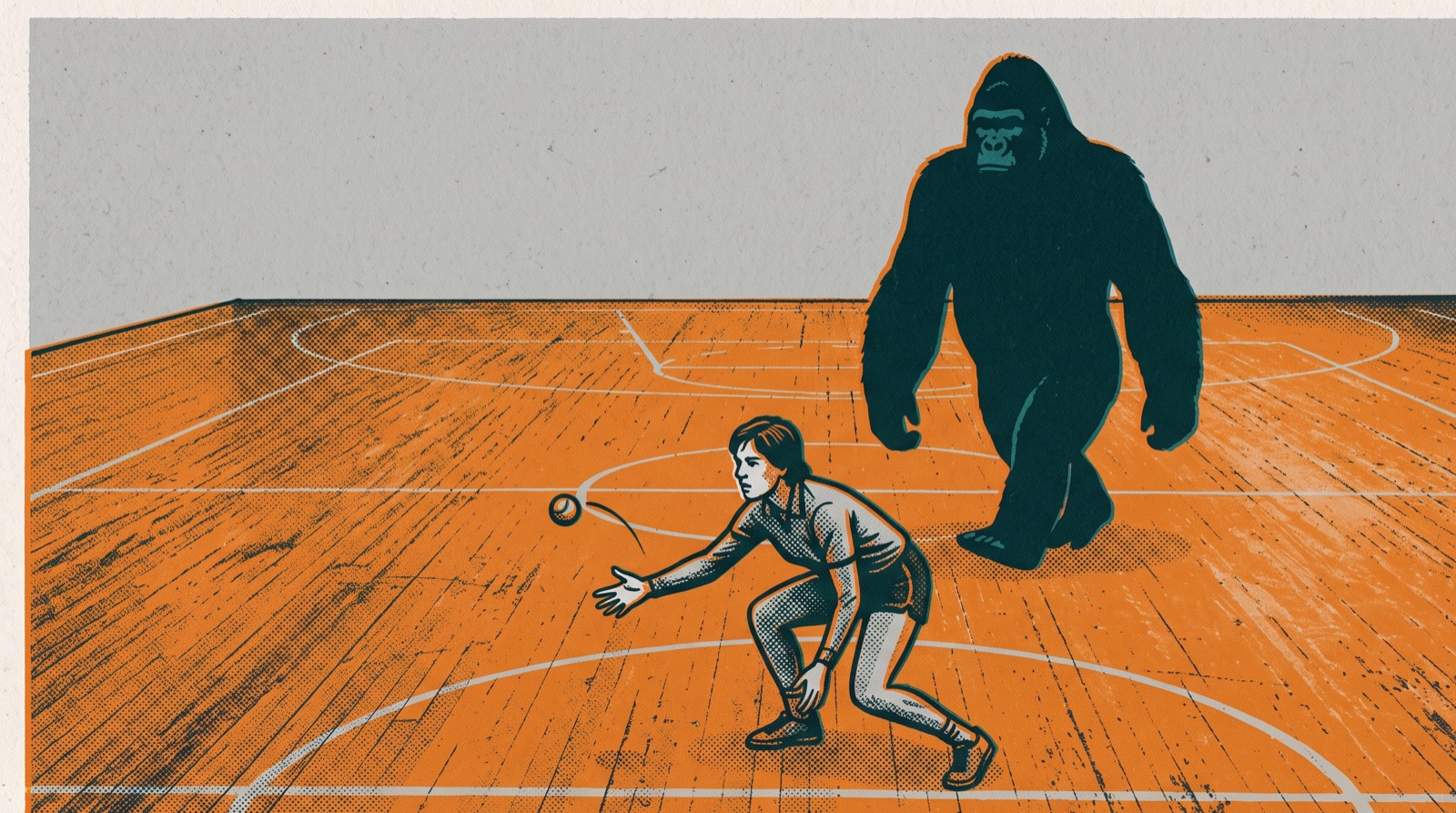
Selective Attention n.
The term encompasses both top-down goal-directed selection and bottom-up capture by salient stimuli; these two modes interact rather than operate independently.
The definition
Selective Attention is the cognitive capacity to direct processing resources towards a chosen target while actively suppressing competing stimuli. Enhancement of the attended signal and inhibition of distractors operate under strict capacity constraints that cannot be indefinitely extended. The mechanism is foundational to working memory efficiency, perceptual coherence, and the sustained focus that characterises high-performance states such as flow.
The mechanism
The dominant account of selective attention's spatial operation is Posner's spotlight model: attention can be covertly oriented to any location in the visual field without corresponding eye movement, enhancing stimulus detection at the attended site and trading off against reduced processing elsewhere.1 Like a torch beam that sharpens the illuminated object at the cost of ambient vision, the spotlight has finite width. Treisman's feature integration theory shows why object recognition requires this directed spotlight: basic visual features (colour, shape, orientation) are registered automatically across the whole field in parallel, but binding them into a coherent percept demands focused attention.2
Contemporary synthesis characterises selective attention as the selection of a target for task performance, comprising enhancement of the attended signal, active suppression of competing inputs, and operation under capacity constraints that cannot be indefinitely extended.4 Goal-directed top-down control selects task-relevant stimuli while proactively suppressing anticipated distractors. Filtering efficiency (how precisely targets are encoded while irrelevant stimuli are excluded) is a distinct cognitive dimension and a uniquely strong predictor of working memory capacity across developmental and adult populations.3
The Attention Filter — Selective attention filters a flood of sensory input down to the few things you consciously process.
In practice
Competitive performance provides the clearest window into selective attention in action, because the cost of attentional failure is immediate and measurable.
Worked example
An elite sprinter at the starting blocks operates in a noisy arena: a full crowd, warming-up competitors, and awareness of their own heartbeat all compete for attention. In the seconds before the gun, their attentional spotlight has already narrowed to the auditory cue. Adjacent lane movements, ambient sound, and other inputs are actively deprioritised; the filtering is deliberate and pre-emptive rather than passive.
The performance advantage comes not from blocking distractors after they arise but from proactively suppressing them before they consume capacity.
Why it matters
Individual differences in attentional filtering efficiency account for substantial variance in working memory capacity, and working memory is the operative cognitive resource for complex performance across learning, decision-making, and skilled action.3 Filtering capacity continues developing past age seven, meaning it is a trainable cognitive dimension throughout adult life rather than a fixed trait. Strategies that directly target distractor suppression yield measurable gains in cognitive performance, making selective attention one of the clearer leverage points in intentional development.
Failures of attentional gating do not stay contained. Selective attention is not a single isolated mechanism; it interacts with working memory, perception, and motor systems, so a breakdown at the filtering stage cascades into broader performance deficits across learning, decision-making, and skilled action.24 Attentional capture by salient but task-irrelevant distractors can derail goal-directed behaviour even in skilled performers; the ability to proactively suppress anticipated distractors, rather than merely react after capture occurs, is the determinant of sustained high performance.4
Questions of record
What is the spotlight model of selective attention and how does it work?
The spotlight model, developed by Posner, holds that attention can be directed to a specific spatial location without moving the eyes (covert orienting). The attended region receives enhanced stimulus processing; surrounding regions are relatively degraded. The spotlight can be deliberately positioned before a target appears, making selective attention a proactive filter rather than a reactive one.
How does selective attention differ from divided attention?
Selective attention concentrates all available processing resources on a single target while actively suppressing distractors; divided attention attempts to process two or more streams simultaneously, distributing limited capacity across them. Because selective attention operates under strict capacity constraints, distributing those resources across competing tasks typically degrades performance in each.
Can selective attention be trained and improved?
Yes. Filtering efficiency (the ability to encode targets while excluding irrelevant stimuli) is a distinct cognitive dimension that continues to develop past childhood and is responsive to targeted training in adults. Programmes designed specifically to challenge distractor suppression, rather than general sustained attention, produce the clearest working memory gains, since filtering efficiency directly predicts capacity in that domain.
How does selective attention relate to flow state and peak performance?
Selective attention provides the filtering mechanism that makes sustained peak performance possible. Athletes and skilled performers who direct attention narrowly to task-relevant cues demonstrate measurably superior reaction times and decision accuracy compared with those who do not. Proactive suppression of anticipated distractors, rather than reactive management of interruptions, is the specific skill that predicts sustained rather than intermittent high performance.
Sources
Appears in
- HyperfocusGlossary