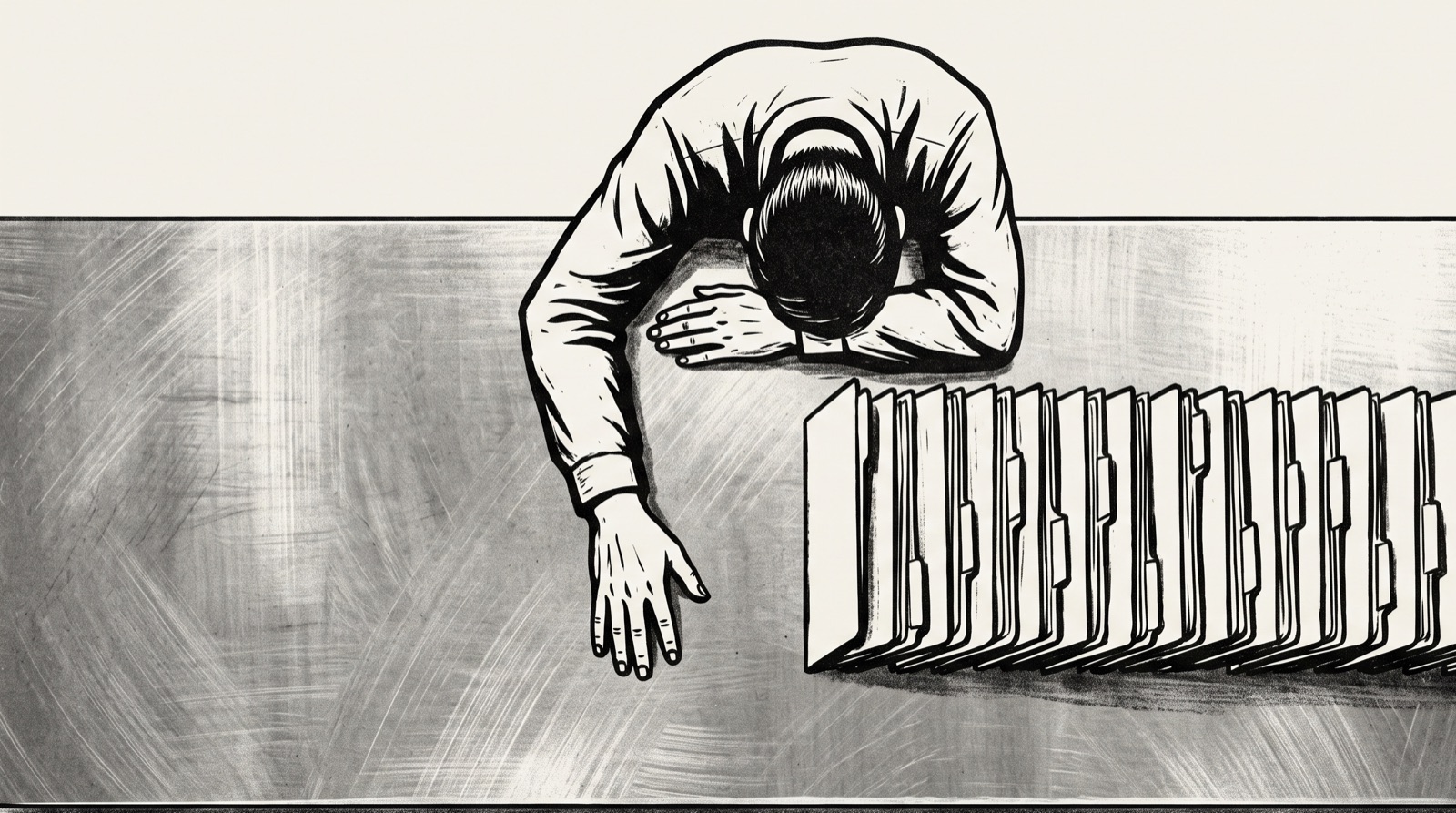
Decision Fatigue n.
The underlying mechanism, ego depletion, has not replicated reliably across large multilab studies; motivational or attentional explanations may better account for the observed pattern.
also known as choice fatigue
The definition
Decision Fatigue is the progressive decline in the quality of choices that occurs after a sustained period of decision-making. As the volume of decisions accumulates throughout a session, the self-regulatory capacity required for deliberate, effortful choice becomes depleted. The decision-maker consequently defaults to safer status-quo options, makes increasingly impulsive selections, or avoids deciding altogether.
The mechanism
The original explanation for decision fatigue is the ego depletion model, developed by Baumeister and colleagues1. The model holds that acts of self-control and deliberate decision-making draw on a shared, limited pool of self-regulatory energy. Once this pool is sufficiently depleted, performance on subsequent self-control tasks reliably deteriorates. The decision-maker defaults to status-quo choices, defers the decision, or makes impulsive selections that conserve deliberative effort.
Muraven and Baumeister extended the model with a muscle analogy2: short-term exertion produces temporary performance decline, but repeated practice over time may build regulatory capacity rather than permanently erode it. On this view, decision fatigue is not an immutable ceiling but a trainable threshold.
The resource model's empirical standing is, however, contested. A preregistered replication across 23 laboratories (N = 2,141) found no reliable ego depletion effect (d = 0.04)4, and a subsequent 36-laboratory test (N = 3,531) produced a similarly non-significant result (d = 0.06)5. Participants who reported higher subjective fatigue did perform worse on later tasks, suggesting motivational or attentional mediation rather than a biological resource running dry. The mechanism remains unresolved; the behavioural pattern does not.
Quality Declines — Decision quality erodes across a long run of choices — later decisions get worse or default to the easy option.
In practice
The judicial system provides one of the most-studied demonstrations of decision fatigue operating in a high-volume, high-stakes professional context.
Worked example
A sitting judge working through a session of parole hearings faces dozens of consequential decisions in sequence. Early in the session, favourable rulings predominate. As the session extends without a break, the proportion of favourable rulings falls sharply, approaching near-zero. After a scheduled recess, the rate returns to its opening level. The pattern holds across case types and is unrelated to case severity.3
When decision volume is high, position in the queue predicts outcome as reliably as the substance of the case.
Why it matters
The real-world stakes are starkest in judicial data. Parole was granted in approximately 65% of cases at the start of each session, falling to near zero just before the next scheduled break, then recovering fully after it.3 The effect was independent of case severity or defendant characteristics, which means consequential outcomes were shaped by cognitive state rather than case merit.
For professionals managing high-decision-volume roles, two structural responses have solid field support. Scheduling consequential decisions early in the day or immediately after a break reduces exposure to accumulated decision load.3 Structuring environments to eliminate unnecessary choices, through templated workflows, predetermined attire, or committed meal plans, preserves regulatory bandwidth for decisions that genuinely require deliberation.2 Because the replication evidence leaves the precise mechanism open, these approaches are best framed as managing motivation and attention rather than refilling a depleted resource.4
Questions of record
What causes decision fatigue?
Decision fatigue arises when sustained deliberate choice-making depletes self-regulatory resources, or at least the motivational engagement required for effortful reasoning. The ego depletion model attributes this to a finite shared resource; replication studies suggest motivational or attentional withdrawal may be the more accurate explanation. The practical outcome is the same: choice quality declines as the decision count rises.
Is the science behind decision fatigue reliable? Has it replicated?
The behavioural pattern has real-world support, but the underlying ego depletion model has not held up under rigorous replication. Two large multilab studies (totalling more than 5,600 participants across nearly 60 laboratories) found no significant depletion effect using the canonical sequential-task paradigm. Higher subjective fatigue did predict worse performance, pointing to motivational rather than resource-depletion explanations.
How can decision fatigue be reduced?
Scheduling high-stakes decisions early in the day or immediately after a break reduces exposure to accumulated decision load. Eliminating unnecessary choices through routinised workflows, committed meal plans, and templated attire preserves regulatory bandwidth for decisions requiring genuine deliberation. Rest periods serve as partial resets, as the judicial parole data demonstrate.
What is the difference between decision fatigue and ego depletion?
Ego depletion is the theoretical mechanism proposed to explain decision fatigue and related self-control failures: a shared, finite resource is consumed by effortful choice until performance deteriorates. Decision fatigue describes the observable behavioural outcome of this process. The terms are related but not synonymous; ego depletion is a model, and decision fatigue is a measurable decline in choice quality.