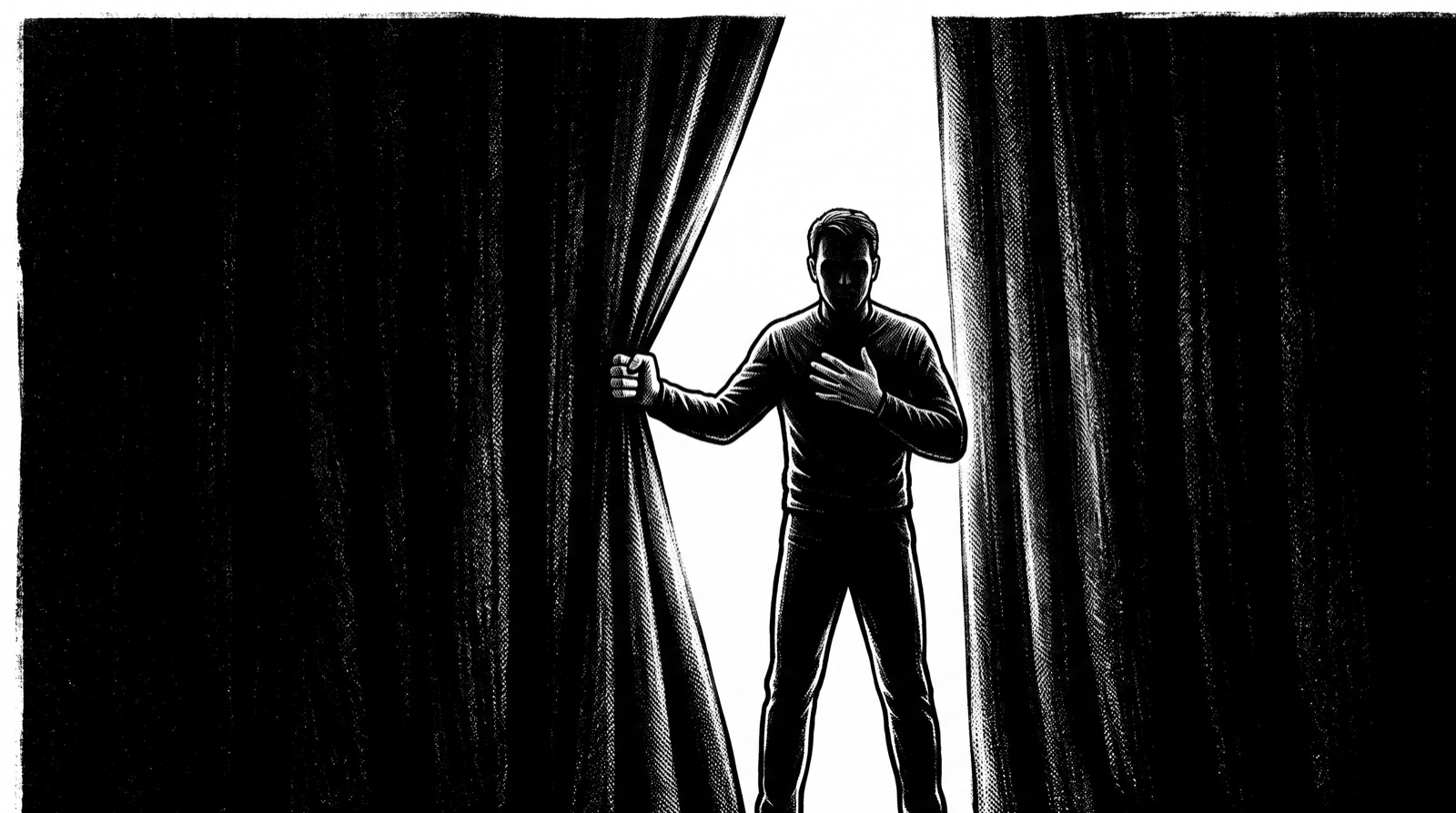
Performance Anxiety n.
The response has two separable components: cognitive anxiety (worry, negative expectations) and somatic anxiety (perceived physiological arousal), each with distinct timecourses and performance effects.
also known as stage fright
The definition
Performance anxiety is an acute stress response triggered by perceived evaluative threat in a high-stakes situation. It activates the sympathetic nervous system, raising heart rate, tightening muscles, and redirecting attention toward self-monitoring rather than task execution. In skilled performers, this attentional shift disrupts procedural automaticity, producing the decline in execution known as choking under pressure.
SMD 0.88
pooled reduction in performance anxiety from psychological interventions across 20 trials
NIERING ET AL. · 20234
The mechanism
The physiological signature of performance anxiety is fight-or-flight activation: the sympathetic autonomic nervous system raises heart rate, releases cortisol into circulation, and mobilises glucose, while withdrawing parasympathetic tone3. This pattern is physiologically indistinguishable from the response to physical threat. The difference is that the triggering stimulus is social rather than physical: an audience, an examiner, a scoreboard.
The cognitive disruption follows a specific pathway described by the explicit monitoring hypothesis1. Under evaluative pressure, skilled performers begin attending consciously to procedural steps that ordinarily run without supervision, interrupting the automaticity that makes expert performance fluid. A trained surgeon whose attention shifts to the grip of the scalpel, or a musician who starts monitoring finger placement, is exhibiting exactly this mechanism. The result is degraded output despite intact physical capability.
Competitive anxiety has two separable components with different timecourses2. Somatic anxiety, the perception of physiological arousal, peaks immediately before competition and dissipates once performance begins. Cognitive anxiety, comprising worry and negative outcome expectations, fluctuates throughout based on perceived uncertainty about the outcome. Because these components have independent origins, they respond to different management strategies; collapsing them into a single construct obscures this.
Anxiety & Performance — A little anxiety can sharpen performance; past the peak it impairs focus, memory and execution.
In practice
The mechanism becomes concrete in high-stakes evaluation scenarios where skill level alone cannot explain outcome variation.
Worked example
A musician with years of formal training sits before an examination panel. Under normal rehearsal conditions, technical passages execute without conscious oversight. Under the panel's gaze, attention shifts inward: fingering, breath, posture. The procedural sequence that ran automatically now requires deliberate supervision, consuming working memory that should be processing expression and dynamics. Technical errors surface in passages that have not produced errors in months of practice.
The deficit is attentional rather than technical: the same skill executes flawlessly in private but degrades when conscious monitoring displaces automaticity.
Why it matters
Performance anxiety matters beyond discomfort because it disproportionately impairs complex, analytically loaded skills1. Working memory and attentional control are the resources it consumes, so high-stakes examinations, presentations, and intricate procedural tasks suffer more severely than highly automatised physical routines. A competitive athlete executing a deeply grooved physical movement may experience somatic symptoms without significant performance loss; the same level of anxiety in a lawyer's oral argument or a clinician's diagnostic reasoning can produce measurable degradation.
The response is modifiable. A meta-analysis of 20 controlled trials found psychological interventions reduced performance anxiety with a standardised mean difference of 0.88, a large effect4. The same physiological arousal state that produces debilitating anxiety can, with deliberate appraisal reframing, be interpreted as facilitative excitement, shifting the performer's orientation toward the challenge rather than away from it3.
Questions of record
What is the difference between performance anxiety and general anxiety disorder?
Performance anxiety is situation-specific: it is triggered by perceived evaluation in a defined high-stakes context and typically resolves when that context ends. Unlike chronic anxiety conditions, it does not persist across unrelated life domains. The two can co-occur and symptoms overlap, but their triggers and trajectories differ.
Does performance anxiety get worse with higher stakes?
Cognitive anxiety scales with perceived outcome uncertainty: as the consequences of failure grow more significant and the performer's confidence in a successful outcome falls, cognitive worry intensifies. Somatic symptoms follow a different pattern, peaking shortly before performance regardless of stakes level. Higher stakes primarily amplify the cognitive component.
Can performance anxiety be channelled into a performance advantage?
The physiological arousal that accompanies performance anxiety is not inherently harmful. The same elevated heart rate and heightened alertness can function as facilitative excitement when the performer appraises the arousal as helpful rather than threatening. This appraisal reframing, supported by evidence from directional anxiety research, is a trainable skill rather than a fixed disposition.
What evidence-based techniques reduce performance anxiety?
Cognitive-behavioural therapy, mindfulness-based interventions, and structured pre-performance routines have the strongest controlled-trial support. A pooled analysis of 20 trials found these approaches produced a standardised mean difference of 0.88 in anxiety reduction, a large effect. Attentional focus cues that redirect attention from movement mechanics toward external targets also counteract the explicit monitoring mechanism directly.
Sources
Appears in
- YipsGlossary